Food is never simply food. Everything has its purpose, and each element will respond uniquely within a system. The texture, flavour, and shelf life are defined by carbohydrates, proteins, and fats. Nutrition, stability, and nutritional positioning are determined by vitamins, minerals, and additives. Even cooking, fermenting or preserving the product can change the final product radically.
Understanding the types of food and their interactions across different types of food turns food product development into a structured strategy rather than intuition.
This blog explains the classification of food with examples, and why food consultants evaluate every stage to create products that are not only delicious but also stable, scalable, and market-ready.
Classification of the Different Types of Food
1. Macronutrient-Based Types
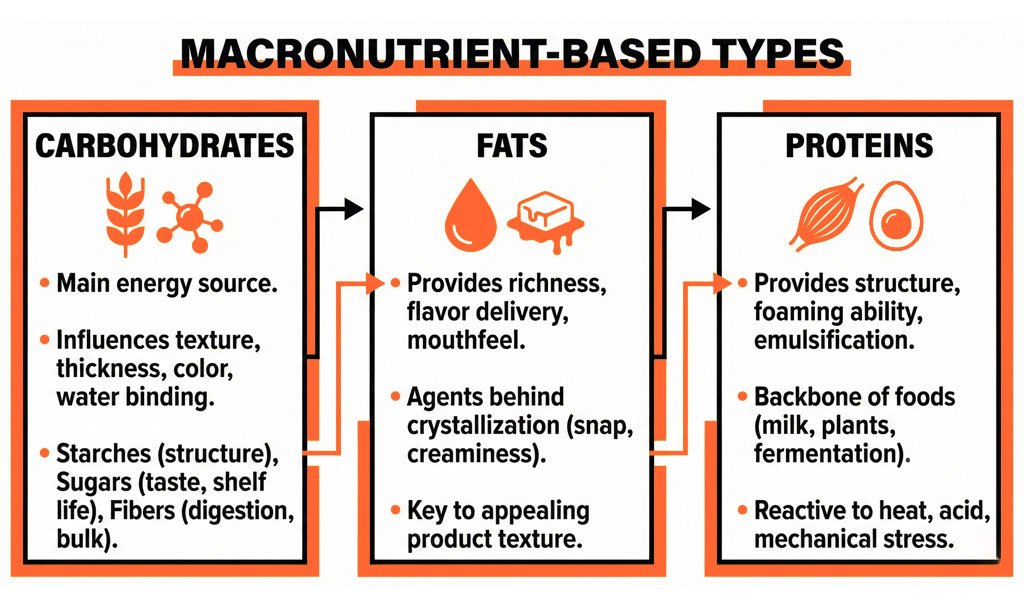
Carbohydrates
Carbohydrates are the primary energy source, but in food systems, they do much more. They influence structure, viscosity, colour, sweetness, and moisture retention.
- Examples: Rice, wheat, starches, sugars, dietary fibre
- Starches provide structure in baked goods
- Sugars contribute to flavour, browning, and shelf life
- Fibres improve texture and digestive value
Carbohydrates form the foundation of many food types, defining the overall eating experience.
Fats
Fats are critical for richness, mouthfeel, and flavour delivery. They also control crystallisation, which determines texture.
- Examples: Butter, vegetable oils, cocoa butter, ghee
- Influence creaminess, spreadability, and melting behaviour
- Carry fat-soluble flavours and aromas
The right fat system often differentiates a premium product from an average one.
Proteins
Proteins provide structure, emulsification, and foaming properties, making them essential across multiple food categories.
- Examples: Milk protein, soy protein, pea protein, egg protein
- Enable gel formation, stability, and aeration
- Highly sensitive to heat, pH, and processing conditions
Proteins are among the most technically complex components in different types of food production.
2. Micro-Ingredient Categories
Vitamins
Vitamins define the nutritional value but are highly unstable.
- Examples: Vitamin C, Vitamin D, B-complex
- Sensitive to heat, light, and oxygen
- Require careful formulation for retention
Minerals
Minerals may seem simple but have a strong functional impact.
- Examples: Iron, calcium, zinc
- Affect pH, flavour, and protein interactions
- Can influence stability and taste
These micro-components play a crucial role in the classification and function of food.
You May Also Like: Trends in Food Product Development
3. Processing-Level Classification
Raw Foods
Raw materials determine the baseline quality and consistency.
- Examples: Fresh fruits, vegetables, grains
- Variability impacts final product predictability
Cooked & Heat-Treated Foods
Heat processing improves safety, flavour, and texture.
- Examples: Baked goods, pasteurised milk, cooked meals
- Requires control to ensure batch consistency
Preserved Foods
Preservation methods extend shelf life and define product identity.
- Examples: Pickles, dried foods, fermented products
- Methods: drying, fermentation, freezing, preservatives
Each processing method creates a distinct category of food with unique characteristics.
Want to optimise your Food Business? Request a free consultation!
Explore Our Exclusive Food Product Development
Types of Food Used in Food Production Systems
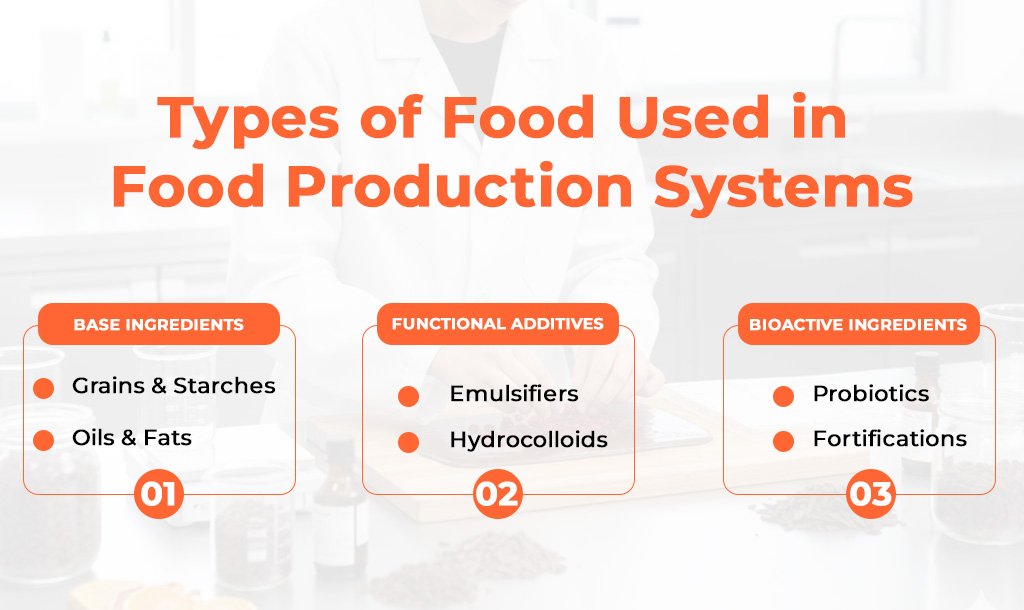
Base Ingredients
- Grains & Starches: Provide structure and bulk
- Oils & Fats: Enhance texture, lubrication, and flavour delivery
Functional Additives
- Emulsifiers: Stabilise oil-water systems
- Hydrocolloids: Control viscosity, texture, and moisture
Bioactive Ingredients
- Probiotics: Add functional health benefits but require controlled processing
- Fortification: Iron, omega-3, vitamins improve nutritional positioning
These components define how different types of food production systems are designed and optimized.
You May Also Like: Food Packaging and Labelling Regulations
Scientific Approach to Product Development
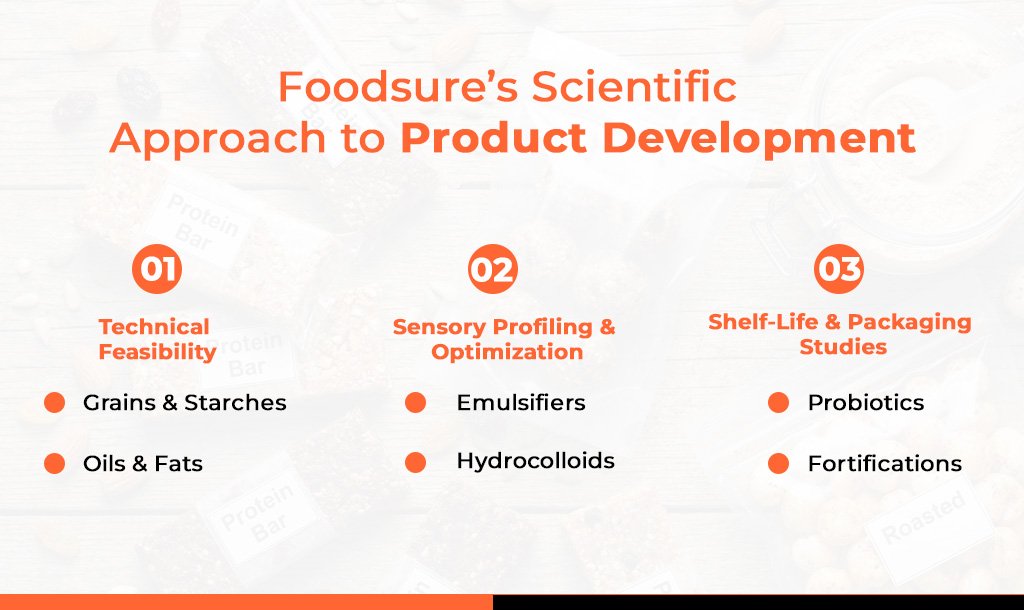
Technical Feasibility
- Ingredient Interactions: Ingredients do not often act separately. Proteins bind minerals. Fats affect the release of flavours. Starches are sensitive to moisture and heat.
- Stability Assessment: A product might look perfect on day one, then fall apart by week three. Predicting oxidation, moisture migration, and texture drift is essential.
Sensory Profiling & Optimisation
- Texture Sensory Tools: Texture defines a product as much as flavour. Tools like rheology curves or bite-force tests help quantify what the tongue already knows.
- Flavour Sensory Mapping: Flavour isn’t just taste; it’s aroma, mouthfeel, and after-notes. Mapping these elements helps refine a product until it hits the right balance.
Shelf-Life & Packaging Studies
- Chemical Stability: Oxidation, pH shifts, and nutrient degradation all shape shelf life. Good packaging slows these down.
- Microbial Stability: Safety validation is a way of adhering to compliance, and it safeguards brand credibility.
You May Also Like: Art and Science of Food Production
Create Your Signature Food Product Today!
From recipe to launch, our experts turn your Food idea into a market-winning product.
⭐ Rated 4.9/5 by 100+ D2C Founders & FMCG Brands
How Foodsure’s Food Consultants Evaluate Food Categories
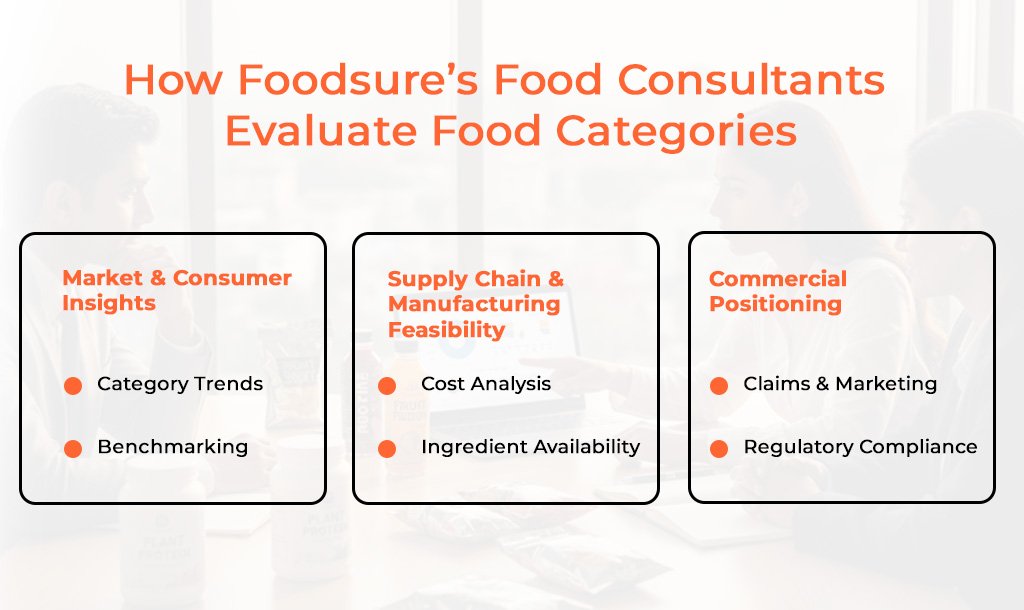
Market & Consumer Insights
- Trend analysis to identify high-growth food types
- Benchmarking against competitors
Supply Chain & Manufacturing Feasibility
- Cost modelling for profitability
- Ingredient availability for scalability
Commercial Positioning
- Claims validation (nutrition, clean label, functional)
- Regulatory compliance alignment
Every decision is aligned with both science and market demand.
Emerging Types of Foods Shaping the IndustryPlant-Based Proteins
Plant-Based Foods
- Meat alternatives using structured proteins
- Dairy alternatives requiring balance of taste, protein, and stability
Precision Fermentation Foods
- High-purity novel proteins
- Enzyme-driven texture and flavour modification
Sustainable Food Systems
- Upcycled ingredients with functional benefits
- Regenerative agriculture-based raw materials
These innovations are redefining what are the different types of foods in modern markets.
You May Also Like: Food Business Ideas
Foodsure’s Perspective on the Future of Food Categories
Learning about the types of foods is beyond the identification of ingredients. It involves studying the reaction of components, processing changes in components and how stability influences the performance. Product development is scientifically evaluated, and it becomes organised, scalable, and business-oriented. Food is a system, and the secret of success in it is to know how the system functions.
Let’s bring your food idea to life and turn it into a market-winning product with the best Food Production Company in India.
Book a FREE call with our formulation expert. Contact now at +91 8130404757
“Read More Blogs Related to Food Product Development”
👉 10 Stages of Food Product Development
👉 Leading Food Testing Laboratory in India
Frequently Asked Questions
Q1. What are the main types of food?
The main types of food are carbohydrates, proteins, fats, vitamins, minerals, and water, each serving a unique role in nutrition.
Q2. What are processed foods?
Processed foods are foods that have been altered from their natural state, often for convenience, preservation, or flavour, like canned vegetables, chips, and ready-to-eat meals.
Q3. What is the difference between plant-based and animal-based foods?
Plant-based foods come from plants (fruits, vegetables, grains), while animal-based foods come from animals (meat, fish, eggs, dairy).
Q4. Why is it important to eat a variety of foods?
Eating a variety of foods ensures you get all essential nutrients, supports overall health, and reduces the risk of nutrient deficiencies.
Q5. What are examples of high-protein foods?
High-protein foods include chicken, fish, eggs, beans, lentils, tofu, and nuts. Protein is essential for muscle growth and repair.
Q6. What are examples of high-carbohydrate foods?
High-carbohydrate foods include rice, pasta, bread, potatoes, and cereals, which provide energy for daily activities.
Q7. What foods should be eaten in moderation?
Foods high in sugar, salt, and unhealthy fats, such as sugary drinks, fried snacks, and processed meats, should be eaten in moderation.