Formulating the perfect Manhattan goes beyond simply combining whiskey, sweet vermouth, and bitters. It’s about initiating a consistent, high-quality experience that honours the drink’s classic flavour while ensuring it performs well at scale. From ingredient selection to formulation and shelf stability, every detail matters. The goal is simple; to deliver a Manhattan that tastes just as smooth and balanced in the first bottle as it does in the ten-thousandth, without compromising quality or consistency.
Manhattan drink is a very strict kind of drink. Minor mistakes in the formulation can be identified quickly, especially when the scale is large. This blog elaborates on the reasons behind the difficulty to formulate a Manhattan drink recipe and the methods used by successful beverage brands to create consecutive systems instead of relying on guesswork.
Why Manhattan Drink Recipe Formulation Is Harder Than It Looks
Usually, people think a Manhattan is just whiskey, vermouth, and bitters, but when it comes to a bar scale, it’s a different game.
Balancing whiskey, vermouth, and bitters at scale
Bitters usually bring a lot of character to a small batch drink; however, the same variation in a production batch creates inconsistency. The proof of the whiskey, the sugar level in vermouth, and the intensity of the bitters can all change slightly for different suppliers and lots. These changes can become significant quickly. The recipe for a Manhattan cocktail requires to have perfect and controlled ratios that give a natural and not artificial impression.
Alcohol consistency vs. craft taste
Consumers demand a handcrafted profile but still expect every bottle to have the same flavour, such contradictions lead to difficulties. The alcohol proof may vary after dilution, blending, or carbonation. If there are no tight controls, the drink either lacks its characteristic strength or becomes too aggressive. This is the reason why a lot of brands fail to retain the traditional Manhattan character.
Shelf-life and oxidation issues
Vermouth is made from wine, which oxidises, whereas bitters have volatile aromatics. Whiskey is fairly stable; however, the other ingredients that accompany it are not. If the product formulation is not focused on the issues of oxygen exposure, variation in temperature impacts the shelf life, leading to flavour degradation. This is the main reason why the issue of alcohol stability in RTD cocktails is directly connected with it and should not be put aside.
Need expert help formulating a scalable Manhattan cocktail? Contact us today!
The Core Elements of a Perfect Manhattan Drink Recipe Formulation
Let’s break it down. A scalable Manhattan is built on discipline, not shortcuts.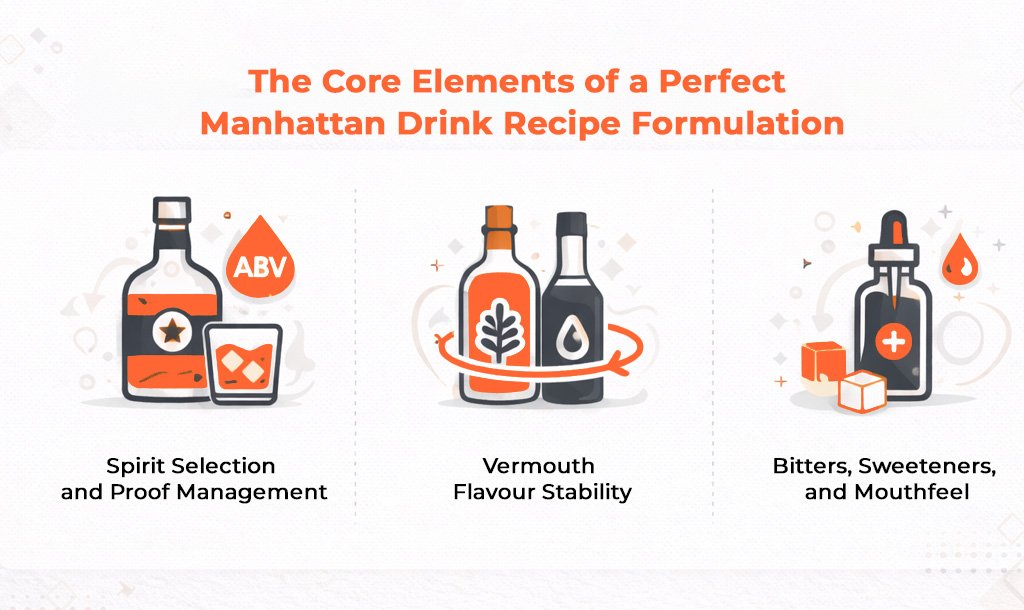
Spirit Selection and Proof Management
Your base whiskey does more than provide alcohol.
Key considerations include:
- Proof selection that holds up after dilution
- Flavour consistency across supplier lots
- Compatibility with vermouth sweetness and bitterness
Brands initially start high proof and strip flavour later. Others start too low and end up with a flat drink. Proof management should be intentional from the first bench sample. This is where flavour balancing becomes critical.
Vermouth Flavour Stability
Vermouth is the most fragile ingredient in the formula.
To manage it:
- Choose styles with known oxidation resistance
- Control sugar levels to protect mouthfeel over time
- Test heat and light exposure early
Many brands underestimate vermouth’s impact on shelf life. Ingredient sourcing guides can help identify producers that understand commercial stability, not just bar use.
Bitters, Sweeteners, and Mouthfeel
Bitters not only add aroma but also structure.
Important factors:
- Bitters concentration consistency
- Sweetener type and solubility
- Final mouthfeel after chilling or dilution
Small tweaks here can make the drink feel thin or lush. This is where experienced beverage formulation services add real value, especially when scaling beyond pilot runs.
How Beverage Brands Standardise Manhattan Flavour at Scale
A good recipe is not enough. The process matters just as much.
Bench Formulation vs. Commercial Production
Bench formulations are inventive. Commercial formulations are regulated. The error that brands make is to think that one can easily become the other.
At the bench scale, you are maximising taste. At the production scale, you are maximising repeatability without compromising character. So, it implies setting specifications, measuring variance, and recording everything.
Pilot Batches and Sensory Testing
Pilot batches bridge the gap. They expose problems early.
Effective brands:
- Run multiple pilot batches under different conditions
- Conduct structured sensory testing, not casual tastings
- Track data, not just opinions
What this really means is fewer surprises later. The goal is not perfection on batch one. It’s predictable by batch five.
When to Partner With a Beverage Formulation Expert
Many brands try to do everything on their own. That usually ends up costing more later. Regulations for beverages are strict, and minor mistakes with labels, alcohol levels, or ingredients can cause huge impacts after launch.
The expertise of a formulation expert helps to ensure that your drink is safe, legal, and holds up over time. They don’t change your idea; they improvise it, so your drink tastes the way you love after shipping, storage, and time on the shelf.
Conclusion
Perfecting a Manhattan isn’t just about the recipe; it’s about making it carefully and in the best possible way. The best brands think beyond one batch; their idea is to start in a way that maintains scale, stability, and consistency so every glass tastes just as good as the first.
Get a Custom Manhattan Drink Recipe Formulation for Your Brand. Book a Free consultation for your Beverage Formulation Strategy.
Frequently Asked Questions
How do you make a Manhattan drink?
Stir whiskey, sweet vermouth, and bitters with ice, then strain into a chilled glass and garnish with a cherry.
What is the ratio for a Manhattan cocktail?
The classic Manhattan ratio is 2 parts whiskey to 1 part sweet vermouth, plus a few dashes of bitters.
How much dilution for a Manhattan?
A Manhattan is typically diluted by about 20–30% through stirring with ice.
What does Manhattan contain?
A Manhattan contains whiskey, sweet vermouth, and aromatic bitters.
What is the basic formula for a cocktail?
The basic cocktail formula includes a base spirit, a sweetener, a modifier or acid, and proper dilution.
What is the perfect Manhattan drink?
A perfect Manhattan uses equal parts sweet and dry vermouth instead of only sweet vermouth.
What is the 2:1:1 rule in bartending?
The 2:1:1 rule refers to two parts spirit, one part sour, and one part sweet.
Which whisky is best for a Manhattan?
Rye whiskey is traditionally considered the best choice for a Manhattan cocktail.
What is Manhattan made of?
Manhattan is made of whiskey, sweet vermouth, aromatic bitters, and a cherry garnish.
What is the golden rule of cocktails?
The golden rule of cocktails is to balance strength, sweetness, bitterness, and acidity.
What are the 4 components of a cocktail?
The four components are base spirit, modifier, sweetener, and bitters or acid.
What are the common mistakes when making a Manhattan?
Common mistakes include shaking instead of stirring, using low-quality vermouth, and incorrect ratios.