The formulation is sound in the laboratory: the flavour is properly balanced, the mouthfeel does not have impurities, and the initial stability testing is positive. There are positive sensory assessments, hence people will be assured of the preparedness of the product. However, in most of the early commercial production batches, these assumptions are often violated. The drink can either experience flavour creep, phase separation at the storage stage, or carbonation, or can be functionally unstable at the production line. This success versus commercial performance difference highlights the reality behind beverage scale-up failure being a recurrent and expensive event that happens.
To most of the founders, it feels like an unfair moment, but why does it collapse in manufacturing? The key reason is the chasm between success in the lab and factory reality, if indeed the formula worked, day in and day out, under controlled conditions. Scale-up failure isn’t about beverage ideas being bad; it is about systems that aren’t rehearsed.
This blog describes why drinks so often fail to make the transition from lab to factory, what the hidden variables are that determine breakdowns and why the beverage scale-up process needs to be designed rather than assumed.
Facing issues taking your beverage from lab to factory?
Understanding Beverage Scale-Up Failure
Beverage scale-up failure occurs when a formulation that performs well in small batches but fails to perform consistently during commercial production. This is one of the most common and expensive pain points in the beverage development process.
The lab terrain is designed for perfect control. The factory is designed for speed, volume, and repetition. When a beverage isn’t made for both, the beverage scale-up exposes weakness instantly.
Beverage scale-up failure isn’t an exception; it is a predictable outgrowth when scale is treated as an afterthought.
The Lab Is a Controlled World. The Factory Is Not.
The biggest reason lab to factory beverage transitions fail is environmental differences.
In the lab:
- Constituents are counted precisely
- Mixing speeds are controlled
- Temperatures are stable
- Batch sizes are small
- Human oversight is constant
In the factory:
- Constituents are handled in bulk
- Mixing dynamics change with volume
- Heat transfer behaves differently
- Time pressures dominate decisions
- Minor diversions multiply at scale
A formulation that relies on “perfect conditions” is inherently vulnerable to beverage scale-up failure.
Ingredient Behaviour Changes at Scale
One of the most undervalued causes of beverage scale-up failure is component behaviour.
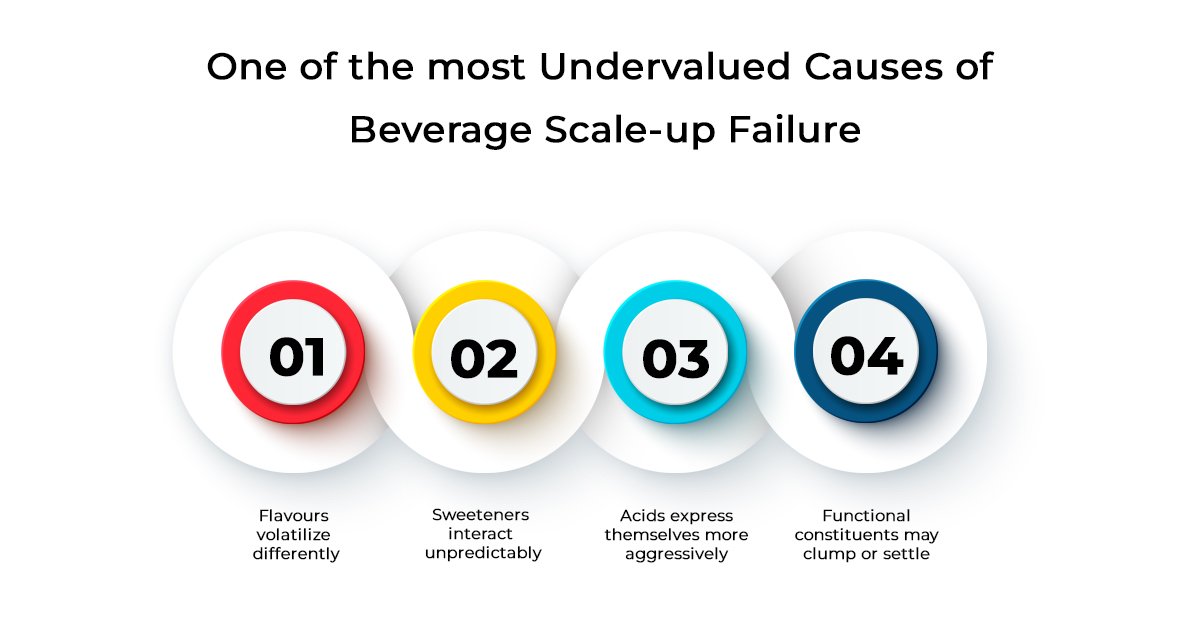
At scale:
- Flavours volatilize differently
- Sweeteners interact unpredictably
- Acids express themselves more aggressively
- Functional constituents may clump or settle
In lab trials, major effects are often visible. In commercial batches, they are necessary. Without anticipating these changes, lab to factory beverage consistency collapses.
Mixing and Shear: The Invisible Variable
Mixing israrely identical between lab and factory. Shear force, turbulence, and dwell time all change as batch size increases.
This leads to:
- Incomplete dissolution
- Emulsion breakdown
- Uneven flavor distribution
- Texture inconsistency
Beverage scale-up process constantly traces back to formulas that are mixing-sensitive but were never stress-tested beyond the lab.
Heat Processing Alters Flavour and Stability
Thermal processing is another major fault line between lab and factory.
In the lab:
- Heating is gentle and uniform
- Exposure times are short
In factories:
- Heat ramps briskly
- Hold times are longer
- Cooling may be uneven
These differences can:
- Flatten flavors
- Increase bitterness
- Destabilise proteins or fibres
- Trigger separation post-fill
When thermal impact isn’t designed into the formulation, beverage scale-up failure becomes inevitable.
Shelf Life That Exists Only on Paper
Lab stability tests frequently stimulate shelf life under ideal conditions. Factories and real-world logistics are far less forgiving. Yet there are so many shelf life issues that beverage consultants have to face.
Common lab to factory beverage issues include:
- Sedimentation over time
- Gas loss in carbonation
- Color drift
- Flavor fade
What appears stable for weeks in the lab may fail after days in distribution. Beverage scale-up failure is frequently discovered not on day one, but weeks later, when recall costs are higher.
Equipment Compatibility Is Not Universal
A formulation doesn’t scale in isolation; it scales inside a specific equipment.
Problems arise when:
- Pumps shear-sensitive constituents
- Filter introduce oxygen
- Carbonation systems vary in efficiency
- Cleaning protocols alter residues
Ignoring equipment compatibility is a direct path to beverage scale-up failure. A formula that works on one line may fail on another.
Pilot Batches Are Not Proof of Scalability
Many founders assume that a successful pilot batch validates scalability. This is a dangerous assumption.
A pilot runs frequently:
- Operates slower than the real production
- Receive extra attention from technicians
- Bypass full efficiency pressures
True beverage scale-up process frequently appears only when speed, volume, and reiteration combine. Scaling isn’t about “making more”, it is about maintaining consistency under pressure.
Why Beverage Scale-Up Failure Is So Expensive
The financial impact of beverage scale-up failure is severe because it strikes late in the process.
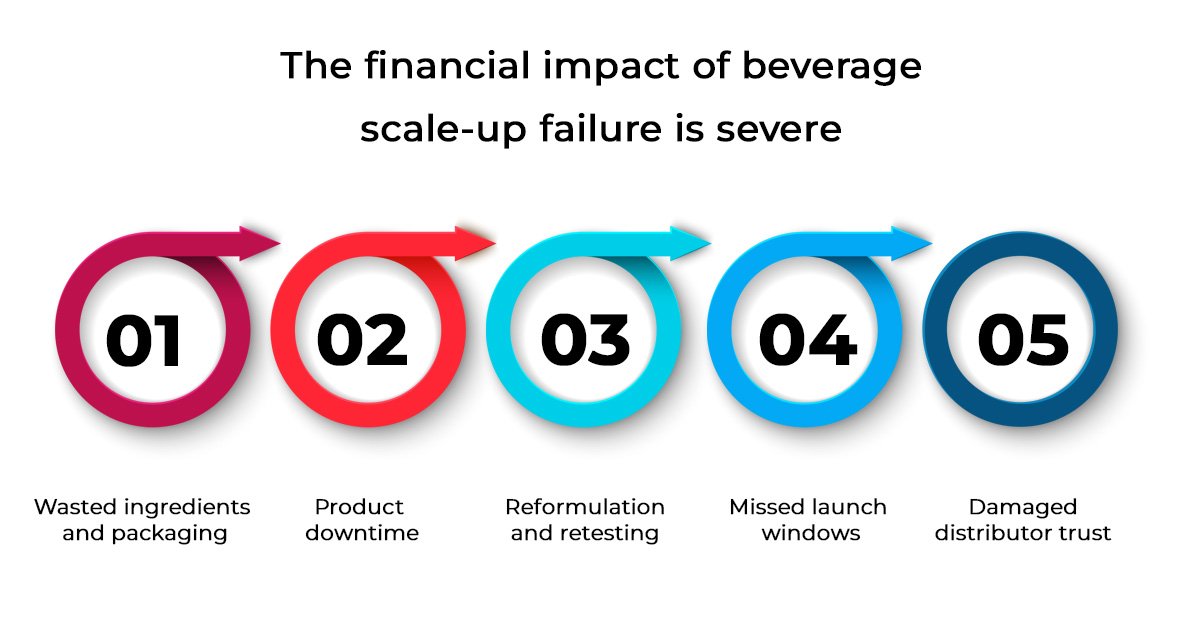
Costs include:
- Wasted ingredients and packaging
- Product downtime
- Reformulation and retesting
- Missed launch windows
- Damaged distributor trust
What could have been addressed early becomes exponentially more expensive after factory exposure.
Designing for Lab to Factory Beverage Success
Successful brands treat scale-up as a design requirement, not a phase.
They:
- Test phrasings under stress conditions
- Simulate factory mixing and heating
- Choose constituents for robustness, not just taste
- Align formulation with manufacturing realities
This approach reduces beverage scale-up failure by aligning creativity with engineering discipline.
Scale-Up Is a System, Not a Step
Beverage scale-up failure happens when the scale is treated as a major challenge. Formulation, processing, equipment, packaging, and logistics must work together. Weakness in any link compromises the whole chain.
Brands that succeed understand that lab to factory beverage transition isn’t about proving the drink works; it is about proving it survives reality.
Related Insights for Beverage Founders
Conclusion
Failure to scale a beverage properly is one of the hardest lessons founders have to learn, and it is also one of the easiest to correct. An adequate beverage solution works only in the lab. It is never whole. It will never be robust until it has been engineered to function properly under manufacturing conditions.
The line dividing failure and success is to expect scale rather than respond to it. This is where experience counts.
At Foodsure, beverage product development considers scale from day one so that as a beverage works well in a lab setting, it works well at a factory scale. But this is also the stage where it becomes essential to stress test your beverage before scaling—while ensuring FSSAI compliance and readiness for real-world production conditions.
Avoid Costly Scale-Up Failures Before They Happen
From scale-aware formulation to factory validation, our beverage scale-up consulting ensures your product survives real manufacturing conditions without reformulation delays.
Trusted by beverage founders and FMCG teams for production-ready solutions
Frequently Asked Questions
What is beverage scale-up failure?
It is when a beverage works in the lab but fails during commercial manufacturing.
Why do lab-tested beverages fail at the factory?
Because factory conditions introduce heat, shear, volume, and time variables absent in labs.
Is a successful pilot batch proof of scalability?
No, pilot batches do not replicate full production pressures.
How do ingredients behave differently at scale?
They may dissolve unevenly, react differently, or destabilise over time.
Does equipment affect beverage scale-up failure?
Yes, pumps, fillers, and carbonation systems significantly impact performance.
Can scale-up failure affect shelf life?
Yes, many failures appear weeks after production due to stability issues.
When should scale-up planning begin?
During formulation, not after lab success.
Are reformulations common after scale-up failure?
Yes, but they are costly and delay launches.
Can beverage scale-up failure be prevented?
Largely, yes, through stress testing and scale-aware formulation.
Who should be involved in scale-up planning?
Formulators, manufacturing teams, and process experts work together.