CBD Infused Drinks in India sit at a crossroads of regulation, formulation science, and consumer trust. Founders face three main challenges, which include FSSAI regulatory uncertainty, technical risks from carbonation and heat, and a market that shows potential but has low survival rates. Add THC stigma, fragile shelf stability, and complex logistics, and it’s clear why most CBD beverage ideas stall before launch.
- Regulatory Fear: Founders of CBD, infused drinks are caught in uncertainty due to FSSAI’s clampdown.
- Formulation Risk: Cannabinoids get degraded by fizz acidity + Indian heat.
- Consumer Doubt: The stigma around THC has led to the sudden loss of trust in CBD beverages.
- Shelf Trap: Logistics issues lead to the wiping out of the viability of the CBD-infused drinks formulation in India.
CBD Infused Drinks Formulation Challenges
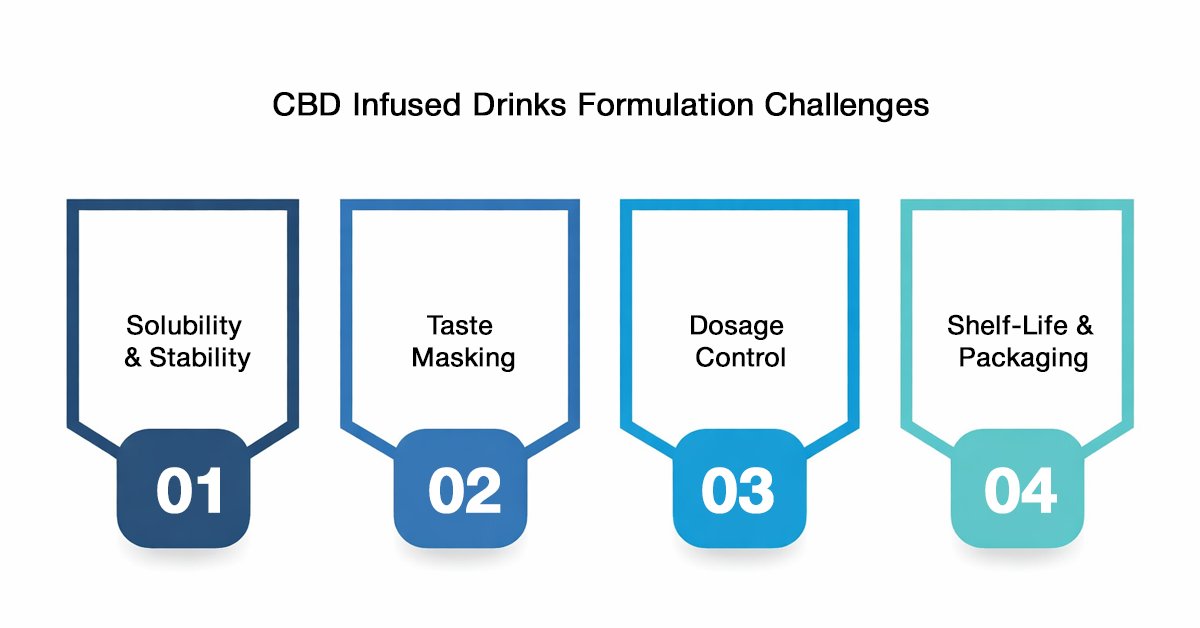
Solubility & Stability
CBD oil repels water-based CBD drinks because its oil-like properties cause it to either clump, separate or float in carbonated beverages. The pH range of carbonation between 3 and 4 results in a 50% breakdown, which occurs every month. The solution uses nanoemulsions, which create 1-10nm droplet sizes to spread CBD evenly while pH buffers safeguard against acidity.
Taste Masking
The bitterness of CBD, which has an earthy, grassy taste, dominates the flavours of functional CBD beverages, which include jeera-lime, as testers reject 70% of unmasked prototypes because they smell like weeds.
The process of encapsulation hides unwanted flavour elements because beta-cyclodextrin complexes enable a 60% reduction in taste detection. The public will accept products that have pure carbonation flavours but do not include any hemp flavour aftertaste.
Dosage Control
CBD beverage regulations in India demand precision, but swings 5mg servings to 2mg or 8mg. Underdosing feels ineffective; overdosing risks side effects. The lab tests, together with 20% overage, provide a balance between label claims and the actual CBD content of infused drinks used in India.
Shelf-Life & Packaging
CBD degrades 80% in 40°C Indian weather conditions, which combine sunlight and oxygen within a period of weeks. The combination of amber glass and PET material with a nitrogen flushing process enables CBD beverages to maintain their quality for six months.
BEVERAGE R&D CONSULTATION
Exploring a Functional Beverage Concept?
We support brands with formulation feasibility, ingredient validation, stability testing, and regulatory alignment before commercial production.
CBD Beverage Regulations in India
As per an article from Cannazo India, the regulations are:
- NDPS Act (Narcotic Drugs and Psychotropic Substances Act, 1985): Regulates all narcotic substances in India. CBD from hemp with <0.3% THC is exempt from strict controls, but higher THC content or marijuana-derived CBD is fully prohibited.
- Drugs & Cosmetics Act (1940): Requires products marketed as medicine to have a manufacturing license, meet safety standards, and be prescribed under medical supervision.
- AYUSH Guidelines: Ayurveda-based cannabis preparations must comply with the Ministry of AYUSH advisory and licensing.
Hemp CBD products become legal after meeting compliance requirements, yet FSSAI regulations and NDPS regulations create obstacles.
Regulatory Snapshot Table
| Aspect | Status | Key constraint |
| Hemp CBD (<0.3% THC) | Allowed | Leaves/stalks only; flowers banned |
| CBD Infused Drinks | Grey Zone | FSSAI flags as “drug-like” claims |
| Dosage Labelling | Mandatory | Exact mg required |
| Functional CBD drinks | Restricted | Wellness claims need an AYUSH license |
| Imports | Restricted | Customs seizes undocumented shipments |
| Medicinal Use | Case-by-Case | CDSCO approval needed |
Market Scope of CBD-Infused Drinks in India
- Growing Interest: According to a report of IMARC group, the market size was USD 228.8 Million in 2024 and is expected to reach USD 799.9 Million by 2033 with a CAGR of 14.92%.
- Consumer Shifts: Cannabidiol helps people who suffer from anxiety and depression because it increases their ability to sleep while it also controls diabetes and reduces their chronic pain and inflammation.
Founder Pain Points
- Legal Panic: There are rapid changes in the regulations of CBD-based beverages in India that have shaken investor confidence severely.
- Batch Wastage: Several lakhs have been wiped off in the fizz production batches, wherein the CBD Infused Drinks turn cloudy or bitter suddenly.
- Supplier Ghosting: The hemp extractors disappear when compliance questions from FSSAI arise.
- Taste Torture: The earthy CBD completely ruins the jeera fizztesters, even calling it “weedy medicine.”
CBD Drinks Explained
- Oil in water issue: Think of CBD as drops of oil in sparkling water; they gather, sift, or float rather than blend uniformly.
- Acid Bath Effect: The lemon, like the acidity (pH 3, 4) of carbonation, gently breaks down CBD molecules, similar to sugar dissolving in hot tea.
- Heat fragility: Packaging CBD in 40 °C trucks in India is like frying eggs in a panthe potency disappears very quickly.
- Earthy taste trap: The grassy bitterness of hemp overpowers the taste of jeera fizz, thus making functional CBD drinks taste like “weed soda.”
The right formulation makes CBD Infused Drinks feel like spa water, not science experiments.
What Actually Works
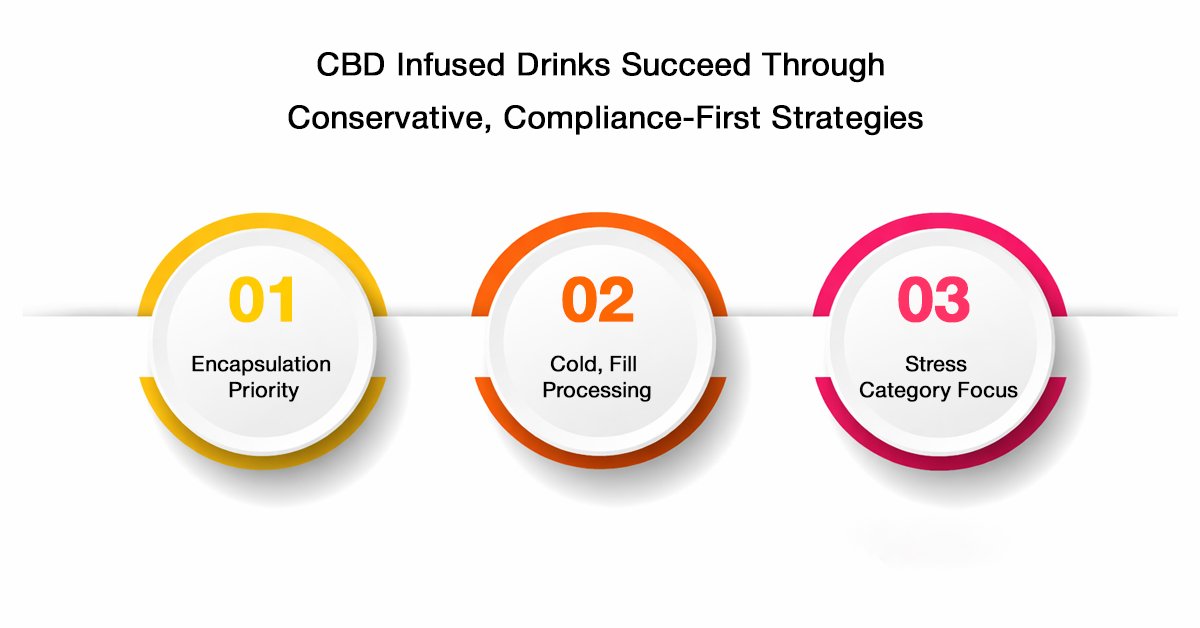
CBD Infused Drinks succeed through conservative, compliance-first strategies:
- Encapsulation Priority: Beta, cyclodextrin masks 60% bitterness for jeera, lime acceptance.
- Cold, Fill Processing: Limits heat exposure, preserves 90% potency vs hot, fill losses.
- Stress Category Focus: Position as “daily calm” mocktails, not recreational drinks.
Proven R&D cuts compliance risk while building consumer trust.
Foodsure’s Guidance Approach
Foodsure has been instrumental in supporting the founders of CBD Infused Drinks, with the formulation and compliance aspects of the product, without any hype, just down-to-earth and practical guidance.
Nanoemulsion stability for taste masking in acidic fizz systems. CBD beverage regulation, India label mapping, heat, proof shelf, and life testing for logistics. Quietly, the company bridges lab ideas to a compliant functional CBD drinks reality.
Founder Takeaway
The CBD-infused beverages achieve their success through their precise product development process and their ability to comply with regulatory requirements.
Core Insight: The production of fizzy beverages requires nanoemulsified low-dose CBD, while functional CBD drinks should be marketed as premium products that provide relaxation.
The long-term development approach establishes success because the CBD drink market needs compliance-based products that will respect Indian regulations.
Exploring CBD-Infused Drinks? Save time, formulation mistakes, and compliance headaches.
FAQs
Are CBD (Commentary Behaviours Drinks) legal in India?
Hemp CBD can be legally used without NDPS if it is THC-free only; The CBD beverage laws in India are still a FSSAI grey area.
Why do functional CBD drinks taste so bad?
The deep bitterness of the earth clashes with the fizz; it needs to be masked before the consumers will accept it.
How can one stabilise a formulation of a drink infused with CBD in India?
Nanoemulsions or encapsulation will offer protection against acidity and heat.
Does FSSAI sanction CBD beverages?
There are no clear rules, and the rejection of the applications should not be considered unless there is sufficient evidence of compliance.
What is the realistic shelf life for cannabinoid beverages?
If you use proper packaging and logistics, the product can remain fresh for 6 months.
Are the effects of CBD Infused Drinks noticeable?
Yes, the effects of flickered benefits are revealed in the calm after stable, biologically available dosing.
Can I import CBD beverages safely?
Since customs are extremely risky, they often block shipments that are not documented.