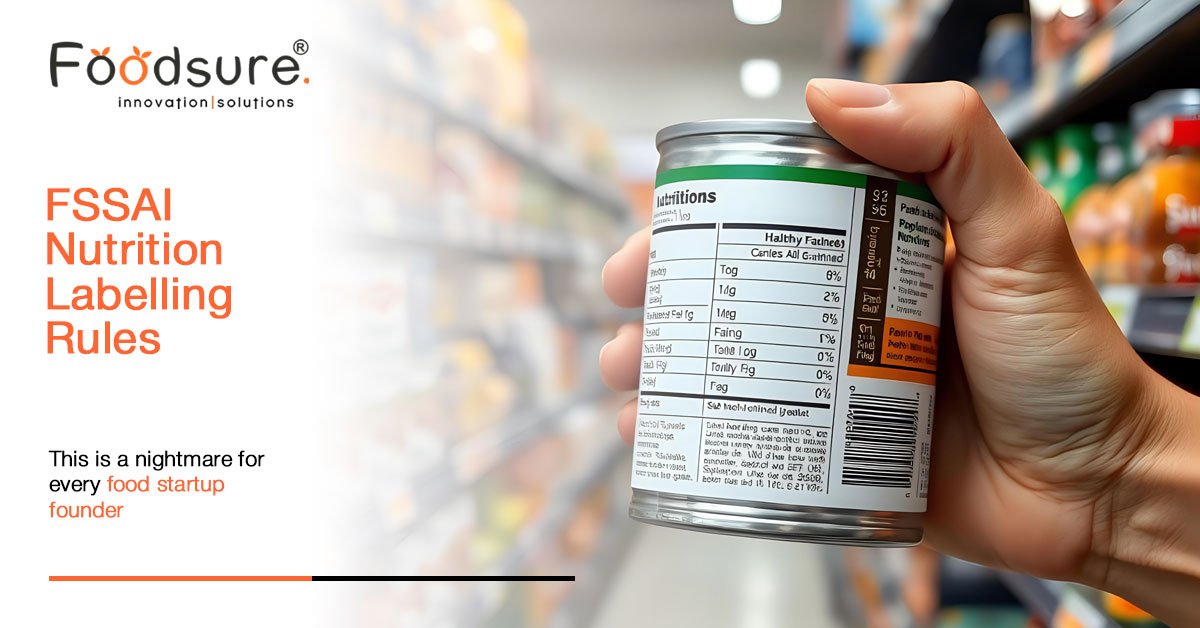
You have put your heart into making an ideal milk protein bar, taste on point, the package smooth, and Instagram worthy. Then, FSSAI nutrition labelling regulations and FSSAI nutrition labelling rules were a whack on the head. Lose a single sugar gram, and all your food production plants stand in a warehouse accumulating dust.
This is a nightmare for every food startup founder. You have mastered the food formulation and food product development, labels?
That’s where dreams die. These regulations require crystalline clear energy, protein, carbs, fats, sugars, and sodium values. Easy when reduced to simpler – but perplexing enough to perplex experience. The no-fluff advice that every SME should have.
Why Your Customers Live for Nutrition Facts
That diabetic mother takes your pack of biscuits: “Sugars in one serving? Total carbs?” Buy/no-buy determined in 3-seconds scan. A survey conducted by KPMG India revealed that Indian consumers have health and wellness as a priority and are drawn to preventive healthcare and natural products. Easy FSSAI nutrition labelling regulations will breed confidence, and bewildered tables will kill sales.
Founders believe in taste selling. However, the fact is that labels are trusted. Scramble them, and FSSAI puts a freeze on your launch.
The Label Traps That Kill Startups
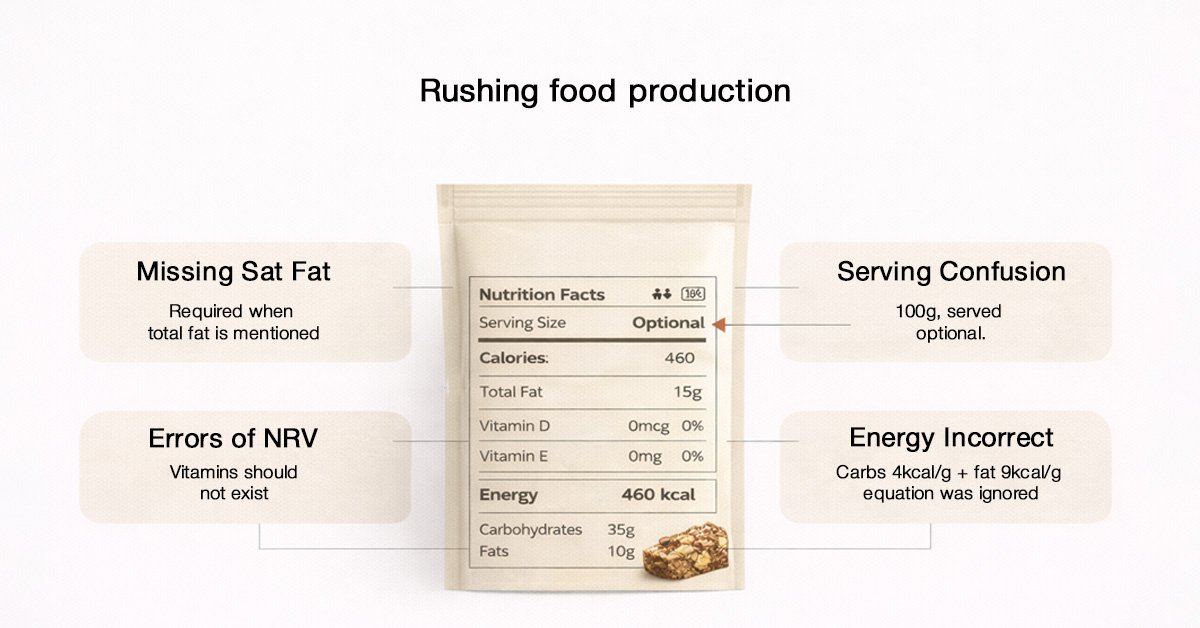
Rushing food production? Common traps:
- Missing Sat Fat: Required when total fat is mentioned.
- Serving Confusion: 100g, served optionally.
- Errors of NRV: Vitamins should not exist.
- Energy Incorrect: Carbs 4kcal/g + fat 9kcal/g equation was ignored.
FSSAI Nutrition Rules: Dead Simple Table
Mandatory per 100 g/100 ml (or per pack if single-serve):
Nutrients | What It Means | Don’t Forget |
Energy | Total calories (kcal + kJ) | Carbs 4kcal/g + Fat 9kcal/g math |
Protein | Grams only | Right conversion factor |
| Carbohydrates | Total + Sugars breakdown | Sugars subset of carbs |
| Total Fat | Total + Saturated | Trans fat if you claim “low” |
| Sodium | milligrams | Salt equivalent optional |
Golden Rules:
- ≥1.2mm font, high contrast table
- Claims = FULL nutrition panel required
- Vitamins/minerals only in the event of ≥5% NRV
- No is indistinctly healthy without evidence
Claims? Better Have Lab Receipts
“High fibre”? Show fibre grams + %NRV. “Sugar-free”? Prove <0.5g sugars. Empty promises are being murdered by FSSAI guidelines on the labelling of food products.
Smart founder move: Validate all that works in the NABL lab.
5 Massive Wins From Perfect Labels
- 73% Trust Premium – Eat right = elevated prices
- Claims Power – Low sodium sales increase by 24% – 28%
- FSSAI Shield -None, no penalty up to 10L
- Codex global alignment – Export Ready
- Less Returns – Fat Margins, Happy customers
Serving Size Secrets Founders Miss
Always show per 100g/ml base. Multi-pack? Add “X servings per package.” Single bar? Per package OK.
Trap: Founders do not mention it as quantified per serving – FSSAI detests that.
Foodsure: Your Nutrition Label Lifeline
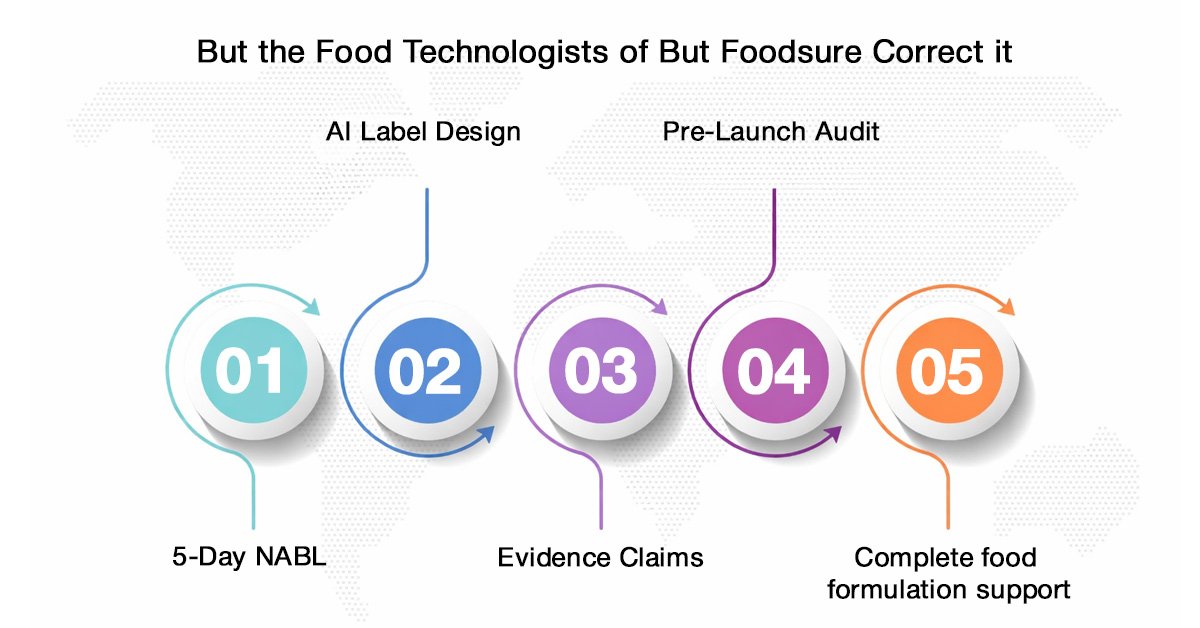
Even the experienced founders are confused by FSSAI nutrition labelling regulations. But the food technologists of foodsure correct it:
- 5-Day NABL: Complete nutrition profile.
- AI Label Design: Artwork on request.
- Evidence Claims: Lab-supported high protein validation.
- Pre-Launch Audit: Learn the mistakes.
- Complete food formulation support: Recipe-to-Pack.
Founder Survival Kit
- Laboratory test FIRST – Print nothing unconfirmed
- King 100g be Base all calculations here
- NRV <5% = silence – Don’t list little vitamins
- All statements are to be presented by a full panel – No exceptions
- Food consultant saves months – Compliance doesn’t DIY
- 3-second design rule – Scan proof labels
Launch Compliant Today
Don’t allow the FSSAI nutrition labelling regulations to kill your food business concept. Foodsure provides claim-ready, lab-tested labels in 10 days – FSSAI assured.
Call us at +91-8130404757 and be FSSAI-ready before the competitors!
FAQs
Q1. What information does a food label require with regard to nutrition?
You are required to report energy, protein, carbohydrates (including sugars), total fat, saturated fat and sodium per 100g or ml.
Q2. What font size would you recommend the nutrition table have?
The size of the minimum font is 1.2 mm, and the table should be clear and easily read with high contrast.
Q3. What should the size of serving be written on the label?
The values of nutrition should always be in 100 g or ml, and when there are various servings of the pack, there should be servings per pack as well.
Q4. Is it legal to make nutrition or health claims without a complete nutrition panel?
No, a full nutrition statement must be made on the label of any nutritional or health claim.
Q5. Adding vitamins and minerals to the label: when?
The list of vitamins/minerals may only include those that contribute at least 5% of the NRV per serving or 100g.