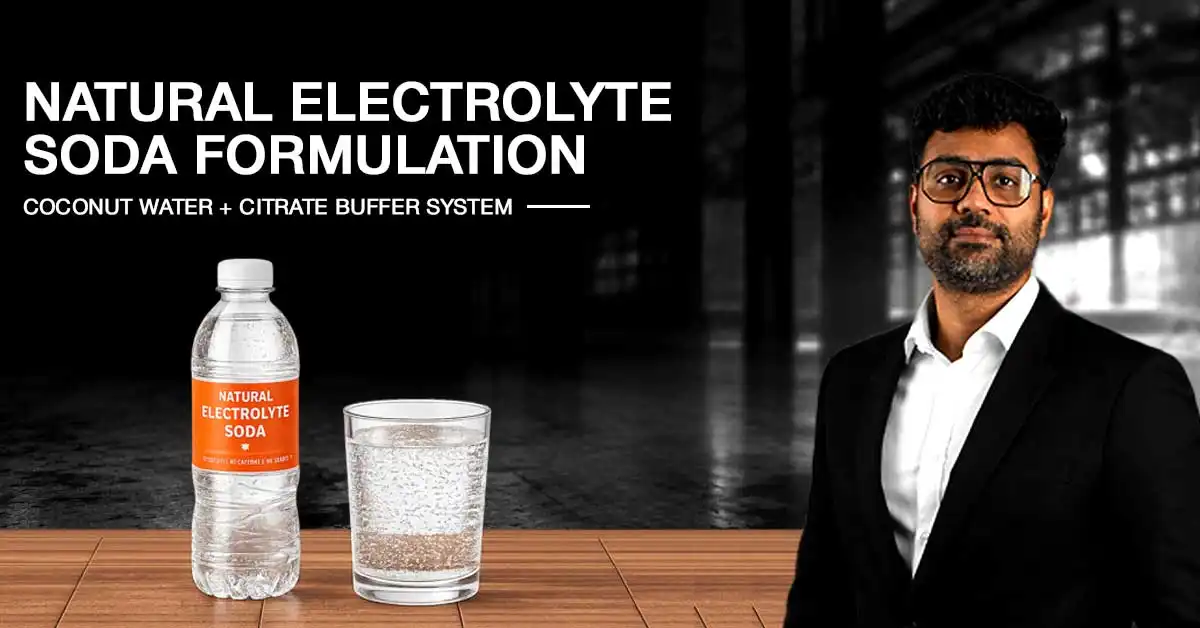
Functional soda formulations in India are evolving rapidly, and the most convincing iteration of such a beverage exists where coconut water meets citrate buffer technology. The combination of the two creates an all natural electrolyte soda, providing founders a clean label, a stable pH balance, mild carbonation, and a truly functional story related to hydration and electrolytes. In this comprehensive guide, we cover everything about electrolyte soda formulation techniques, the science of the citrate buffer system, and the R&D processes required to produce your electrolyte soda.
Natural Electrolyte Soda Is the Format Functional Beverage Founders Are Missing
- Customers demand effervescence but without artificial colors and excessive sugar.
- Electrolyte soda meets both requirements in one SKU.
- Coconut water supplies potassium, magnesium, and natural sugars.
- Citrate buffering ensures pH stability and maintains carbonation.
- Together, they provide a formulation that is both functional and cleanable at scale.
- No other format is able to accomplish this at an economic COGS at present.
The functional beverage market in India is projected to grow at a CAGR of 8.9 percent through 2028, with clean label and low sugar formats leading consumer preference shifts.
Why Most Natural Electrolyte Soda Formulas Fail Before Launch
- Unstable behavior is observed in carbonated systems lacking a buffer.
- pH lower than 3.5 results in salt precipitation in the can.
- Over carbonation leads to the breakdown of delicate coconut flavors.
- Citric acid is not effective enough to stabilize pH.
- Founders underestimate CO2 losses at higher temperatures.
- Color degradation due to the presence of coconut water and low pH is a frequent problem.
Why Natural Electrolyte Soda Formulation Is Technically Demanding
- Coconut water has a natural pH of 4.7-5.0 that is too high to allow ambient stability.
- Rapidly lowering the pH with citric acid produces an unpleasant, acid taste.
- Buffers reduce the pH slowly while simultaneously providing electrolytes.
- Carbonation affects both pH and electrolytes.
- Change in any of the variables of the citrate buffers will affect all others.
- Very few producers have formulated carbonated buffered beverages before.
What Founders Face When Building a Natural Electrolyte Soda
- Finding coconut water with consistent levels of Brix and electrolytes.
- Finding the right ratio between sodium citrate and potassium citrate.
- Finding carbonation levels without masking the flavor of the coconut.
- Finding the appropriate pH of 3.8-4.3 without producing an unpleasant taste.
- Avoiding any browning of the coconut water solids during pasteurization.
- Obtaining the proper FSSAI category for the product.
- Finding a suitable filler who can bottle carbonated beverages with a low MOQ.
How a Natural Electrolyte Soda Formula Actually Works
The Coconut Water Base
- Use young coconut water with 5-6 degree Brix for consistency of electrolytes.
- Pasteurize at 85 degrees centigrade for 15 seconds to reduce microbial load.
- Filter out coconut residues responsible for browning due to low pH.
- Potassium standardised to 150-200 mg and Sodium to 40-60 mg/100 ml.
The Citrate Buffer System
- Combines sodium citrate, potassium citrate, and citric acid in specific ratio.
- Desired pH should be between 3.8-4.2 for shelf life stability and taste balance.
- Buffer system maintains pH value during carbonation process and storage.
- 0.1-0.2 percent Trisodium citrate used for better carbonation stability.
Carbonation and Final Formulation
- Carbonate at 1.5 to 2.5 volumes of CO2 for an effective light and refreshing fizz.
- Carbonation greater than 3.0 volumes robs the beverage of its coconut flavor.
- Introduce top note flavoring at a rate of 0.1 to 0.2 percent.
- Purge with nitrogen the head space before filling to avoid oxidation.
| Factors are : | Natural Electrolyte Soda | Synthetic Sports Drink |
| Electrolyte Source | Coconut water + citrate salts | Synthetic mineral salts |
| Carbonation | Light (1.5-2.5 vol CO2) | None or high (3.0+ vol) |
| pH Range | 3.8-4.3 (citrate buffered) | 2.8-3.5 (phosphoric or citric) |
| Sugar Content | 0-4g per 100ml (natural) | 6-12g per 100ml |
| Clean Label | Yes (minimal ingredients) | No (colours & flavours, preservatives) |
| Sodium per Serving | 150-300 mg (functional range) | 200-500 mg (variable) |
| Consumer Positioning | Functional, wellness, premium | Performance, mass market |
| Retail Price Point | Rs. 80-150 per 250ml | Rs. 30-70 per 250ml |
What Actually Works in Natural Electrolyte Soda Formulation
Get the Citrate Ratio Right First
- Conduct pH titration tests using three citrate ratios prior to pilot production batch.
- Conduct taste panel test at pH values of 3.8, 4.0, and 4.2 to determine balance point.
- Finalize the carbonation process after setting the citrate buffer system.
Control Coconut Water Quality at Source
- State the Brix level between 5.0% – 6.5% for the coconut water supply contract.
- Discard lots exceeding the turbidity level set by you in NTU units.
- Variability in the raw materials is the major cause of batch rejection.
Align Filling Line Capability Early
- Not all co-packers have the capability to process lightly carbonated low-pH drinks.
- Verify the filler system used (counter pressure or gravity).
- Must test seam strength under carbonation before pilot run.
Coconut water contains naturally occurring cytokinin compounds and electrolytes that make it a scientifically credible base for a natural electrolyte soda functional claim.
| Buffer Salts such as : | Functions are | Typical % in Formula | Key Benefits |
| Sodium Citrate | pH stabiliser + sodium source | 0.2-0.5% | Mild & clean taste |
| Potassium Citrate | pH stabiliser + potassium source | 0.1-0.3% | Electrolyte balance |
| Citric Acid | Acidulant + tartness | 0.15-0.35% | Flavour brightness |
| Magnesium Citrate | Magnesium source | 0.05-0.15% | Muscle recovery claim |
| Trisodium Citrate | Buffer + CO2 stabiliser | 0.1-0.2% | Carbonation retention |
How Foodsure Builds Your Natural Electrolyte Soda Formula
- The citrate buffer system is formulated based on the required pH and taste parameters.
- We procure food grade coconut water with guaranteed Brix and electrolyte composition.
- Research and development of our natural electrolyte soda involves testing of carbonation level.
- We handle co-packer validation for carbonated beverages having low pH.
- Scope includes FSSAI product labeling and category identification.
- The formulation dossier will be provided along with stability and carbon dioxide retention data.
- We at Foodsure have developed natural electrolyte sodas for D2C,
- gym channel, modern trade, and HoReCa segment in India.
What Successful Founders Do Differently in Natural Electrolyte Soda Development
- They brief the citrate buffer system specification before meeting the co-packer.
- They conduct pH and taste tests for three buffer concentrations before pilot batches.
- They establish the coconut water Brix specification in advance through the supplier agreement.
- They conduct the CO2 retention study in ambient condition for eight weeks.
- They conduct the natural electrolyte soda testing using three benchmarks available in the market.
- They ensure that the natural electrolyte soda is classified as a carbonated beverage by FSSAI before labeling.
- They consider the natural electrolyte soda development process to be a 5-6 months process minimum.
Clean label beverage launches in India grew by over 34 percent between 2021 and 2024, with electrolyte and hydration claims among the top three functional positionings.
Now you’re ready to concoct your formula for natural electrolyte soda with coconut water and citrate buffer.
Contact us at +91 8130404757 or [email protected]
FAQs on Natural Electrolyte Soda Formulation
- What makes coconut water a good base for a natural electrolyte soda?
- It is a source of potassium, sodium, and magnesium in natural proportions.
- The subtle taste is suitable for use in lightly effervescent and citrus-flavored drinks.
- This drink consultant is able to deliver clean labeling with electrolyte salts free of artificial ingredients.
- What is a citrate buffer system and why is it used in electrolyte sodas?
- Citrate buffer system includes citric acid and citrate salts to control the pH value.
- It prevents any pH drift from happening due to carbonation and storage at room temperature.
- Citrate salts also provide additional sources of potassium and sodium.
- What carbonation level is recommended for a natural electrolyte soda?
- 1.5 – 2.5 volumes CO2 is the ideal amount for this format.
- CO2 above 3.0 volumes eliminates the coconut flavor and takes over the palate.
- Mild carbonation minimizes customer grievances on bloating.
- How long does it take to develop and launch a natural electrolyte soda in India?
- Formula development and pH optimization: 6-8 weeks.
- Development of pilot batch, carbonation proofing, and stability test: 3-4 months.
- FSSAI certification, label development, and co-packer alignment: 6-8 weeks
- What FSSAI category does a carbonated coconut water electrolyte drink fall under?
- Classified either as carbonated water or functional drink based on claims.
- Claims related to electrolytes should be in line with FSSAI criteria for nutraceuticals /functional food.
- It is suggested that category determination by a regulatory expert be done prior to labeling.
- How does Foodsure support natural electrolyte soda development end to end?
- We create citrate buffer systems, secure your coconut water, and perform carbonation tests.
- We qualify co-packers who can fill carbonated drinks with low pH.
- Labeling per FSSAI and formulation dossier comes in all our projects.