In the beverage sector, there might be a great number of perceptions that might seem naively easy and irreversible at the same time, specifically when it comes to formulation. It is at the idea stage, with limited budgets, and under the investigators in watchdog roles, with limited timelines, and willing to just take a commodity to market, that founders are particularly under strain. It is here that beverage formulation cost is an attractive tool to bring to a lower.
The rationale appears to be strong: save on the costs of formulations, speed up the debut, evaluate the demand, and lean it out later. In real life, though, cheap beverage formulation is hardly cheap. It gradually accumulates technical debt that is later reflected in the forms of reformulation, product failure, unexpected complications, and loss of market confidence. The initial savings in the course of research and development might turn out to be the most expensive error in the whole lifecycle of a product.
This discussion indicates that the cost of beverage formulation must be considered as an investment and not an expense, and poor underestimation compromises even the brightest beverage ideas.
Understanding Beverage Formulation Cost Beyond the Lab Fee
Most of the founders confuse the cost of beverage development with the tab for an advisor or lab. As a matter of fact, it is a far bigger ecosystem of choices.
An effective formulation cost will consider:
- The civilizability of ingredients and their sustainability
- Continuity during shelf life and temperature changes
- Adherence to the manufacturing equipment
- Consistency between batches in sensory
- Time of regulatory alignment and labelling
- Airman to commercial scalability
The formulation of inexpensive beverages is often limited to how to get it to taste good nowadays. The development of professional beverage products is aimed at their ability to pass the test of six months, several manufacturers, and thousands of consumers.
In cases where there is a rush or insufficient funding in formulation, the product can perform well in laboratory settings but fail in real-world situations.
How Cheap Beverage Formulation Increases Beverage R&D Cost Later
Ironically, trying to reduce beverage formulation cost beforehand always increases beverage R&D cost later. This happens because shortcuts produce undetermined problems that must be fixed post-launch.
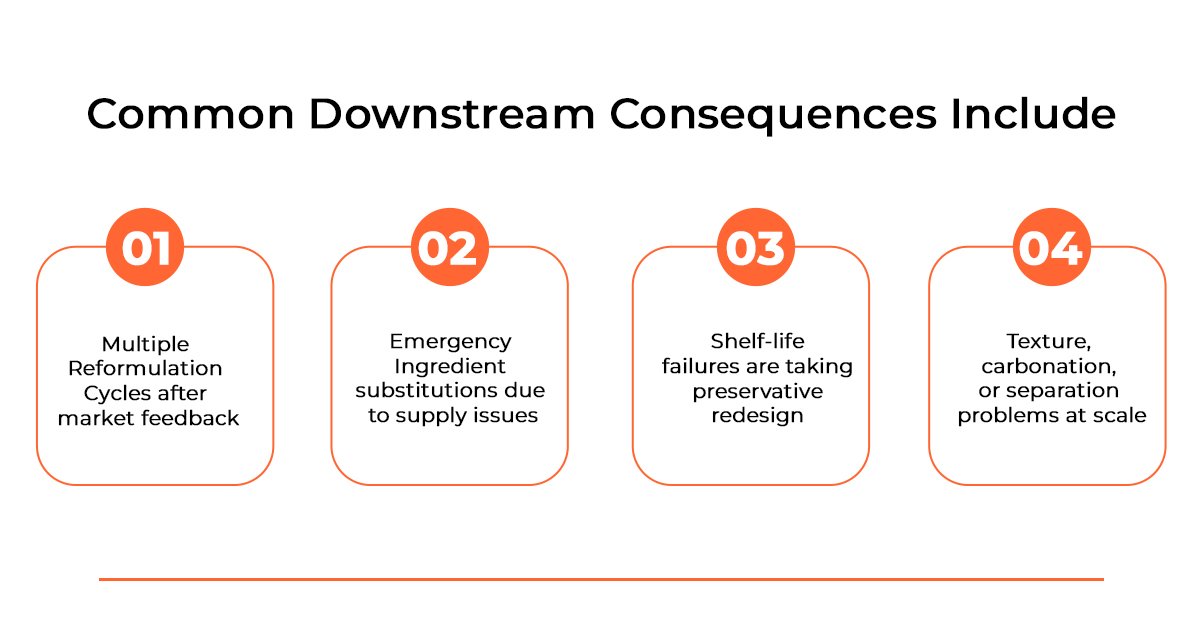
Common downstream consequences include:
- Multiple reformulation cycles after market feedback
- Emergency ingredient substitutions due to supply issues
- Shelf-life failures are taking preservative redesign
- Texture, carbonation, or separation problems at scale
Each reformulation costs more than the original. It involves new testing, product time-out, wasted inventory, and occasionally rebranding. The accretive beverage R&D cost frequently exceeds what a robust original formulation would have needed.
Ingredient Shortcuts That Inflate Beverage Manufacturing Cost
One of the most common drink formulation mistakes is choosing ingredients purely on price without understanding functionality.
Low-cost ingredients may:
- React unpredictably with acids or carbonation
- Lose flavour intensity over time
- Create sedimentation or haze
- Require higher dosage, negating savings
At the manufacturing scale, these issues increase beverage manufacturing cost through higher rejection rates, additional filtration steps, or shorter shelf life. What looked economical on paper becomes operationally expensive.
A strategically planned beverage formulation cost evaluates ingredients for performance across the entire supply chain, not just the procurement invoice.
Cheap Beverage Formulation vs. Scalable Beverage Formulation
Scalability is where cheap beverage formulation fails most visibly. A formula that works in a small batch may behave differently in commercial production.
Problems include:
- Inconsistent carbonation absorption
- Flavour volatility during heat processing
- Emulsionbreakdown during storage
- Variations in mouthfeel across batches
Scalable beverage formulation anticipates these variables during development. It may increase outspoken beverage formulation cost, but it prevents scale-up disasters that can halt launches entirely.
Brands that ignore scalability frequently face painful decisions: delayed launch, scrap inventory, or accept inferior quality.
Regulatory Oversights: The Hidden Cost Multiplier
By not being discussed, the cost of drink formulation for non-supervisory readiness is also not taken into consideration. In many cases, inexpensive formulation methods do not involve compliance.
Problems may include:
- Statements about parts cannot be justifiably made
- Nutritive value changes after scaling-Up
- The additives violate the permissible levels over the shelf life
- The statements with labels will become incorrect.
Non-supervision error correction in the launched process might need relabeling, reformulation, or pullout of products. These are not just costs; in fact, these might affect brands.
In the context of beverage product development, successful development involves regulatory compliance already on the horizon.
Brand Damage: The Cost That Never Appears on Spreadsheets
Maybe the most precious consequence of cheap beverage formulation can not be fluently quantified. Consumer trust, formerly lost, is delicate to rebuild.
Inconsistent taste, sedimentation, gas loss, or short shelf life signal poor quality, even if the conception is strong. Beforehand, adopters form lasting impressions, and negative feedback spreads faster than marketing can repair.
When beverage formulation cost is compromised, brands frequently end up spending further on promotions, discounts, and repositioning to compensate for product weakness.
Why Beverage Formulation Cost Should Be Treated as Risk Insurance
A well- structured beverage formulation serves as a cost function like insurance against future failure. It reduces uncertainty across productions, logistics, compliance, and consumer experience.
Investing appropriately allows brands to:
- Launch with confidence
- Scale without repeated corrections
- Maintain consistency across markets
- Build long- term supplier connections
Rather than asking, “How cheap can formulation be”? Successful brands ask, “How much of a threat can we exclude through formulation? ”
The Strategic Difference Between Cheap and Smart Formulation
Cheap beverage formulation focuses on minimising immediate spend. Smart formulation focuses on minimising continuance cost.
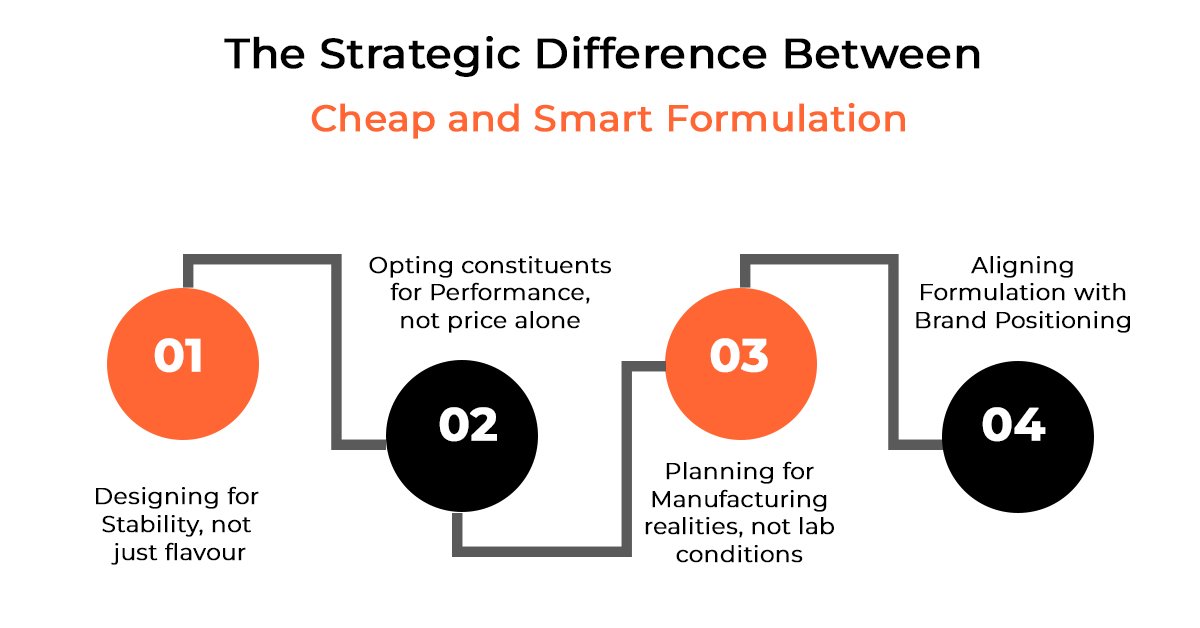
The difference lies in:
- Designing for stability, not just flavour
- Opting constituents for performance, not price alone
- Planning for manufacturing realities, not lab conditions
- Aligning formulation with brand positioning
When beverage formulation cost is optimised intelligently, it becomes one of the strongest foundations of brand life.
Recommended Read –
Beverage R&D Timelines
Beverage Startup Cost
Conclusion
The development of low-cost drinks seems to be a necessary compromise in the first stages of the product design. The fact is that it is an expense that is remitted with compounding interest. The resulting cost savings are nearly always offset by the expenses of new beverage development and research, bloated costs of production, non-managemental corrective actions, and loss of brand equity.
Shrewd brands know that the price of beverage formulation is not about paying more but paying at the right time and right place. A stability-scale-compliance engineered formulation provides defence at the border of the product and its nature.
In this respect, informed formulation partners will be needed. The beverage formulation at Foodsure is viewed as a strategic system, as opposed to a laboratory experiment, with the aspects of functionality, cost efficiency and ability to scale long term. However, it is a good time to reconsider whether your formulation is actually saving or, on the contrary, hidden costs are incurred. Unless you are testing out your formulation plan or about to launch a new beverage. When you are rating your formulation views or are developing your future drink launch.
Frequently Asked Questions
What does beverage formulation typically include?
It includes ingredient selection, stability testing, scalability assessment, and compliance considerations.
Why does cheap beverage formulation fail at scale?
Because it is often tested only in small batches and not designed for commercial manufacturing realities.
How does beverage formulation cost affect shelf life?
Underfunded formulation often ignores degradation, separation, or gas loss over time.
Is a higher beverage formulation cost always better?
Not always, but strategic investment reduces long-term risk and recurring expenses.
Can beverage R&D cost increase after launch?
Yes, reformulations and corrections significantly increase beverage R&D cost post-launch.
How does formulation impact beverage manufacturing cost?
Poor formulations lead to higher wastage, reprocessing, and quality failures.
What are common drink formulation mistakes?
Ignoring scalability, ingredient interactions, regulatory limits, and shelf-life stability.
Why is scalable beverage formulation important?
It ensures consistent quality from pilot batches to mass production.
Can formulation mistakes damage brand perception?
Yes, inconsistency and quality issues directly erode consumer trust.
When should brands invest properly in beverage formulation costs?
At the earliest stage—before launch—when changes are cheapest and most effective.