In beverage development, many moments feel as cheering as a positive tasting session. Everyone in the room agrees that the drink works because of its balanced formulation, clean scent, and appropriate carbonation. Confidence builds quickly. Many teams interpret this moment as readiness. This is where beverage sensory validation is frequently misunderstood.
Sensory approval confirms that a beverage tastes good under controlled conditions. Commercial validation proves that the same sensitive experience survives scale, shelf life, manufacturing variability, and real consumer behaviour. Confusing the two leads to one of the most common causes of post-launch beverage failure.
Beverage sensory validation isn’t about liking a product. It’s about proving that the product can perform consistently, repeatedly, and predictably in the market. Until that evidence exists, approval remains opinion, not evidence.
Approved your beverage? Make sure it performs at scale, on shelf, and in real consumer hands.
The False Security of Internal Sensory Testing
Most early decisions are driven by sensory testing of beverages conducted internally. These marketable tastings generally involve founders, R&D teams, or close stakeholders. The terrain is controlled, samples are fresh, and expectations are aligned.
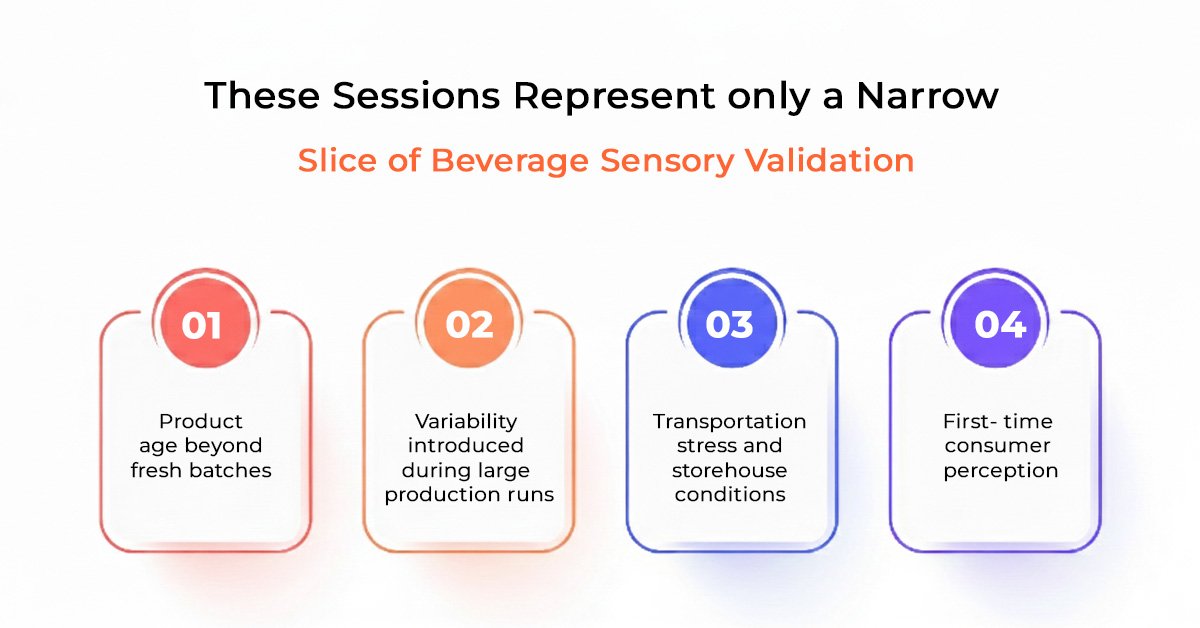
While necessary, these sessions represent only a narrow slice of beverage sensory validation.
Internal testing often ignores:
- Product age beyond fresh batches
- Variability introduced during large production runs
- Transportation stress and storehouse conditions
- First-time consumer perception
A beverage that wins approval in a lab setting has only passed a preliminary gate. Commercial conditions are far less forgiving.
Why Beverage Sensory Analysis Must Go Beyond Flavour
Everyone in the room believes that the drink works because of its balanced formulation, clean scent, and appropriate carbonation.
Commercial beverages experience:
- Oxygen exposure during filling
- Carbonation equilibration over days or weeks
- Temperature cycling during storage
- Ingredient interaction as the product rests
Each factor can subtly alter flavour, mouthfeel, aroma, or finish. Beverage sensory validation accounts for these shifts before the product reaches consumers, not after complaints begin.
Understanding the Difference Between Sensory Approval and Market Success
The difference between sensory approval and market success lies in behaviour, not preference.
Sensory approval answers:
“Does this taste good right now?”
Market success answers:
- “Will consumers buy this again?”
- “Will the experience be consistent every time?”
- “Does the product match expectations beyond the first sip?”
A beverage can earn praise during tastings yet fail to generate repeat purchases. Without repetition, beverage sensory validation has not been achieved, no matter how positive early feedback appears.
Why Beverage Sensory Testing for Scale Is Non-Negotiable
Scaling introduces conditions that no pilot batch can completely replicate. Beverage sensory testing for scale exists because production realities fundamentally change product behaviour.
At scale, beverages encounter:
- Component lot variation
- Mechanical shear during mixing
- Heat exposure during processing
- Line-speed inconsistencies during filling
Each variable influences sensory output. A formulation that feels rounded in small batches may taste sharp, thin, or muted after market runs. Without scale-specific validation, brands mistake production artefacts for formulation flaws. This is why beverage sensory validation must continue through scale, not stop at formulation sign-off.
Why Beverage SOPs Are Sensory Controls
Many teams view beverage SOP documentation as an operational requirement. In reality, SOPs are sensory safeguards.
Process variables such as:
- Mixing sequence
- Hydration time
- Temperature control
- Holding duration
Directly affect flavour development and stability. A weak or inconsistent manufacturing SOP beverage framework allows sensory drift between batches, even when the formulation remains unchanged. True beverage sensory validation depends on locking sensory outcomes into process discipline, not counting on individual execution.
Sensory Fatigue and the Risk of Familiarity Bias
Repeated internal tastings frequently produce sensory fatigue. Panels become habituated to a product, gradually overlooking minor defects. Over time, familiarity replaces objectivity.
This creates a false sense of consistency. Consumers still approach the product without this bias. Their judgment is immediate and uncompromising. Beverage sensory validation must simulate fresh, first-time exposure constantly, rather than relying on habituated internal approval.
Shelf Life Is a Sensory Commitment
Shelf life is constantly discussed in terms of safety and compliance. From a market viewpoint, it is a sensory promise.
A beverage may remain microbiologically stable while becoming:
- Flat in aroma
- Unstable in flavour
- Unpleasant in texture
Market trust erodes if sensory quality degrades before the declared shelf life. Beverage sensory validation requires tracking sensory performance across time, not just confirming original stability.
The Commercial Cost of Skipping Validation
When brands equate approval with validation, they frequently face:
- Strong trial but weak repeat sales
- Expensive reformulations after launch
- Inconsistent consumer feedback
- Distributor resistance due to quality variation
Each issue traces back to deficient beverage sensory validation. The market doesn’t punish creativity; it punishes untested hypotheticals.
Reframing Sensory Strategy for Commercial Reality
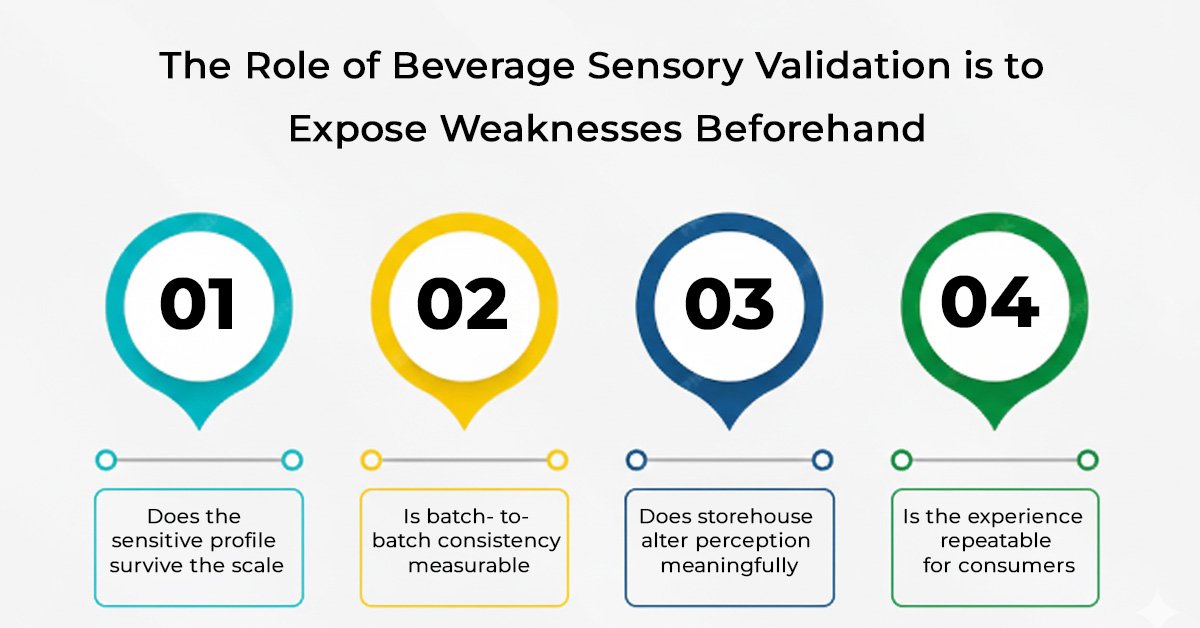
The purpose of sensory evaluation must shift from approval to challenge. The role of beverage sensory validation is to expose weaknesses beforehand, when correction is still affordable.
Effective validation asks:
- Does the sensory profile survive scale?
- Is batch-to-batch consistency measurable?
- Does storehouse storage alter perception meaningfully?
- Is the experience repeatable for consumers?
Only when these questions are answered does sensory approval translate into market readiness.
Related Insights for Beverage Validation & Scale-Up
Conclusion
Sensory approval is a moment of confidence. Beverage sensory validation is a system of evidence. Market success depends not on how a beverage tastes initially, but on how reliably it delivers the same experience across production, distribution, and time.
Brands that treat validation as voluntary frequently learn this lesson after launch, when correction becomes expensive.
At Foodsure, beverage sensory validation is approached as a market risk-reduction process, integrating sensory testing, scale testing, and manufacturing SOP discipline into one framework.
However, the next step isn’t another tasting; it is structured validation. If your beverage has earned approval but has not yet proven itself in real-world conditions, taking that step beforehand can determine whether your product simply enters the market or truly sustains itself in it.
Turn Sensory Approval Into Market Readiness
Foodsure helps beverage brands validate sensory performance across scale, shelf life, and manufacturing conditions — before market failures happen.
Trusted by 100+ beverage founders and FMCG brands for scale-ready product validation.
Frequently Asked Questions
What is beverage sensory validation?
It is the structured process of confirming that a beverage’s sensory performance holds across scale, time, and commercial conditions.
Is sensory approval sufficient for launch?
No. Approval indicates liking, not repeatable market performance.
Why do beverages fail after positive tastings?
Because scale, storage, and process variability were not validated.
How is beverage sensory analysis different from tasting?
It evaluates sensory behaviour across conditions, not just preference.
When should beverage sensory validation begin?
As early as formulation, and continuing through scale-up.
Does manufacturing affect sensory quality?
Yes. SOP discipline directly influences sensory consistency.
Why is shelf life a sensory issue?
Because flavour and texture can degrade before safety limits are reached.
Can internal panels replace consumer testing?
No. Internal familiarity creates bias.
Is beverage sensory testing for scale always required?
Yes, if commercial consistency is expected.
How does Foodsure support sensory validation?
By integrating sensory evaluation with scale testing and SOP-driven manufacturing control.