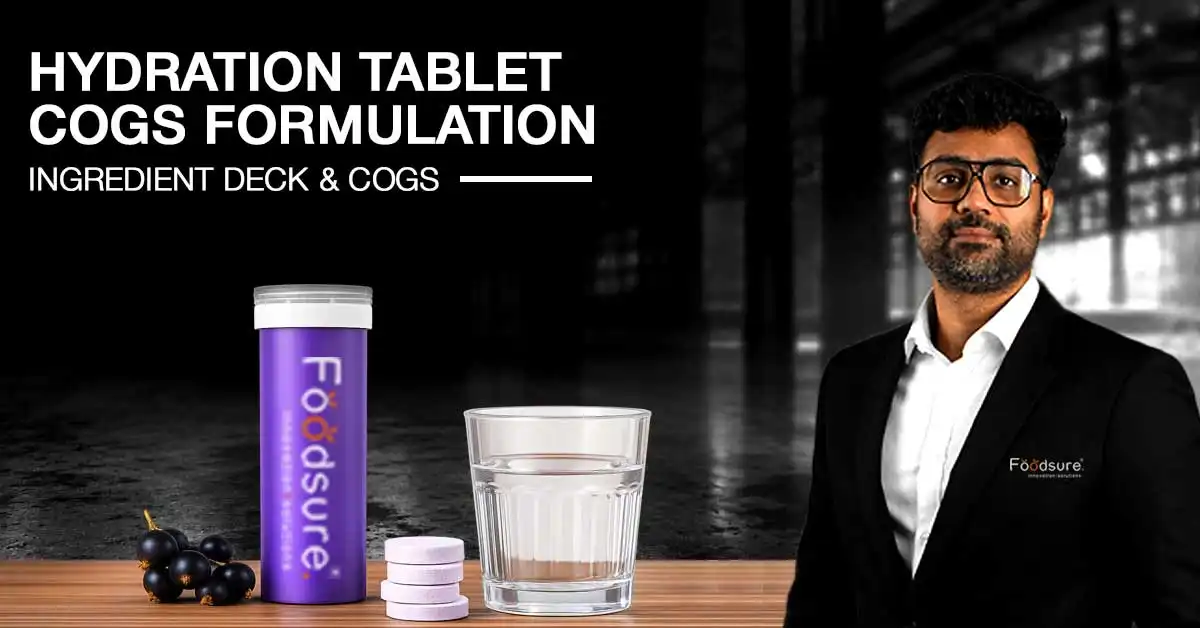
Prior to briefing your manufacturers, you must be aware of what your hydration tablets will contain and how much each one will cost you. Many entrepreneurs obtain a preliminary quote, make the assumption that it is correct, and later find out the true COGS of their hydration tablet COGS after six months have elapsed. The following guide provides the complete list of ingredients in your hydration tablets, the costs involved in manufacturing them for three different brands, and all the aspects influencing your COGS.
Your Hydration Tablet COGS Will Surprise You
- Typical entrepreneurs price their tablets as low as Rs. 2-3.
- But actual hydration tablets’ cost of goods sold (COGS)
- starts out being in the range of Rs. 6-10.
- The difference lies in packaging, testing, and quality of ingredients used.
- Ingredients decisions made right at the beginning will fix your COGS.
- Making any changes to ingredients after stability testing takes 3 to 4 months.
- Your COGS is more than just the raw material cost.
The Indian nutraceutical tablet market is growing at over 12 percent CAGR through 2027, making cost competitive hydration tablet formulation a key differentiator.
Why Founders Misjudge Hydration Tablet COGS
- Quoted rates of manufacturers rarely take into account testing or regulatory costs.
- Costs of flavors or sweeteners differ five times according to the grade of the supplier.
- Package design is quoted separately and usually understated by forty percent.
- MOQ obligations increase the unit cost at pilot stage.
- Changing ingredients during scale up leads to revalidation costs.
- Comparisons made by the founders are based on retail MRP and not actual COGS.
Why Hydration Tablet COGS Is Hard to Pin Down Early
- Ingredients’ cost is impacted by import duty and forex fluctuation.
- The price of citric acid and potassium citrate change every quarter.
- The cost of spray dried flavor depends on the type of oil and its encapsulation process.
- The cost of manufacturing is affected by batch size and machinery used.
- The cost of QC will vary according to testing parameters for each batch.
- There is no established COGS structure available for hydration tablets in India.
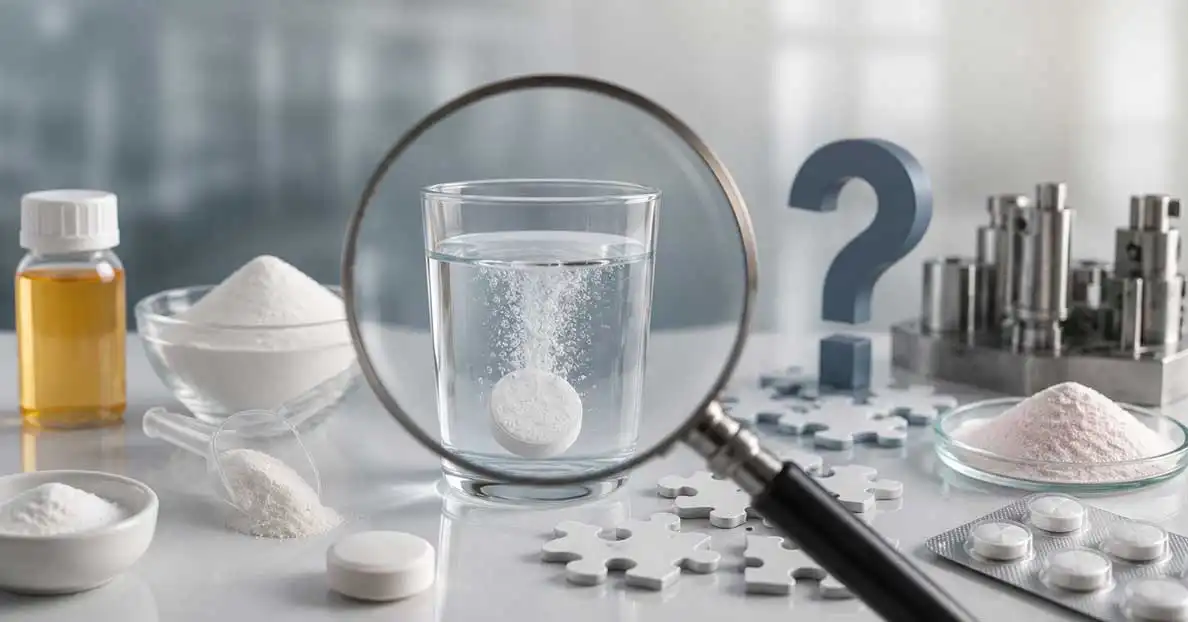
What Founders Face When Building the Ingredient Deck
- Searching for food grade electrolyte sources and balancing its usage against taste.
- Maintaining sodium content for taste without compromising functionality.
- Availability of anhydrous citric acid for effervescent stability.
- Selecting sweeteners which will impact both COGS and claim.
- Getting colour approval through FSSAI permitted additives list.
- Selecting flavors compatible with effervescent base resulting in off-notes.
What Goes Into a Dissolvable Hydration Tablet
Core Electrolyte Layer
- NaCl forms the basis of any hydration formulation.
- Potassium citrate is better than potassium chloride in terms of flavor.
- Magnesium sulphate or magnesium citrate for muscles.
- Proportion of electrolytes decides isotonicity and rate of absorption.
Effervescent Base
- The combination of citric acid and sodium bicarbonate gives rise to the reaction.
- Should be anhydrous, so that reaction does not occur before use.
- Determines how fizzy the drink will be.
- Inappropriate ratio results in crumbled tablets or poor dissolving.
Functional Carriers and Additives
- The addition of maltodextrin or dextrose provides body and compressibility.
- The spray dried flavor should not contain any oil content.
- Sub 0.5% sucralose or stevia should be added for sweetness.
- Only water soluble coloring from the FSSAI approved list is permitted.
| Ingredients are : | Functions | Typical % in Formula | Approx Cost (Rs. per kg) |
| Sodium Chloride | Primary electrolyte | 15 to 20% | Rs. 20-40 |
| Potassium Citrate | Electrolyte balance | 8 to 12% | Rs. 180-250 |
| Magnesium Sulphate | Muscle function | 3 to 6% | Rs. 60-90 |
| Citric Acid (anhydrous) | Effervescent reaction or pH | 20 to 28% | Rs. 90-130 |
| Sodium Bicarbonate | CO2 release or effervescence | 18 to 24% | Rs. 30-50 |
| Dextrose or Maltodextrin | Carrier or isotonicity | 10 to 15% | Rs. 45-70 |
| Flavour (spray dried) | Taste masking | 2 to 4% | Rs. 400-900 |
| Sweetener (sucralose or stevia) | Sweetness | 0.1 to 0.5% | Rs. 600-2400 |
| Colour (water soluble) | Appearance | 0.05 to 0.2% | Rs. 800-1500 |
What Actually Works When Optimising Hydration Tablet COGS
Lock Ingredient Grades Before Pilot
- Electrolytes for food are about 30-40% cheaper than pharma grade.
- Seek approval for use with your regulatory adviser first.
- Do not change grades once you start stability studies.
Negotiate Flavour Costs Separately
- Flavoring is your biggest variable cost in the ingredient list.
- Get three different quotes from flavor houses prior to formulations.
- Spray dried form lasts longer than liquid in tablet formulations.
Right-Size Your Packaging Spec
- Aluminum packaging for effervescent increases production cost by Rs. 2-4 for each tablet.
- Plastic packing for non-effervescent costs less than Rs. 1.
- Usually packaging constitutes 25 to 35 %of the total cost of hydration tablets.
According to industry benchmarks, packaging accounts for 28 to 35 percent of total COGS for tablet format nutraceuticals in emerging markets.
| Cost Head :- | Budget Brand (Rs.) | Mid Range Brand (Rs.) | Premium Brand (Rs.) |
| Raw Materials (per tablet) | 1.20-1.80 | 2.00-3.00 | 3.50-5.50 |
| Manufacturing & Labour | 0.40-0.60 | 0.60-0.90 | 0.90-1.40 |
| Packaging (tube or blister) | 0.80-1.20 | 1.50-2.50 | 3.00-5.00 |
| Testing & QC | 0.10-0.20 | 0.20-0.35 | 0.35-0.60 |
| Regulatory or Label | 0.05-0.10 | 0.10-0.20 | 0.20-0.40 |
| Total COGS per Tablet | 2.55-3.90 | 4.40-6.95 | 7.95-12.90 |
How Foodsure Builds Your Hydration Tablet COGS Model
- We work backward from your target MRP, arriving at a realistic COGS.
- We purchase electrolytes that are food grade from vetted suppliers.
- We review flavor house offers and suggest the best one.
- Hydration tablet COGS calculations factor in testing expenses and regulatory requirements.
- Before producing any batch, we create a pilot-to-scale cost projection.
- We provide you with an itemized ingredient list complete with COGS per unit.
- COGS modeling done by Foodsure for startup companies has resulted in reduced manufacture rates of 12-18 percent.
What Successful Founders Do Differently With Hydration Tablet COGS
- This way, they develop their COGS model before approaching any suppliers.
- They have individual quotes from the suppliers rather than from the manufacturer.
- They secure ingredient grades in their formulation brief instead of doing it verbally.
- They sample 2 to 3 flavors before finalizing on a particular supplier.
- They incorporate all quality control aspects within each of their COGS.
- They separately analyze hydration tablets COGS for pilot batches and when scaled up.
- They view COGS as a living document and not just a calculation.
Looking for an accurate COGS projection for your hydration tablet formula?
Contact us at +91 8130404757 or [email protected]
FAQs on Hydration Tablet COGS and Ingredient Deck
- What is a realistic hydration tablet COGS in India for a new brand?
- Budget formula: Rs. 2.55 – Rs. 3.90 per tablet.
- Average formula: Rs. 4.40 – Rs. 6.95 per tablet.
- Premium formula: Rs. 7.95 – Rs. 12.90 per tablet.
- Which ingredient contributes most to hydration tablet COGS?
- It is packaging, accounting for up to 25-35 percent of total COGS.
- Flavor is the costliest raw material component of all.
- The cost of electrolytes is fairly consistent, although quality does vary.
- Can I reduce hydration tablet COGS without changing the formula?
- Yes. Changes to packaging specifications bring about the most rapid COGS reduction.
- Procurement of flavor through a flavor house results in a 15-25 percent cost saving.
- Increasing MOQ from 10,000 units to 50,000 results in substantial savings per unit.
- What is the minimum MOQ to make hydration tablet COGS viable?
- For non effervescent tablets, MOQ of 10,000 units is viable.
- For effervescent tablets, MOQ should be at least 50,000 units.
- At lower MOQ, COGS per unit could be twice the scaling up
- Does FSSAI compliance add significantly to hydration tablet COGS?
- Costs associated with regulatory approval and labeling are between Rs. 0.05 – Rs. 0.40 per unit.
- One time cost for compliance set up is Rs. 50,000 to Rs. 2,00,000.
- Distributed over one lakh units, effect on COGS will be below Rs. 2 per unit.
- How does Foodsure help with the ingredient deck and COGS model?
- We prepare an extensive ingredient deck with detailed costing information.
- COGS model includes sourcing, processing, packaging and Quality Control Costs.
- We make a Pilot run to Scale projection before making any batch commitments.