Launching a food brand in India can feel exciting and full of opportunity. Consumers are open to new products, quick commerce is expanding, and modern retail continues to grow. For many entrepreneurs, this creates the perfect environment for a successful food brand launch. However, many founders often overlook the food brand launch Challenges that come with entering such a competitive and complex market.
However, behind every successful food brand is a complex operational reality. Many founders focus on branding, packaging, and flavour, but underestimate the backend economics. Among the many challenges faced by small food businesses in India, three factors consistently create the biggest roadblocks: Minimum Order Quantity (MOQ), shelf life, and margins. These factors directly affect cash flow, scalability, and long-term survival.
Wanna Launch your Food Brand With Us?
This blog explains these three obstacles in a simple, down-to-earth manner based on how food brands in India are really created, not on what it looks like on pitch decks.
Understanding the Reality of Food Brand Launch Challenges in India
India’s food ecosystem is unique. It is price-sensitive, highly competitive, and tightly regulated. Consumers expect value, retailers demand margins, and manufacturers require production volumes.
For a startup entering the market, balancing these expectations can be difficult.
Many founders assume that a strong product will automatically succeed. In reality, most food launch failures happen because of operational challenges, not because the product tastes bad.
Three technical and commercial factors usually determine success or failure:
- Minimum Order Quantity (MOQ)
- Shelf life stability
- Sustainable profit margins
These issues are common across markets with free food challenges in India, where businesses must operate efficiently while competing with established brands.
Minimum Order Quantity (MOQ): The First Hidden Barrier
MOQ stands for Minimum Order Quantity, which is the smallest production batch a manufacturer allows.
Manufacturers set MOQs to cover costs related to machine setup, labour, and raw materials. While this improves manufacturing efficiency, it creates a major barrier for startups.
For a new brand testing the market, high MOQ requirements can create immediate financial pressure.
Why MOQs Are a Problem for New Food Brands
Most contract manufacturers in India are designed for medium or large-scale production. They prefer bigger batch sizes to maximise production efficiency.
However, startups typically want smaller batches to test market demand.
Common MOQ-related challenges include:
- Large upfront production investment
- Inventory accumulation before demand is proven
- Cash locked in unsold stock
- Higher financial risk during early stages
For example, a snack manufacturer may require 8-12 tonnes per batch, while packaged foods may require 5,000–10,000 units per production run.
How MOQ Impacts Food Brand Launch Challenges in India
Elevated financial risk is one of the negative consequences of high minimum order quantities (MOQs). When a product is not sold quickly, brands have to pay for storage; moreover, they run the risk of the product expiring, and finally, there is the pressure to give discounts. Many new food companies with great products close not because of bad products but because they made too much initially.
Shelf Life: The Silent Business Killer
Shelf life is probably one of the biggest food brand launch challenges in India that gets underrated. Most founders believe that a product will sell if it tastes good. However, retailers, distributors, and online platforms have a different perspective.
Why Shelf Life Is More Important Than Taste?
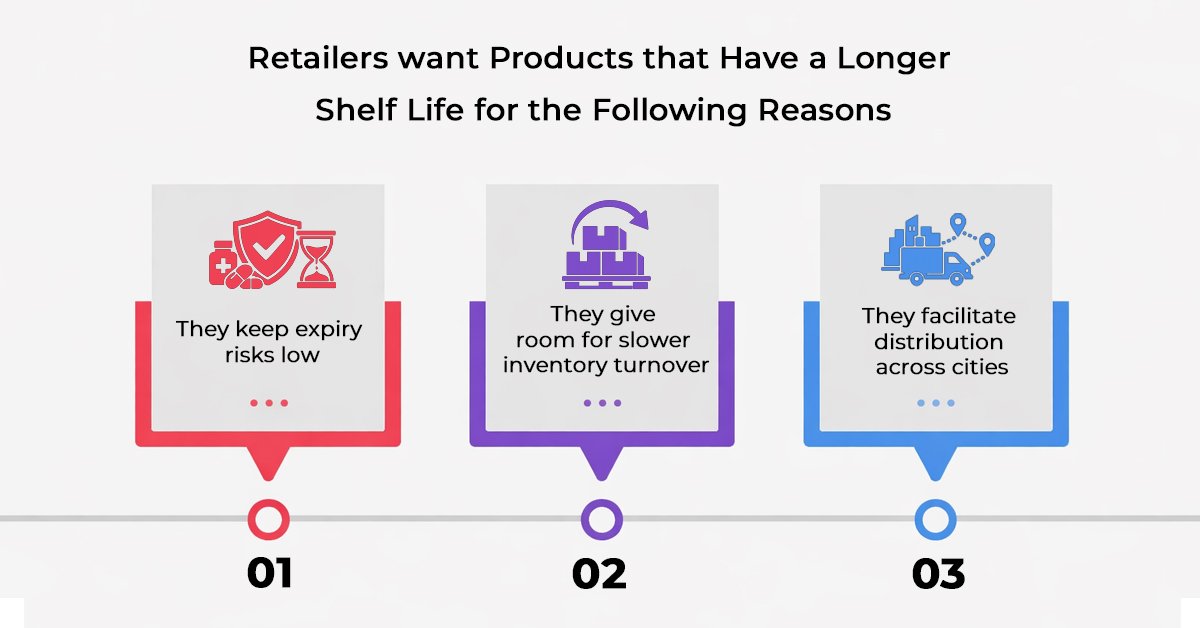
Retailers prefer products with a longer shelf life because it allows:
- Reduced expiry risk
- More time for inventory turnover
- Wider distribution across regions
If a product has a short shelf life, retailers may avoid stocking it because the risk of returns increases. For startups, this creates a serious distribution challenge.
Shelf Life Challenges for Indian Food Startups
Some typical problems are:
- Natural or clean-label products are only good for a short period of time
- Processing that is not consistent has an impact on the stability
- Climate conditions are making the products go bad faster
- No proper shelf, life testing.
- Brands find it challenging to enter modern trade, export markets, or even scale regionally without the support of adequate shelf life.
Balancing Clean Labels and Shelf Stability
Consumers today prefer clean-label products with fewer preservatives. While this improves brand perception, it also makes shelf-life management more complex.
Brands must find ways to maintain stability through:
- Smart ingredient selection
- Controlled processing techniques
- Improved packaging solutions
Ignoring these technical factors can lead to product returns, quality complaints, and reputational damage.
Margins: Where Most Food Brands Break
Margins are the most brutal reality check in the food business. On paper, the pricing may look fine. In reality, the food startup cost structure in India appears from every direction.
The Real Cost Structure of a Food Brand
Most founders tend to figure out their margins only using the cost of raw materials and manufacturing. However, a viable food brand is required to factor in:
- Packaging and printing costs
- Logistics and warehousing
- Distributor and retailer margins
- Marketing and promotions
- Platform commissions (for online sales)
- GST and compliance costs
Once all these are factored in, margins shrink quickly.
Why Margins Are a Major Food Brand Launch Challenge in India
India’s food market is highly price-driven. Consumers compare prices aggressively, and retailers expect healthy margins to stock new brands.
A typical margin structure might be set up as follows:
- Distributor margin: 8-15%
- Retailer margin: 20-35%
- Platform commission: 15-25%
Brands end up either uncompetitive or losing money if the prices are not set carefully.
The Interconnection Between MOQ, Shelf Life & Margins
These three challenges do not exist in isolation. They are deeply connected.
- High MOQ increases inventory holding time, making shelf life critical
- Short shelf life increases wastage, hurting margins
- Poor margins reduce the ability to absorb MOQ risks
Ignoring even one of these can collapse the entire business model. For example, producing a large MOQ of a short shelf-life product with thin margins is one of the fastest ways to drain capital.
How Smart Founders Reduce These Risks
Experienced founders and food professionals approach launch differently. They prioritise stability over speed.
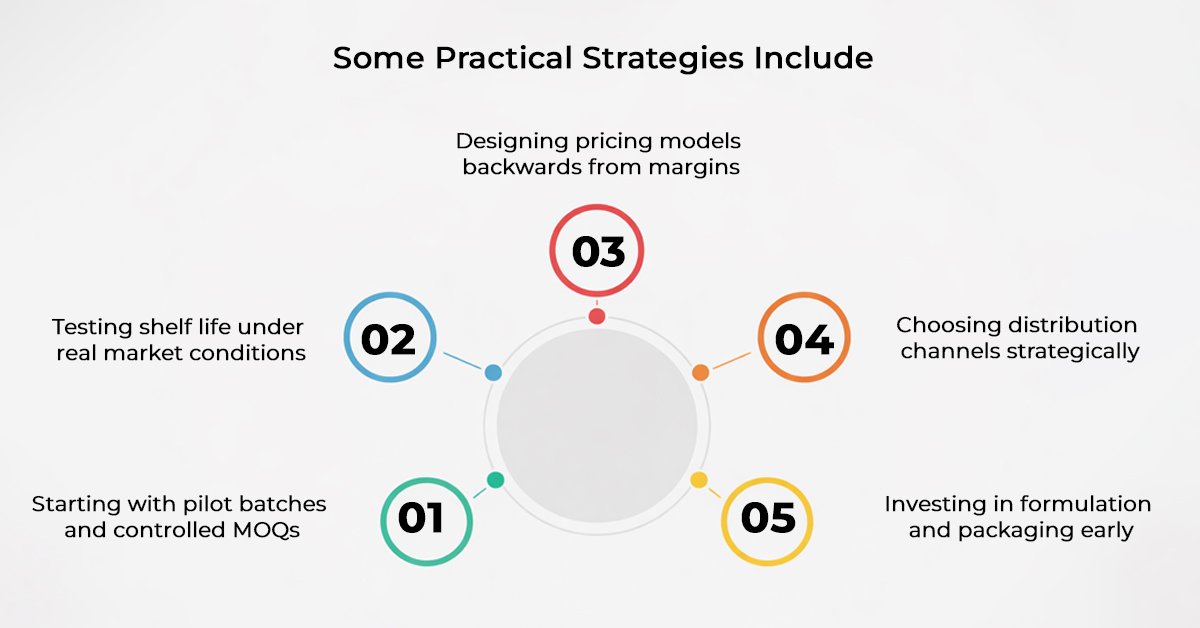
Some practical strategies include:
- Starting with pilot production batches
- Testing shelf life under real market conditions
- Designing pricing models backwards from margins
- Choosing distribution channels strategically
- Investing in formulation and packaging early
These steps may slow down the launch slightly, but they significantly increase long-term survival.
The Importance of Planning in Food Businesses
Launching a food brand is not just about creating a great recipe. It requires building a sustainable business system. Successful brands treat operational factors such as MOQ, shelf life, and margins as core strategic decisions.
They understand that long-term growth depends on controlled expansion and strong technical planning. In highly competitive markets with free food challenges in India, brands that manage these operational risks early gain a major advantage.
Final Thoughts: Building a Food Brand That Lasts
Launching a successful food launch in India requires more than just a great product. Factors like MOQ, shelf life, and margins play a major role in determining whether a brand can survive and scale. Understanding these operational realities helps founders overcome the challenges faced by small food businesses in India and compete in markets with free food challenges in India.
Connect with our food experts to develop stable, scalable, and market-ready food products with the right formulation and strategy.
Turn Taste Approval Into Market Proof
Strong flavour alone does not prevent food brand failure. Commercial success depends on shelf life, scalability, compliance, and repeat consumer behaviour.
FAQ’s (Frequently Asked Questions)
What is MOQ in food manufacturing?
MOQ stands for Minimum Order Quantity. It is the minimum production quantity a manufacturer requires per batch to make food manufacturing commercially viable.
Why is MOQ a challenge for new food brands in India?
High MOQs force startups to invest heavily before market demand is validated, increasing financial risk and inventory pressure.
How does MOQ affect cash flow in food startups?
Large MOQs lock working capital in inventory, slowing cash rotation and limiting spending on marketing, distribution, and growth.
Why is shelf life critical for launching a food brand in India?
Longer shelf life reduces expiry losses and enables distribution across multiple regions, retail formats, and online platforms.
Can a food product fail despite great taste?
Yes. Poor shelf life, unstable formulation, and quality inconsistency often lead to returns, rejections, and delisting despite good taste.
Are clean-label food products harder to scale in India?
Yes. Removing preservatives often shortens shelf life and increases formulation complexity, making scale-up more challenging.
What are typical margin expectations in the Indian food market?
Retailers and distributors together usually demand 30–50% margins, excluding platform commissions and promotional costs.
Why do food brand margins look good on paper but fail in reality?
Hidden costs such as logistics, promotions, sampling, wastage, and platform fees significantly reduce actual profitability.
How are MOQ, shelf life, and margins connected?
High MOQs increase inventory risk, short shelf life causes wastage, and both directly impact margins and cash flow.
How can food startups reduce launch risks in India?
Food startups can reduce risk by starting with pilot batches, validating shelf life early, and pricing products backwards from target margins.