The Common Challenges Small Manufacturers Face in Food Innovation
Small food manufacturers often struggle with food innovation due to limited facilities, a lack of testing tools, and no access to food scientists. This makes the food innovation process slower, more expensive, and riskier. Turning new ideas into profitable, innovative food products becomes challenging, especially with fast-changing trends like plant-based snacks and functional beverages. Without a clear strategy for innovation in the food industry, businesses may waste time, money, and launch products that fail to connect with their target market.
Read more: Food Product Development.
🚀 Ready to get the best New Food Innovations?
Get expert help with Food Innovation, compliance, and market-ready strategies. Book a FREE 30-minute consultation with our team today.
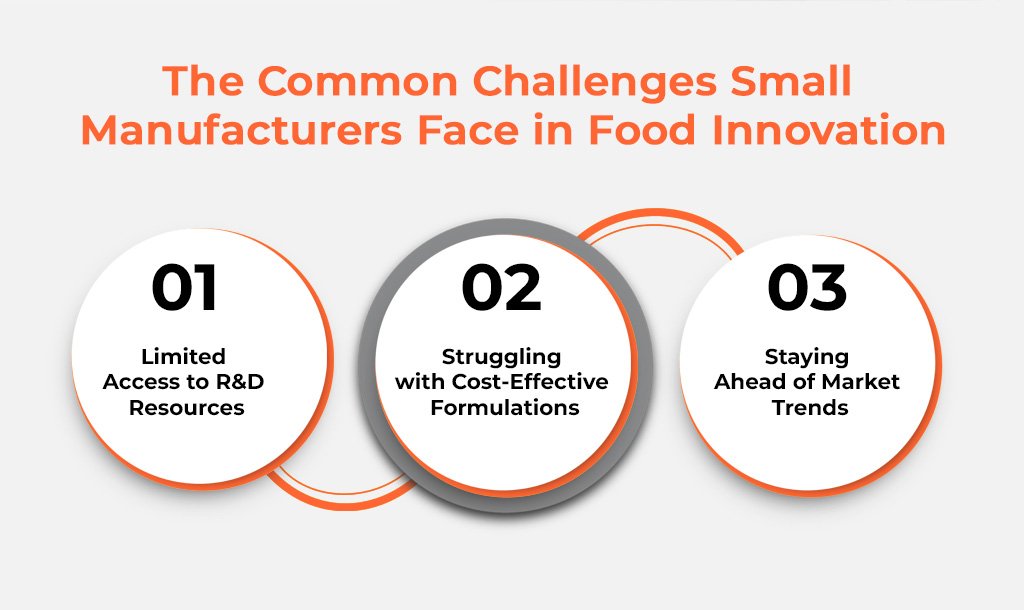
1. Limited Access to R&D Resources
Small food businesses often lack access to full laboratories or in-house scientists, which slows down food product development and limits structured food innovation. Without proper R&D support, it becomes difficult to validate formulations, ensure food product compliance, and confidently confirm new compositions before market launch in the competitive food industry.
2. Struggling with Cost-Effective Formulations
Managing ingredient costs, production limitations, and product taste at the same time can make food product development challenging. Small manufacturers must focus on a cost-effective food innovation process that reduces R&D expenses while maintaining quality, consistency, and compliance in the competitive food industry.
3. Staying Ahead of Market Trends
Market trends in the food industry change fast. Without proper market research and a strong food innovation process, your product may miss demand or launch too late.
Stay ahead with expert food product development support, and get your idea formulated at Foodsure today.
Proven Strategies for Streamlined Food Innovation
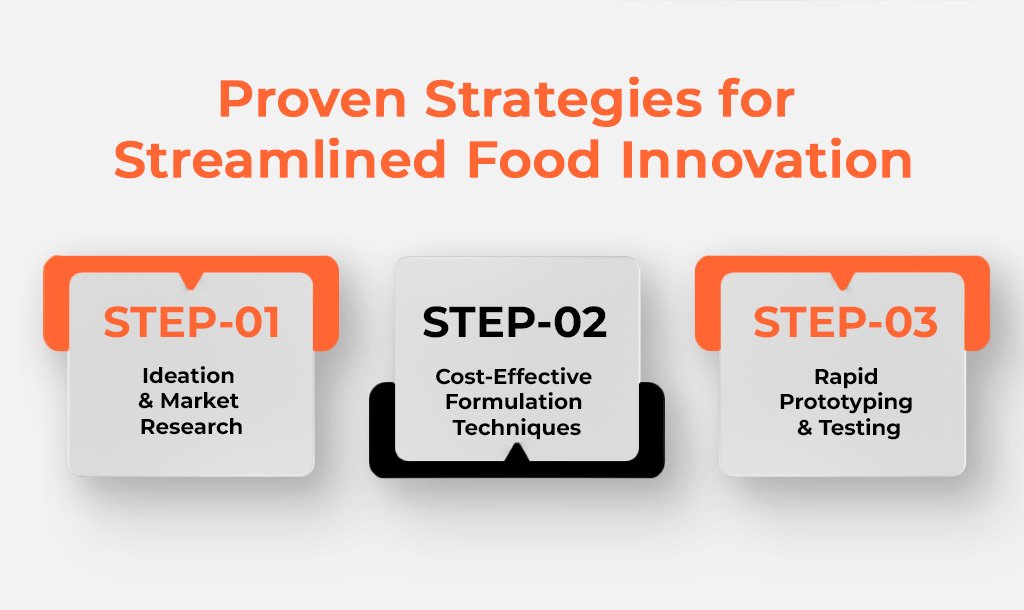
There is no need for food formulation to be a mess that is out of control. To make it easier, let’s consider what practical steps it consists of. The main advantages of those steps are the saving of time and money, the reduction of risk, and faster product launching.
Read More: Food Packaging and Labelling
Step 1: Ideation & Market Research
Before starting product development, it is important to understand your customers.
- Identify who your target buyers are
- Understand their needs, problems, and preferences
- Use surveys, social media insights, and trend reports
- Study competitors and market demand
- Choose ideas based on feasibility, cost, and market potential
Always rely on data, not assumptions. This helps you select the right product direction.
Step 2: Cost-Effective Formulation Techniques
Focus on developing a product that is both quality-driven and budget-friendly.
- Use basic and reliable ingredients
- Conduct trials in small batches
- Explore ingredient alternatives to: Reduce cost, and Maintain taste and texture
- Maintain proper documentation of every change
- Ensure consistency in every test
This approach reduces waste, saves money, and improves efficiency.
Step 3: Rapid Prototyping & Testing
Move quickly from concept to sample development.
- Create small prototypes
- Test for: Taste, Texture, Shelf life, Consumer acceptance
- Collect early feedback
- Improve the formula based on real responses
Early testing reduces risk before large-scale production.
Tools & Resources to Simplify Your Food Innovation Journey
Here is the content in short pointer form with keywords included:
- Not every innovation requires a major change.
- Use food formulation tools and a strong product development strategy.
- Implement recipe management systems to organise formulations.
- Leverage food trend analysis to identify market opportunities.
- Follow a structured R&D process to reduce development time.
- Adopt an efficient innovation process to improve productivity.
- Even small manufacturers can compete with larger brands by working systematically and smartly.
Are you willing to change food innovation?
If you are in food product development that leads to sales that you are really committed to, then knowing the process is half the battle. One expert is the main reason for faster food product development, fewer errors, and products that consumers will relate to. New Food Innovations are still central, but they do not have to always be based on rumours; instead, you can come up with a plan to turn your creativity into marketable products.
Contact Foodsure at +91 8130404757 to access all the information and services you need to make your brand the one choice for India and International.

🚀 Launch with Confidence | Best Food Innovation
Trusted by 500+ D2C Brands
FAQs
Q1. What are the 4 types of innovations?
They have four types of innovations: one is the creation of new products. Another is the improvement of the process. The third one, which deals with the use of a new marketing method. The last is changing the organisational structure of a business.
Q2. Examples of innovative foods are?
Those are the ones that include artificial and plant-based meats, lab-grown meat, edible packaging, and foods with extra health benefits.
Q3. What are the 7 sources of innovation?
The seven sources of innovation are often the seven exceptional things: surprises, problems, needs, industry changes, changes in population, changing perceptions, and knowledge.
Q4. What are the 7 steps innovation process?
Firstly, you recognise opportunity, then generate ideas, develop them into concepts, check them, perfect them, implement them, and lastly evaluate them.
Q5. What is the Gen Z trend in food?
Generation Z is a group of people who, among other features, love sustainable, plant-based, convenient, healthy, and flavour-rich foods.
Q6. What are the three main types of innovation?
They consist of minor enhancements (incremental), major game-changers (disruptive), and totally new ideas (radical).
Q7. What are the food innovation technologies?
Those are 3D food printing, smart packaging, fermentation tech, lab-grown meat, and AI tools for designing food.