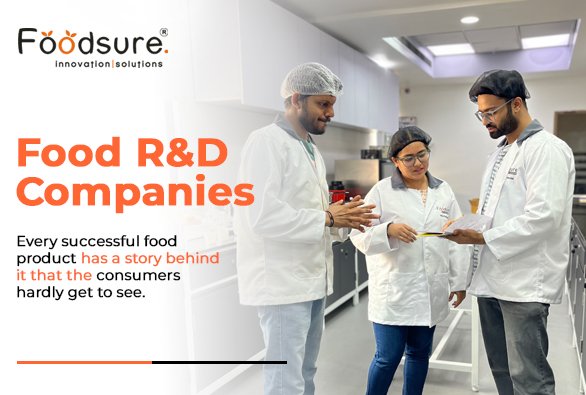
Every successful food product has a story behind it that consumers rarely see. It is often a long journey of refinement, testing, and technical decision-making that can take months or even years before a product finally reaches the shelf. This unseen process is where food R&D companies play their most decisive role by building trust, consistency, and repeat purchases.
Food innovation today is driven by science, regulations, consumer expectations, and business realities. Whether the product is a clean-label snack, a fortified staple, or a functional beverage, precision in food formulation is essential. Food R&D expertise is no longer optional; it is a necessity for brands that want to manage complexity and remain competitive.
As a company deeply involved in product innovation, we view food research and development as the backbone of sustainable food businesses.
Want to optimise your Food Business? Request a free consultation!
Explore Our Exclusive Food Product Development
The Evolving Role of Food R&D in the Modern Market
Over the past decade, the food industry has transformed significantly. Consumers are more informed, regulations are stricter, and competition is intense. Today’s food products must meet nutritional requirements, deliver great taste, ensure safety, and maintain shelf life — all at the same time.
This shift has turned food R&D companies into strategic partners rather than backend support teams. Their role now extends beyond recipe creation. They help brands convert ideas into scalable, repeatable products suitable for real-world manufacturing and distribution.
Modern food R&D answers not only “Can we make this?” but also “Can we make this consistently, safely, and profitably?”
Why Brands Partner with Food R&D Companies
Many brands begin with a promising idea or a home-style prototype. However, scaling such concepts without expert intervention often leads to costly reformulations, production delays, or compromised quality.
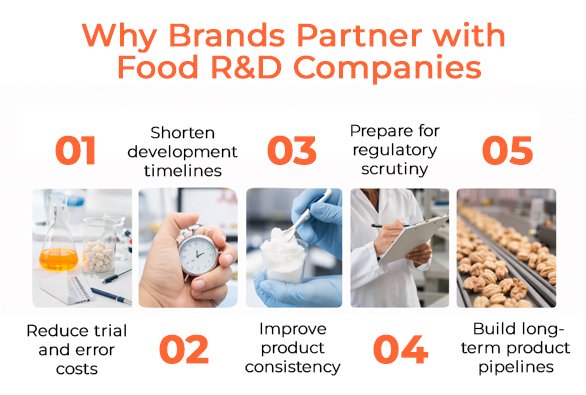
Experienced food R&D partners bring structure and control to innovation. They help brands achieve key objectives such as:
- Reducing trial-and-error costs
- Shortening development timelines
- Improving product consistency
- Preparing for regulatory scrutiny
- Building long-term product pipelines
By collaborating with food R&D companies, brands gain access to scientific expertise, technical infrastructure, and industry insight that is difficult to develop internally.
Formulation: Where Innovation Takes Shape
Formulation lies at the core of product development. A product’s success depends not only on individual ingredients but on how those ingredients interact during processing, storage, and consumption.
Food formulation is a controlled scientific process, not simple mixing. Decisions made at this stage directly influence texture, taste, nutritional value, shelf life, and final product cost.
A skilled formulation expert understands ingredient behavior under heat, pressure, moisture, and time, ensuring performance throughout the product lifecycle.
You May Also Like: Art and Science of Food Formulation
Balancing Creativity with Scientific Discipline
While innovation must excite consumers, it must also be disciplined behind the scenes. Strong R&D teams balance creativity with feasibility testing and process validation.
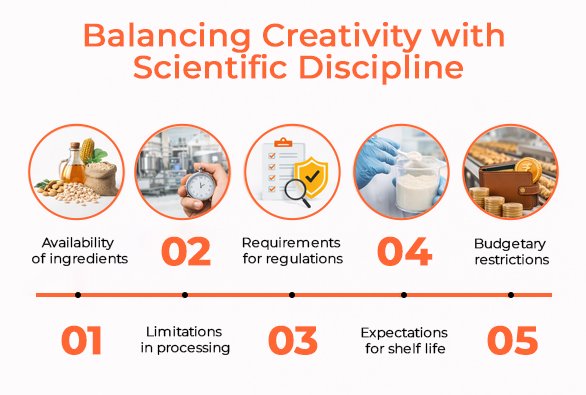
Leading food R&D firms evaluate every concept against:
- Ingredient availability
- Processing limitations
- Regulatory requirements
- Shelf-life expectations
- Budget constraints
This ensures that innovation is not only appealing but also sustainable and scalable.
The Critical Importance of Food Testing
Food testing is often undervalued, yet it is one of the most crucial development stages. Products that perform well in small batches may behave differently over time or at scale.
Testing evaluates stability, safety, texture retention, and flavor consistency under real-world conditions. It protects brands from recalls, complaints, and legal risks.
Structured testing allows brands to move forward with confidence based on evidence rather than assumptions.
Scaling Up Without Losing Quality
Scaling up is where many products fail. What works in pilot batches does not always translate smoothly into large-scale production.
Successful scale-up requires formula adjustments, equipment alignment, and process optimization. Ingredients can behave differently under varied temperatures, shear forces, and processing speeds.
Experienced food R&D companies ensure that safety, flavor, and quality remain intact as production volumes grow. Scale-up readiness is embedded early in development, not treated as a final step.
Research & Development as a Long-Term Strategy
R&D should not be treated as a one-time activity. It is an ongoing investment that allows brands to adapt quickly to market shifts, regulatory changes, and ingredient challenges.
By working with food R&D companies, brands can build innovation pipelines instead of single products, supporting continuous growth and portfolio expansion.
Regulatory Confidence Through R&D Expertise
Regulatory compliance is mandatory in the food industry. Each market and category comes with specific labeling, ingredient, and safety requirements.
R&D expertise ensures compliance is built into products from the earliest stages, preventing last-minute changes, launch delays, and unexpected costs.
Food R&D partners guide brands through testing, validation, and documentation with clarity and confidence.
Why Formulation, Testing, and Scale-Up Must Work Together
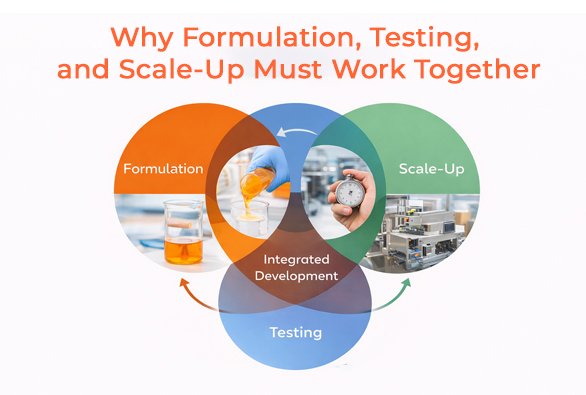
Formulation, testing, and scale-up are interconnected pillars. A great-tasting formulation fails if shelf-life testing is unsuccessful. A stable product is unsustainable if it cannot be scaled profitably.
Strong food R&D firms integrate all three pillars. Testing informs formulation improvements, and scale-up considerations guide early development decisions.
This integrated approach distinguishes commercially successful products from short-lived launches.
Our Perspective as a Food R&D Partner
We believe R&D should be collaborative, not transactional. Ideas are refined, not replaced.
As an extension of our partners’ teams, we contribute technical expertise, market understanding, and real-world execution. Our focus remains on long-term success through formulation, food testing, and scale-up readiness.
We see ourselves as growth partners, not just R&D service providers.
The Future of Food R&D Companies
The future of food belongs to brands that balance innovation with responsibility. Sustainability, safety, transparency, and nutrition will define consumer trust.
Food R&D companies will increasingly shape strategy, risk management, and innovation leadership, not just development. Early investment in strong R&D partnerships allows brands to lead change instead of reacting to it.
Conclusion
Food innovation is driven by thoughtful development rather than speed alone. Food R&D companies remain the key drivers that transform ideas into products meeting commercial, quality, and regulatory standards.
While global corporations use advanced processing and ingredient expertise to innovate at scale, Foodsure focuses on practical formulation, food testing, and scale-up guidance for both emerging and established brands.
By collaborating closely with product teams and manufacturers, Foodsure helps turn validated concepts into market-ready solutions. In an industry where trust is built bite by bite, the right food R&D partnership becomes a lasting competitive advantage.
Need Expert Support from Food R&D Companies?
Foodsure is among the trusted Food R&D Companies supporting food brands with end-to-end research and development solutions.
Our experts help transform product ideas into safe, compliant, and market-ready foods through scientific formulation, testing, and scale-up support.
How Foodsure Supports Food R&D Projects
- Food formulation and ingredient functionality optimisation
- Product testing for safety, stability, and shelf life
- Regulatory and compliance validation (FSSAI-aligned)
- Pilot trials and scale-up support for manufacturing readiness
- Reformulation to improve taste, nutrition, cost, or shelf life
Who Benefits from Our Food R&D Services
- Food startups developing new products
- FMCG and D2C brands launching or upgrading food ranges
- Private label owners and contract manufacturers
- Brands targeting health, functional, and special-diet segments
Talk to Food R&D Experts – Free Consultation
Planning to develop, improve, or scale a food product and looking for reliable Food R&D Companies?
Get expert guidance from formulation to commercial readiness.
Frequently Asked Questions
What do food R&D companies specialise in?
Food R&D companies are specialist research and development units that work on food formulation, product testing, regulatory validation, and scale-up to ensure products are safe, consistent, and market-ready.
Why are food R&D companies important for food brands?
Food R&D companies help brands reduce development risks, avoid expensive reformulations, and ensure products perform reliably during manufacturing, storage, and distribution.
How is food formulation different from a regular recipe?
Food formulation is a scientific process that considers ingredient functionality, processing behaviour, shelf life, cost, and regulatory compliance — not just taste.
What role does a formulation specialist play in product development?
A formulation specialist develops and fine-tunes recipes to ensure stability, scalability, batch-to-batch consistency, and alignment with nutrition and regulatory goals.
Why is food testing necessary before launching a product?
Food testing validates shelf life, safety, texture, and flavour stability, helping brands reduce the risk of recalls, quality failures, or regulatory issues after launch.
Can food R&D companies help scale products for mass production?
Yes. Food R&D companies provide scale-up support to ensure formulations behave consistently when transitioning from pilot trials to full-scale manufacturing.
Are food R&D services only for large food companies?
No. Startups and growing brands often benefit the most, as food R&D companies provide access to expertise and infrastructure without the need to build in-house teams.
How long does a typical food R&D project take?
Timelines vary depending on complexity, but many projects move from concept validation to pilot and scale testing within a few weeks to a few months.
Can existing food products be improved through R&D?
Yes. Food R&D companies support reformulation projects to improve taste, nutrition, shelf life, cost efficiency, and regulatory compliance.
How does a company like Foodsure support food brands?
Foodsure works closely with brands on formulation, food testing, and scale-up, helping bridge the gap between ideas and commercially viable, market-ready products.