Launching a packaged food product in India used to be all about the product’s taste, price, or brand. But we are living in an era where consumers carefully read the labels, retail stores audit your documentation, and online platforms run compliance checks before they even decide to sell your product. Under such circumstances, a food label that is incorrect or non-compliant with the regulations can be a silent barrier to your growth.
Many entrepreneurs confide in the belief that just by having an FSSAI licence, their food label would be approved. The truth is, there is a difference between an FSSAI licence and an FSSAI approved food label. One of them allows you to run a food business. The other one decides whether your product can be legally placed on a store shelf.
This blog explains how to check if a food label is FSSAI approved, what most brands miss during label creation, and how to fix issues before they become costly launch delays.
Why FSSAI Label Compliance Matters More Than Ever
The Indian food market has changed drastically in a very short time.
Today, new customers do not make a decision on taste or price only. They read the ingredients, doubt the claims, compare the nutrition panels and demand transparency. Also, retail chains and e-commerce platforms have increased their store requirements, thus making food labelling compliance with FSSAI a critical factor for brands that are planning to scale.
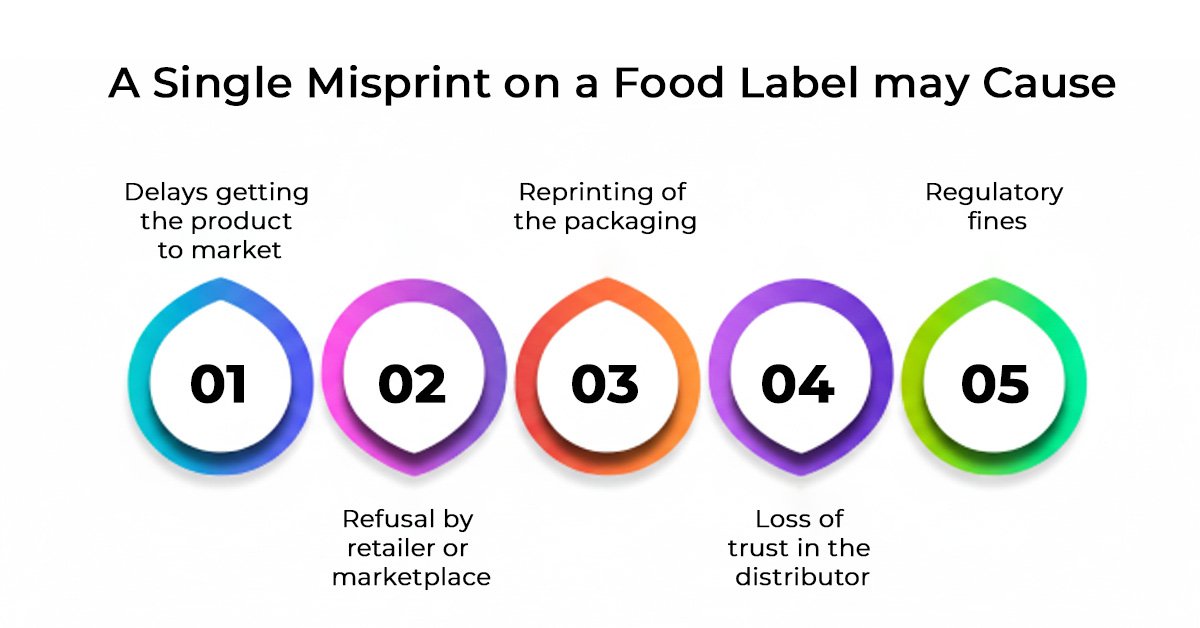
A single misprint on a food label may cause:
- Delays getting the product to market
- Refusal by retailer or marketplace
- Reprinting of the packaging
- Loss of trust in the distributor
- Regulatory fines
Usually, these issues are discovered only after thousands of packs have been printed, after which the correction becomes costly and stressful.
The Common Misconception About “FSSAI Approved” Labels
FSSAI does not provide a certificate that the label is approved. Instead, it lays down detailed packaging and labelling regulations that every packaged food product must comply with. The food business operator, whose food labelling the authority should approve, is therefore required to make sure the label conforms to these standards.
This is the main point at which many founders become confused. A label may be professional, visually attractive, and packed with information, but still fail to meet FSSAI food labelling compliance during audits.
Determining whether an FSSAI-approved food label needs a thorough check, a systematic review, and not a visual judgment is the right approach.
Step-by-Step: How to Check Whether Your Food Label Is FSSAI Compliant
If you’re unsure how to check if a food label is FSSAI-approved, below is a practical framework founders can use to evaluate their food label before launch or scale.
FSSAI Food Label Compliance Checklist
| Step | What to Check | Why It Matters |
|---|---|---|
| 1 | FSSAI Licence Number | Mandatory legal identification |
| 2 | Product Name & Category | Must match FSSAI definitions |
| 3 | Ingredient List Order | Ingredients must be listed in descending order by weight |
| 4 | Allergen Declaration | Mandatory for consumer safety |
| 5 | Nutritional Information Panel | Must follow standardised format and units |
| 6 | Veg / Non-Veg Logo | Legal requirement in India |
| 7 | Net Quantity & Units | Prevents misleading information |
| 8 | Manufacturer / Packer Details | Ensures traceability and accountability |
| 9 | Date Coding & Batch Info | Essential for recalls and quality tracking |
| 10 | Claims & Marketing Text | Prevents misleading or non-compliant communication |
Each of these elements must follow specific FSSAI rules, not assumptions.
Where Most Food Labels Go Wrong
Usually, label problems do not arise from founders ignoring the law. They arise because the labels are conceived before the product formulation, and the compliance alignment is completely locked, e.g., no changes can be made to the formula.
Some of the common mistakes in FSSAI food labels include:
- Ingredients reorder post, scale-up changes
- Nutrition facts copied from the internet
- Claims such as high protein or healthy without meeting the criteria
- Allergen statement left out for commonly used ingredients
- Font size or positioning mistakes that are against the FSSAI rules
The points of the above generally come out in:
- Distributor audits
- Retail onboarding
- Marketplace verification
- Regulatory inspections
Once it’s at that stage, the correction turns into a reaction rather than a plan.
A Real-World Scenario: When Labels Block Growth
A fast-growing snack brand had excellent demand, and distributors were showing a lot of interest in scaling their operations. The product was FSSAI licensed, had nice packaging, and customers gave positive feedback.
However, during retail onboarding, the label was found non-compliant with FSSAI food labelling rules by the food lab because of:
- The nutrition format is wrong
- No allergen declaration
- A claim that did not meet FSSAI criteria
The outcome? Packaging had to be reprinted, the launch was delayed, and momentum was lost.
The product itself was great, but the label was not ready for scale.
Why Label Compliance Is Linked to Food Product Development
Food labels are not separate entities. They are the immediate result of food formulation and product development decisions.
Any change in:
- Ingredient composition
- Processing method
- Serving size
- Shelf life
Results in changes in the requirements to be included on the label.
Therefore, getting an FSSAI, approved food label should be part of the food product development process and not an afterthought done just to tick a box.
What Actually Works for Founders
Founders who don’t encounter label problems simply stick to a clear principle:
Formulation → Compliance → Packaging
They:
- Lock recipes before label design
- Validate nutrition through formulation data
- Review claims against FSSAI thresholds.
- Treat the label as a legal document, not just marketing
This approach helps brands avoid common mistakes in FSSAI food labels and protects long-term credibility.
How Foodsure Supports Label-Ready Product Development (Soft)
At Foodsure, we collaborate with food founders, startups, and FMCG brands to ensure that product formulation, compliance, and labelling are aligned right from the start.
Our mission is usually:
- Looking at recipes from a compliance perspective
- Aligning food formulation with nutrition claims
- Designing labels as per FSSAI norms
- Getting products ready for retail and marketplace audits
It’s that simple: your product must pass FSSAI, approved food label checks just as easily as it passes taste tests.
The Founder’s Takeaway
A food label is not just packaging; it’s a legal promise to the consumer.
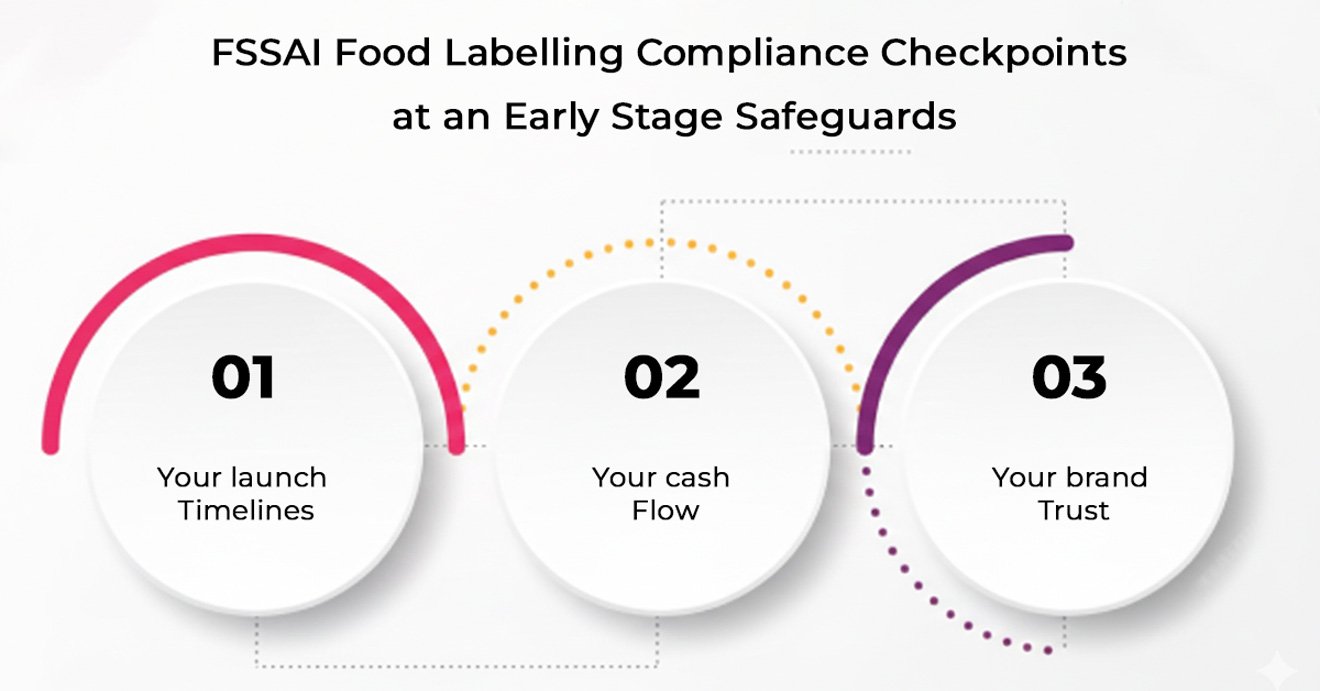
If your label is not FSSAI compliant, your product is always one audit away from disruption, no matter how good it tastes or how strong your branding is. Carrying out FSSAI food labelling compliance checkpoints at an early stage safeguards:
- Your launch timelines
- Your cash flow
- Your brand trust
Strong Brands Start With Compliant Labels, Partner With Foodsure!
Collaborate with Foodsure to confirm that your product has an FSSAI-approved food label and complies with all the regulatory requirements before launch or scale.
We educate brands on how to verify a food label is FSSAI-approved, prevent the most common compliance errors, and grow with confidence. Dial +91 81304 04757 to begin.
Create an FSSAI Approved Food Label Without Approval Delays
Foodsure helps food brands build FSSAI approved food labels that meet regulations, avoid errors, and support smooth approvals — backed by regulatory expertise and labelling science.
Explore Product Development Services
Foodsure helps food brands build FSSAI approved food labels that meet regulations, avoid errors, and support smooth approvals — backed by regulatory expertise and labelling science.
FAQs
How do I check if my food label is FSSAI-approved?
Match your label with FSSAI rules for licence number, ingredients, nutrition, allergens, and claims.
Does an FSSAI licence automatically approve my label?
No, the licence is for the business; the label must comply separately.
What are the most common FSSAI label mistakes?
Wrong ingredient order, unsupported claims, missing allergens, and format errors.
Can my product be rejected due to label issues?
Yes, retailers and marketplaces reject non-compliant labels.
When should FSSAI label compliance be checked?
It should be checked during formulation, not at final packaging.