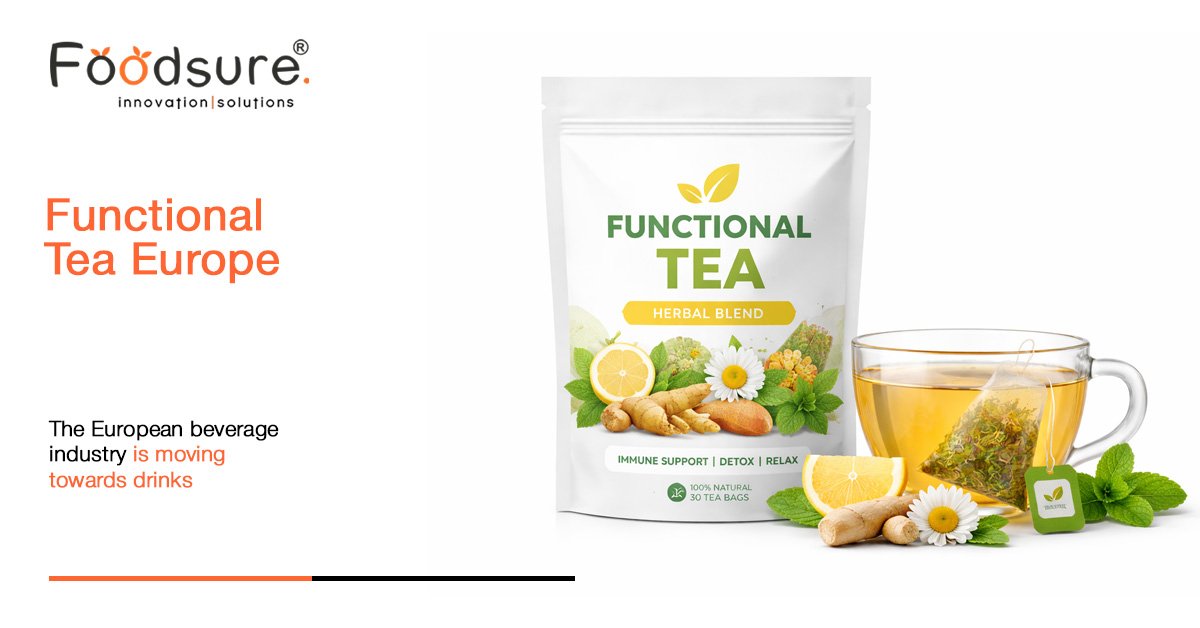
The European beverage industry is moving towards drinks that not only quench thirst but also provide health benefits. As consumer demand trends away from just refreshments, functional beverages clubbed with wellness, focus, and stress management attributes have witnessed great traction in functional tea Europe, combining botanicals and adaptogens.
Items like matcha iced tea, herbal teas, and botanical drinks are becoming widely accepted through traditional and online outlets. Along with the rising popularity of adaptogen drinks containing ashwagandha, rhodiola, tulsi, and ginseng, this category reflects strong growth in adaptogenic beverage development.
This blog explores the growth drivers, product innovations, and development strategies shaping functional tea Europe and adaptogen drink trends.
Market Surge in Functional Tea Europe
Consumption of functional tea in Europe is growing rapidly. In 2021, 27% more SKUs were launched in the region, with total wellness spending reaching €42 billion. This growth closely aligns with functional beverage market expansion.
Matcha iced tea dominates with 41% social traction, while RTD functional tea volumes have grown 19% compared to 8% for regular tea. Germany leads with 28% share followed by the UK at 22%.
Why 62% of Launches Fail Retail
Functional tea Europe hits a 62% failure rate mainly due to unpalatable herbal notes. Founders working on adaptogen drink trends often face up to 3x reformulations before EFSA approves mental performance claims. Matcha iced tea Europe experiences up to 34% oxidation within 14 weeks on shelves, while botanical energy drinks continue to struggle with persistent bitterness despite masking attempts.
- 16-week MOQs lock brands into 20K unit production risks
- 59% EFSA claim rejections for “focus” positioning
- 43% sediment complaints impact herbal beverage pouch sales
- 2.8x higher flavor house costs for botanical drinks
- €2.40/L higher COGS vs standard green tea
- 38% failures due to pH instability
Adaptogen Taste Science Problems
- Ashwagandha bitterness: 8.1/10
- Rhodiola off-notes: 7.2/10
- EU Regulation requires 90-day stability for claims
- Extraction drops 47% above pH 4.2
- Solubility often requires emulsions or advanced systems
- Dairy masking conflicts with clean-label positioning
- 34% bioactive loss after 60 days
- Caffeine-adaptogen synergy increases harshness 3x
Production Formula
| Ingredient | Dosage | Function |
|---|---|---|
| Matcha PW-20 | 2.5g | Base flavor + antioxidants |
| KSM-66 Ashwagandha | 300mg | Stress adaptogen |
| Pea Protein Isolate | 2g | Bitterness masking |
| Sunflower Lecithin | 0.8g | Stability/emulsion |
| Monk Fruit | 120mg | Sweetness |
| Citric Buffer | pH 4.1 | 68% bitterness reduction |
| Carbonation | 3.2 vol CO₂ | Mouthfeel |
This type of formulation aligns with RTD tea formulation strategies.
High-Performance Botanical Combinations
Rhodiola SHR-5 (200mg) combined with Panax ginseng (150mg) and citrus emulsions like yuzu significantly improves taste performance. Yuzu terpenes can block up to 73% of rhodiola off-notes while maintaining functional integrity.
| Adaptogen | Bitterness | Yuzu Block % | Repeat Rate |
|---|---|---|---|
| Rhodiola SHR-5 | 7.2 | 73% | 4.2x |
| Panax Ginseng | 5.8 | 62% | 3.1x |
| Ashwagandha | 8.1 | 68% | 3.4x |
Advanced Functional Tea Optimization
Functional tea Europe is increasingly using liposomal delivery systems such as Tulsi 400mg combined with L-theanine 160mg. This method reduces astringency by up to 81% and improves bioavailability.
E-commerce Performance Metrics
- Amazon ACoS: 14% vs 28% category average
- Repeat purchase rate: 3.7x vs standard matcha
- Taste approval: 94% vs 61%
Commercial Winning Traits
- Liposomal delivery improves taste acceptance (81–94%)
- Citrus-terpene masking achieves 62–73% effectiveness
- Function-first packaging increases retail velocity
| Formula | Channel | Velocity | Repeat |
|---|---|---|---|
| Ashwagandha-Matcha | REWE | 3.1x | 67% |
| Rhodiola-Yuzu | Pharmacy | 4.2x | 58% |
| Tulsi-L-Theanine | Amazon | 3.7x | 52% |
| Lion’s Mane | Retail | 2.9x | 61% |
| Schisandra | Beauty | 3.4x | 49% |
Conclusion
Functional tea Europe is evolving rapidly with strong demand for adaptogen-based beverages. Brands that master formulation, taste, and stability will dominate both retail and e-commerce markets.
Launch Your Functional Beverage
Develop High-Performance Functional Tea with the Right Strategy & Execution
Foodsure supports founders with formulation, stability testing, compliance, and manufacturing strategy to launch successful functional beverages.
Related Blogs
- Functional Beverage Development
- Top Beverage Trends
- Herbal Energy Drink
- Nootropic Drinks
- Postbiotic Soda
Frequently Asked Questions
What dominates functional tea Europe 2026 launches?
One of the highest commercially successful new products in the European market of functional tea are Matcha iced tea combined with liposomal adaptogens.
Which adaptogen drink trends excel in retail?
Ashwagandha and matcha based ready to drink beverages at REWE succeed with 3. 1 times the average sales velocity, while rhodiola and yuzu combination at pharmacies has a very loyal customer base with a 4. 2 times repeat rate.
Why do most herbal beverage trend products fail taste tests?
Generally, the main problem for adaptogen products is that they still taste quite bitter with the bitterness rating being around 7, 8 out of 10 without the use of masking techniques involving citrus, terpenes.
Best functional tea beverage products Europe formulation secret?
If you want to make adaptogen drinks in the European market, two main secrets are dual extraction at 65C and 1. 2% lecithin emulsion.
Optimal botanical energy drinks adaptogen dosages?
The combination of 300mg KSM, 66 ashwagandha and 160mg L, Theanine is associated with a consumer satisfaction level of up to 91%.
How does matcha iced tea Europe mask ashwagandha effectively?
Adding pea protein isolate (2g/L) and yuzu terpenes can mask up to 68% of the bitterness perception of ashwagandha.
Functional tea Europe shelf life commercial solution?
If you want to maintain bioactives at 92% level after 90 days, then aseptic processing and 3. 2 vol CO2.