Starting a food product formulation from scratch and launching it in just 90 days may sound daunting, but with the right strategy, it’s absolutely achievable. Success in food formulation depends on structured planning, market alignment, and expert guidance. That’s where an experienced food technology consultant makes the difference.
Whether you’re building a startup or scaling an existing brand, strong product formulation, precise food recipe formulation, and clear execution can take your idea from concept to commercial launch faster than you think.
This guide walks you through every stage of food product formulation, from ideation to market entry in 90 days. Read on and make your planning sharper, smarter, and market-ready.
Food Formulation Product Market Insights (2025 – 2026)
The Indian and global food markets are expanding rapidly, creating strong opportunities for new brands entering through smart food product formulation strategies.
| Market | Current Value | Growth Projection |
|---|---|---|
| Indian Packaged Food Market (2023) | $2.8 Billion | $6.4 Billion by 2029 |
| Global Health & Wellness Market (2024) | $962.32 Billion | $1.98 Trillion by 2032 |
These numbers show that demand for innovative, health-driven, and convenient food products is only increasing. A strong food formulation approach can help you capture this opportunity.

Why Food Product Development Is Crucial For Startups In India
India’s food sector is becoming more competitive every year. Consumer preferences are shifting toward plant-based foods, low-sugar options, functional ingredients, and clean-label products.
Effective food product formulation ensures:
- High product quality
- Regulatory compliance
- Cost efficiency
- Market relevance
- Scalability for mass production
Without structured product formulation, startups often struggle with consistency, shelf life, or compliance issues.
Your 90-Day Food Product & Brand Launchpad
A structured timeline helps avoid delays and confusion. Below is a simplified roadmap:
| Phase | Timeline | Phase Name | Key Focus | Main Outcome |
|---|---|---|---|---|
| Phase 1 | Days 1–15 | Ideation & Concept Development | Market research, USP definition, consumer insights | Clear product concept & positioning |
| Phase 2 | Days 16–30 | Recipe Formulation & R&D | Ingredient selection, trials, nutrition profiling | Finalised food recipe formulation |
| Phase 3 | Days 31–45 | Testing & Refinement | Sensory testing, shelf-life study, and costing | Optimised and validated product formulation |
| Phase 4 | Days 46–60 | Regulatory Compliance & FSSAI Approval | Licensing, labelling, compliance checks | Legal approvals & compliant food formulation |
| Phase 5 | Days 61–75 | Packaging Design & Branding | Packaging material selection, branding, and design | Market-ready packaging & brand identity |
| Phase 6 | Days 76–85 | Production Planning & Scaling | Manufacturer finalisation, batch scaling, QC systems | Scalable production setup |
| Phase 7 | Days 86–90 | Marketing Strategy & Launch | Go-to-market planning, promotions, and distribution | Commercial product launch |
This structured roadmap ensures your food product formulation moves systematically from idea to market in 90 days with expert guidance from a food technology consultant.
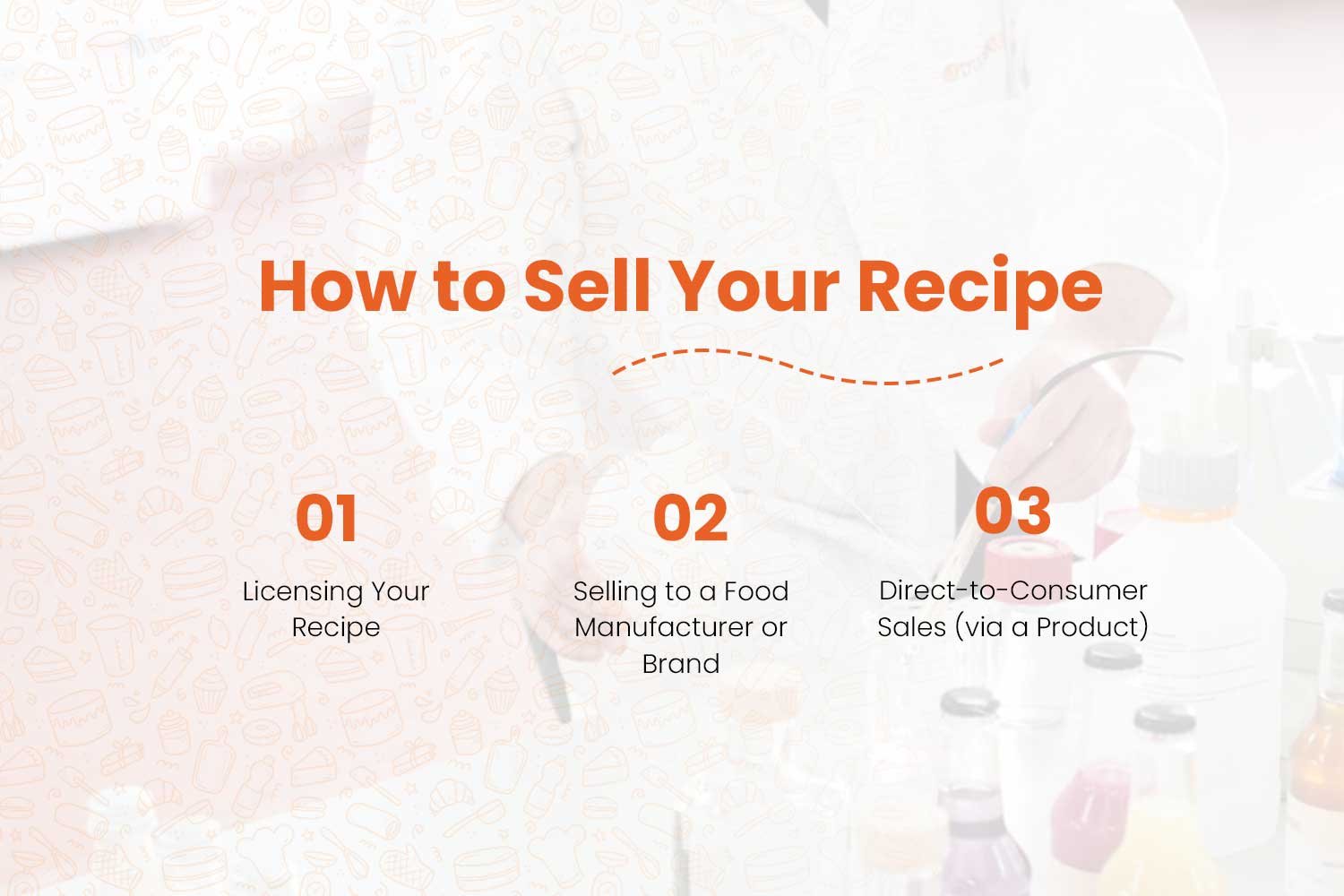
How To Sell Your Food Recipe?
Selling a recipe can be a great business opportunity if done right. Whether you’re a food entrepreneur or a professional developer, monetising your food recipe formulation through smart food product formulation strategies can create strong revenue streams. Here’s how you can approach it:
Licensing Your Recipe
Licensing your food recipe formulation means allowing others to produce and sell your recipe under agreed terms. This lets you retain ownership of the intellectual property while earning royalties from the commercialised food product formulation.
How to License:
- Find potential partners such as food brands, manufacturers, or companies aligned with your food formulation concept.
- Negotiate royalty fees, duration, and exclusivity terms.
- Draft a clear licensing agreement covering IP rights and product formulation usage terms.
Selling to a Food Manufacturer or Brand
Another option is selling your product formulation outright to an established food company. In this case, the brand handles manufacturing, marketing, and distribution of your developed food product formulation.
How to Sell:
- Research brands that could benefit from your food formulation concept.
- Prepare a professional pitch highlighting uniqueness, scalability, and market potential.
- Present your food recipe formulation to multiple companies to increase your chances of closing a deal.
Direct-to-Consumer Sales
If you prefer more control, you can launch your own brand using your developed food product formulation. This approach allows you to manage branding, marketing, and scaling directly.
How to Sell:
- Develop a production and marketing plan with guidance from a food technology consultant if needed.
- Build a website or e-commerce platform.
- Promote your food formulation through digital marketing, influencer collaborations, and social media campaigns.
Case Studies That Speak For Themselves
1. Tata Soulfull – Taking Millets to the Masses
- Challenge: The brand Tata wishes to promote healthy, traditional Indian millets in a modern format that appeals to urban families.
- What Happened: You know what they partnered with a food technology consultant to create millet-based snacks and cereals that are tasty, quick to prepare, and kid-friendly.
- Result: Today, Soulfull is a household name. Their Ragi Bites and Millet Muesli are top sellers in the healthy food aisle.
2. Amul’s Chocolate Range – From Dairy to Delicious Treats
- Challenge: Amul wanted to expand its products beyond dairy into chocolates and compete with global brands.
- What Happened: With the help of advanced food manufacturing technology and recipe development, they created a wide range of chocolates, from milk to dark, and even protein bars.
- Result: Amul chocolates are now a major player in the Indian chocolate market, with growing export demand.
Your Food Innovation Journey Starts Here With Foodsure!
Food product formulation is a mixture of art and science. For a successful brand launch, you need an expert food technology consultant who can guide you and lead your brand towards success.
Contact the best food formulation consultant, and get a free consultation today!