
Most food startups begin with a powerful idea and a strong belief:
“I already have a great recipe. I just need to produce it.”
This assumption has quietly drained the budgets of many promising food startups. In reality, developing a successful product involves far more than a recipe. The journey includes research, formulation, testing, compliance, packaging, and manufacturing preparation.
Want to optimise your Food Business? Request a free consultation!
Explore Our Exclusive Food Product Development
Understanding the real food product development cost in India is essential for any founder entering the food industry. Without proper planning, the process eventually teaches the same lesson, but often through expensive trial and error.
Through this blog, we break down the actual cost components of product development, where most expenses come from, and why budgeting properly is just as important as perfecting the taste.
Breaking Down Product Development Expenses
Food product development is not a single event; it is a multi-stage process that transforms an idea into a commercially viable product.
The development journey typically includes:
- Product research and ideation
- Ingredient trials and formulation
- Packaging selection
- Shelf-life testing
- Regulatory approvals
- Manufacturing preparation
Each stage contributes to the product’s value but also adds to the overall cost. Skipping or rushing these steps often results in reformulation, production delays, or failure during commercial manufacturing.
Think of product development like building a foundation. Customers may never see it, but everything depends on it.
How Much to Budget for Developing a Food Product in India?
The costs are not uniform and depend on the category and complexity, but the following is a fairly practical food and beverage development start-up point in India:
- General food formulation: ₹1.5 lakh – ₹2.5 lakh
- Functional or fortified products: ₹3 lakh – ₹5 lakh
- Innovative or claim-based products: ₹7 lakh – ₹10 lakh+
These estimates cover formulation and initial R&D only. When founders ask how much research costs in India, they are often surprised to learn that formulation is just one part of the development journey.
Other critical stages, such as packaging validation, shelf-life testing, and pilot manufacturing, can significantly influence the final cost.
Why Does Food Product Development Cost More Than Expected?
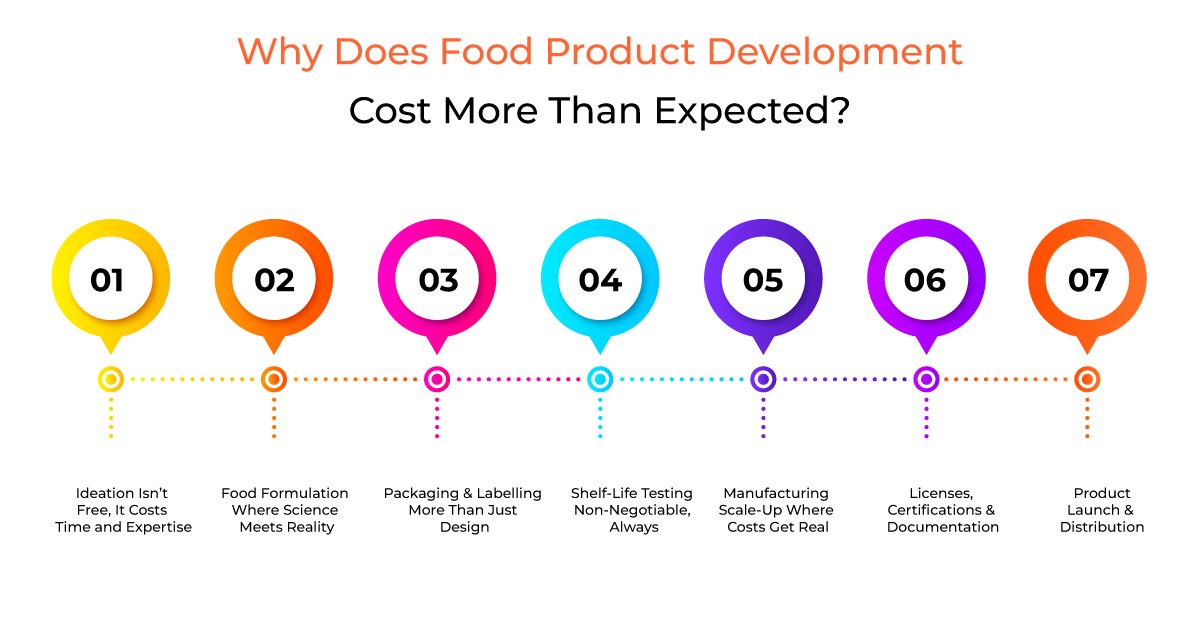
1. Ideation Isn’t Free, It Costs Time and Expertise
Many founders assume ideation is free. In reality, it requires research, market understanding, and regulatory checks.
This stage typically involves:
- Market trend analysis
- Competitor product evaluation
- Regulatory feasibility
- Ingredient sourcing research
The cost of early strategic guidance can range between ₹50,000 and ₹2,00,000. However, this investment often prevents costly mistakes later in development.
2. Food Formulation: Where Science Meets Reality
Food formulation is not simply mixing ingredients. It involves designing a stable product that performs consistently under real-world conditions.
The process includes:
- Ingredient functionality testing
- Multiple laboratory trials
- Sensory evaluation
- Nutritional validation
Most products require three to five formulation iterations before reaching a stable version. This stage represents a significant portion of the total development cost.
Brands launching niche products, such as those following a dehydrated business plan, often require additional testing to ensure proper moisture stability and shelf-life performance.
3. Packaging & Labelling: More Than Just Design
Packaging, undeniably, is a key element in the preservation of a product, its safety, and adherence to regulations. Besides being attractive, it has to safeguard the item and fulfil the legal obligations.
- Choosing the right kind of packaging material
- Organic and inorganic stability testing and compatibility
- Regulatory labelling and validation
- Barcode and compliance checks
The overall packaging-related development cost can range from ₹50,000 to ₹3,00,00,0 depending upon the extent of assistance needed.
4. Shelf-Life Testing: Non-Negotiable, Always
Shelf-life testing is one of the costs that are least recognised but most significant. Nevertheless, it is indispensable to both retail and consumer acceptance.
- Microbiology testing
- Accelerated and real-time studies
- Simulations of storage conditions
Skipping this step is impossible. It can range from ₹40,000 to ₹1,50,000 added to your overall cost of food product development in India, depending on the type of product.
5. Manufacturing Scale-Up: Where Costs Get Real
It is a common belief that a laboratory-tested recipe will yield the same results when implemented in a factory. However, the real situation is the opposite, as production size requires different tests of pilot runs, compatibility of equipment, and even a change of formulations.
- Pilot batch trials
- Tests for sourcing bulk ingredients
- Process optimization
This is the phase where food product development takes a step closer to reality and where bad planning can rapidly increase costs.
6. Licenses, Certifications & Documentation
Regulatory compliance is another necessary cost in the development process.
In India, food products must comply with FSSAI regulations, and certain product categories may require additional documentation.
Typical regulatory expenses include:
- FSSAI registration or licensing
- Nutritional testing and analysis
- Allergen documentation
- Claim validation
These steps usually add ₹25,000 to ₹1,50,000+ to development costs.
7. Product Launch & Distribution
The development process does not finish once the product is prepared. Marketing, sampling, platform onboarding, and distribution setup are some of the important steps in launching.
The budgets allocated for launches are quite different and can range anywhere from ₹1,00,000 for minor D2C launches to ₹10,00,000 or even more for large-scale rollouts. Though this is not a part of formulation, it still accounts for a significant portion of the real cost of food product development in India.
Hidden Costs Many Founders Overlook
Several expenses appear only after development begins.
Common hidden costs include:
- Reformulation cycles
- Ingredient minimum order quantities
- Re-testing after recipe modifications
- Production delays and logistics adjustments
These factors often cause the actual cost of food product development to exceed initial expectations.
What Influences Cost Variation Between Products?

- Functional or speciality ingredients
- Health or nutrition claims
- Export readiness
- Complex processing methods
- Longer shelf-life requirements
The more intricate the claims are, the more the investment in food product development to support the claims will be.
Why Investing in Prototyping Pays Off Big Time
Prototyping allows founders to validate their product concept before committing to full-scale production.
Benefits of prototyping include:
- Early identification of formulation issues
- Market testing opportunities
- Reduced risk during commercial launch
Although prototyping increases initial R&D expenses, it often prevents far more expensive mistakes later.
This is why experienced food product development services focus heavily on structured prototyping and testing.
India vs World-wide Development Costs
India remains one of the most cost-effective environments for food innovation. A product that might cost ₹2–4 lakh to develop in India could easily require $15,000 or more in the US or Europe.
However, costs within India can still vary depending on:
- Laboratory infrastructure
- Ingredient sourcing
- Manufacturing capabilities
- Regulatory complexity
Proper planning is therefore more important than location alone.
Conclusion
A successful product launch begins long before the product reaches store shelves.
Understanding the true cost of product development in India helps founders plan realistically, allocate budgets effectively, and avoid expensive surprises later. With proper planning, research, and structured formulation, development becomes a strategic investment rather than an unpredictable expense.
Launch Your Food Product with Zero Compliance Hassles – Get Expert Help Today!
(4.9 Rating)
Frequently Asked Questions
The average product development cost in India?
In India, the costs usually lie between ₹1.5 lakhs and ₹10-15 lakhs, depending on the product complexity and claims made on the product.
Why is product development more expensive than expected?
This is because it entails not merely the recipe but also Research and Development, food formulation, lab trials, shelf-life testing, packaging, licenses, and scale-up.
What elements contribute to the product development cost in India?
More money needs to be spent on the development costs, with the inclusion of functional ingredients, special health claims, longer shelf life, export requirements, and multiple formulation trials.
Does food formulation have the highest costs in product development?
Yes, Food formulation takes the biggest share as multiple lab trials, ingredient testing, and compliance validation are mandatory requirements.
Can there be reductions in the cost of product development?
The costs actually can be minimised with appropriate planning, early checking on feasibility, and a well-strategised Research & Development. Now, skipping one or more steps leads to an increment in cost.
Should I conduct shelf-life testing for my food product?
Certainly. Shelf-life testing is a prerequisite for food safety, regulatory compliance, and retail acceptance.
How many formulation trials are needed typically in food processing?
A majority of the products need three to five trials for formulation to get the desired flavour, texture, shelf life of the product, and compliance with the laws.
Is the cost of product development containing the licenses?
In addition to licensing and certifications like FSSAI, there are extra costs that depend on the product type and market, and they vary.
What makes scale-up a reason for the increase in the development cost?
Scaling up involves pilot production, technology compatibility testing, and reformulation, which in turn lead to increased development costs in a painstaking process.
Is it costlier to make a food product in India than abroad?
Yes, producing a food product in India is not only much cheaper than in the US or Europe but also of the same quality standards.