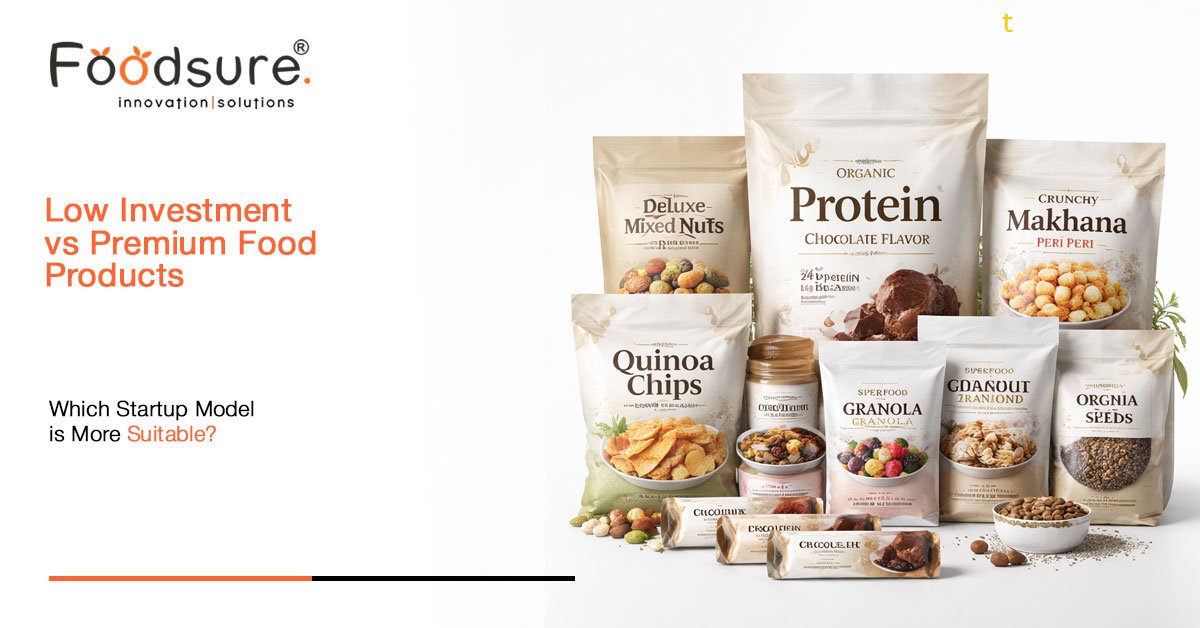
The question that every food entrepreneur faces is, do I start fast and lean, or do I start with a premium brand from day one? The debate between Low Investment vs Premium Food Products is one of the most important decisions that will determine the future of your food startup. The food startup market in India is booming. However, for many entrepreneurs, the question of whether to go for a low investment food startup India or a premium food startup is still a topic of debate. Here is a detailed analysis of the debate between the Low Investment vs Premium Food Products business model for your food startup.
What Is the Core Difference in Low Investment vs Premium Food Products?
Before venturing into any kind of business, it is essential to understand the fundamental difference between the two. Low Investment vs. Premium Food Products are not merely a play of price points. Rather, it’s an entirely different mindset when it comes to building brands, developing products, and targeting customers.
While developing low-cost food products, the focus is on time to market, number of SKUs, and price points. The premium food brand launch cost is approximately between ₹25-40 lakhs, while early-stage startups can be started at an initial investment of merely ₹5-10 lakhs.
Comparison: Low Investment vs. Premium Food Products for Startup Founders
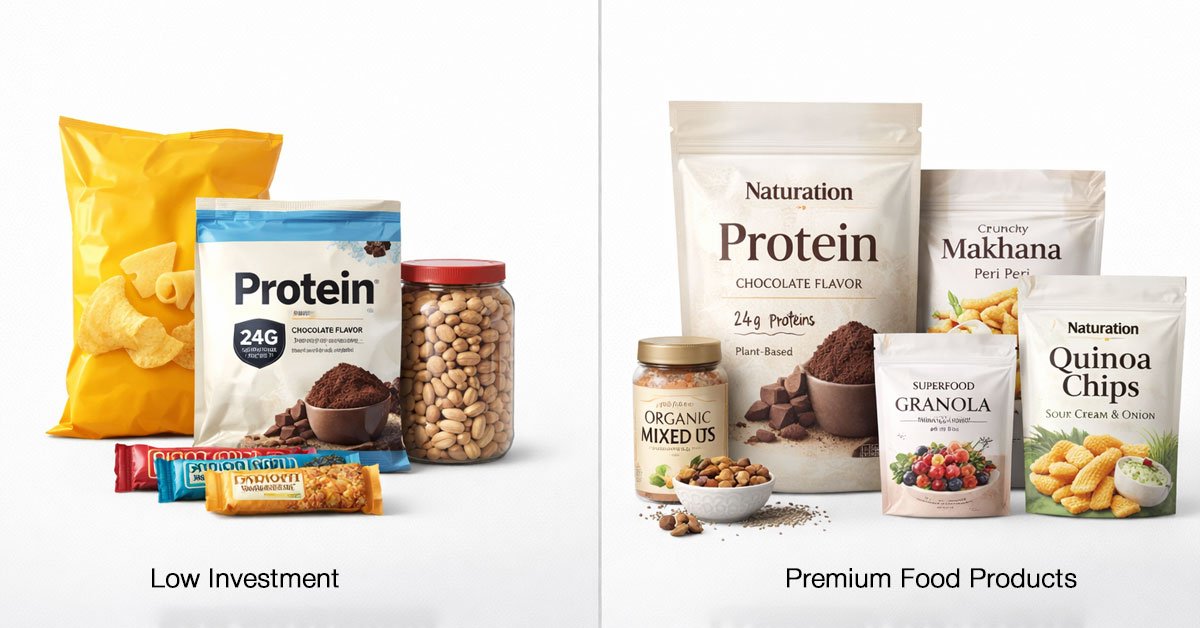
The selection process requires an objective comparison to have a clear opinion.
| Feature | Low Investment | Premium Model |
| Launch Budget | ₹5–10 Lakhs | ₹25–40 Lakhs |
| Time to Market | 8–12 Weeks | 20–30 Weeks |
| Target Audience | Mass Market | Niche Buyers |
| Margin Structure | Thin Margins | High Margins |
Market Trends in Low Investment vs Premium Food Products
The Indian food market is witnessing a paradigm shift. Each model enjoys its own set of market drivers. However, the low investment model in food startups in India is witnessing explosive growth, while premium food products are dominating urban India.
- Healthy and clean label foods are in high demand
- Tier 2 cities are driving low-cost food product innovation
- D2C is helping premium food product launches reach more customers
- Private label food brands are changing traditional retail
- Premium brand loyalty is driven by sustainable practices
- Quick commerce is accelerating lean startup growth
The global functional foods market is estimated to grow to USD 309.8 billion by 2030. Indian food startups are in an excellent position to leverage this growth opportunity.
Core Components of Low Investment Model vs. Premium Food Products
The components of each model extend far beyond the culinary space. Both approaches require a completely different stack in terms of operation, sourcing, and branding.
| Component | Low Investment | Premium Model |
| Raw Materials | Standard Grade | Specialty Sourced |
| Packaging Design | Minimal Budget | Premium Finish |
| Certifications | Basic FSSAI | USDA, Organic, Specialised |
| Distribution | Local Retail | D2C + Modern Trade |
The Real Problem With Choosing the Wrong Model
Many founders are failing not because they have a bad product, but because they chose the wrong model for their resources and market conditions.
- Low investment brands are underpriced
- Premium brands drain cash before they achieve traction
- Misaligned model positioning confuses target customers
- Poor packaging kills premium perception in an instant
The wrong model choice is one of the top reasons why food startups are failing in their first few months.
Development Stages of Low Investment vs Premium Food Products
While the actual process of developing each of these models will vary, there are fundamental differences between the two. This will help entrepreneurs better understand the process, which will aid them in planning the time required for each phase, as well as the cost involved.
| Stage | Low Investment | Premium Model |
| Phase One | Recipe Testing | Concept Development |
| Phase Two | Cost Optimization | Ingredient Sourcing |
| Phase Three | Pilot Batch | Brand Identity |
| Phase Four | Local Distribution | Retail Negotiation |
The Right Process for Choosing Your Food Startup Business Model
The right process for decision-making will help entrepreneurs avoid emotional decision-making. The food brand ROI comparison should take into account not just the initial investment but also the lifetime value of customers, the number of categories to compete in, and access to distribution channels.
- Start with auditing your capital situation honestly
- Determine whether your product caters to mass markets or a niche market
- Determine your distribution readiness before selecting your business model
- Determine your competitor pricing strategy for your category
- Determine how price-sensitive your customers will be through a small-scale pilot group
- Determine your break-even point for your business model options
At Foodsure, we have seen that entrepreneurs who compare business models before launch avoid the most costly errors in the earliest days of their business.
Clean Label Thinking in Low Investment vs Premium Food Products
The clean label movement is changing the face of both the low-investment space and the premium space. Whether you’re developing a low-investment brand or a premium brand, clean labels are not a luxury; they’re a necessity.
- Eliminate artificial preservatives from the base recipe
- Eliminate synthetic flavours from the base recipe
- Use recognisable, simple ingredient statements
- Use non-GMO ingredients when possible
- Emphasise natural certifications on packaging
Premium brands that ignore the clean label trend become irrelevant, whereas low-cost food product development brands that take clean labels seriously can compete well beyond their means.
Manufacturing Realities for Low Investment vs. Premium Food Products
The decisions that go into manufacturing determine the cost profile of your entire brand. Early-stage startups outsource to third-party co-packers to minimise capital outlay, while premium brands invest in proprietary manufacturing to maintain control over quality and differentiation. Low Investment vs. Premium Food Products have different manufacturing realities. Premium formats involve managed sourcing, sophisticated quality control, and may even involve cold chain logistics. Early-stage startups focus on shelf-stable products with fewer manufacturing steps and lower variability in raw material costs.
At Foodsure, we assist brands at both ends of the spectrum to create manufacturing strategies that are scalable, compliant, and cost-effective from day one.
Conclusion: Which Model Actually Wins in the Long Run?
In conclusion, there is no one-size-fits-all answer to the Low Investment model vs. Premium Food Products debate. The correct model entirely depends on your financial position, category ambition, distribution access, and consumer insight. What matters most is alignment between your financials, your brand promise, and your buyer’s expectations.
At Foodsure, we help founders across both approaches build food products that are launch-ready, scalable, and strategically solid from the very first batch. Are you ready to find the right model for your food startup? Contact Foodsure to build your launch strategy now!
You May Also Like: 22 New & Proven Food Business Ideas
FAQs
What is the minimum budget for a low investment food startup India?
The minimum budget for most lean food startups in India is between 5-10 lakhs for product development and compliance.
What is the typical premium food brand launch cost in India?
The launch cost for most premium food brand launches in India is between 25-40 lakhs.
Which model provides better food brand ROI comparison results?
While premium brands provide higher profit margins in the long term, low investment options provide better cash flow in the short term.
Is low cost food product development viable for D2C food brands?
Yes, many successful D2C food brands started lean and grew to scale after validating their audience.
How long does a food startup business model decision take to validate?
Most entrepreneurs can validate their business model decision within 3-6 months of launch.
Can a low investment food startup India compete with premium food brands?
Yes, through community development, clean label marketing, and other differentiation strategies for food categories.
When should a lean startup look to scale to a premium model?
When their gross profit margins are consistent, they have loyal customers to market to, and their distribution is wide enough to accommodate a premium price point.