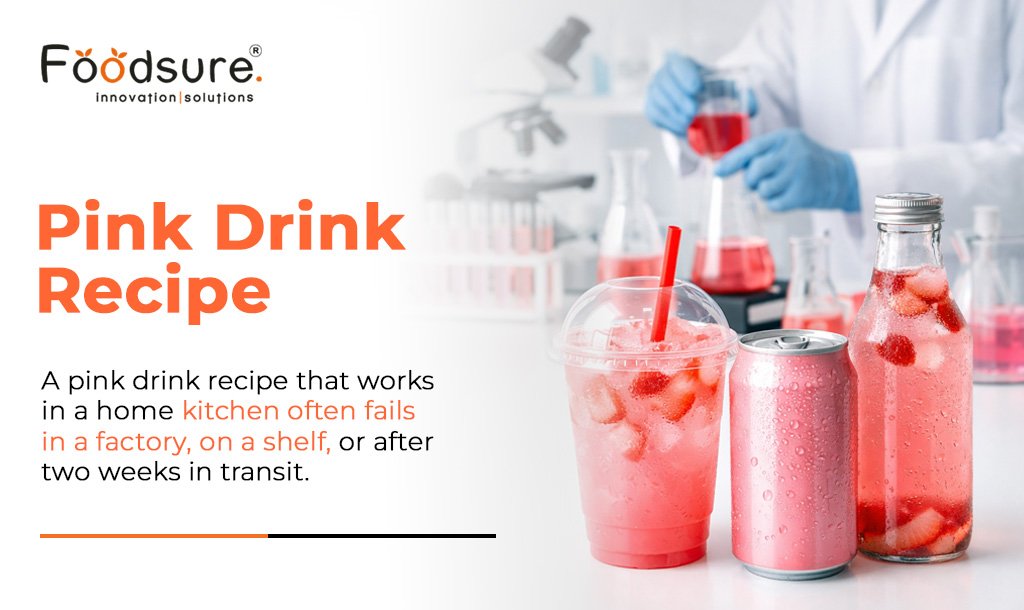
Scroll through Instagram, and you’ll see it everywhere. Tall glasses glowing pink. Perfect foam. Clean labels. But here’s the thing most people don’t talk about: many viral pink drinks collapse the moment someone tries to produce them at scale. A pink drink recipe that works in a home kitchen often fails in a factory, on a shelf, or after two weeks in transit. And no, it’s not just beetroot or strawberry doing the magic. The real difference lies in formulation choices most brands never mention.
If you’re serious about building a pink drink that actually sells, this is where clarity begins.
Why Most Pink Drink Recipes Fail in the Market
The majority of the pink drinks that are sold commercially do not fail due to marketing. The failure is due to the inability of the product to sustain itself as soon as the conditions of the real world strike. Let’s break it down.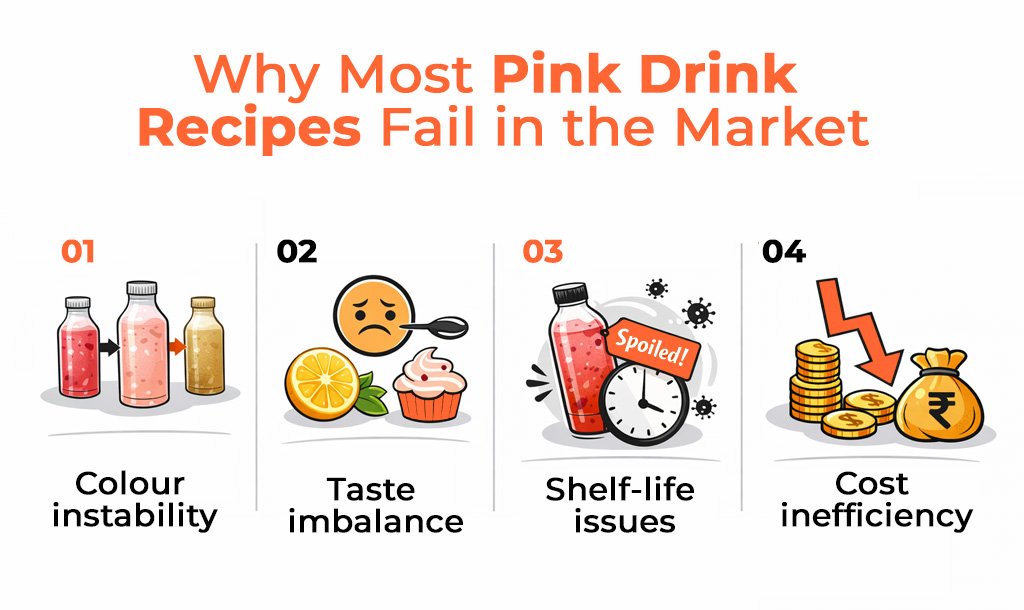
- Colour instability: That pretty pink is usually dulled or browned or evened out by light or heat, or a change of pH. Natural colours are fragile, and unless controlled, they fade at a rapid rate.
- Taste imbalance: A lot of recipes are too sweet to be able to cover up the bitterness or acidity. The first sip feels fine. The second feels heavy.
- Shelf-life issues: Something fresh on day one may be flat, sour, or metallic in three weeks. Oxidation and microbial growth are not concerned with aesthetics.
- Cost inefficiency: Certain pink drink recipes in the commercial world are based on the ingredients that appear on paper but burst when scaled.
This is not a difficult thing. A beverage that looks good on camera is not necessarily designed with distribution, storage, and repurchase.
The Hidden Formula Brands Don’t Talk About
Most of the successful pink drink is not constructed with a hero ingredient. They’re built around systems like colour systems, flavour systems, stability systems and colour Engineering (Not Just Ingredients).
Natural pink is fragile. Enduring brands do not decorate colour as a variable.
- Natural colour sources: Beetroot, hibiscus, dragon fruit, and radish do not act in the same way. Some fade in light, whereas some avoid heat and acidity. The selection of the source is determined by the environment of the drink and not trends.
- pH control: The pink pigments are very sensitive to pH. A change in tone can be produced by a transition between 3.2 and 3.8. Intelligent formulations pre-lock pH and create flavour around it.
- Heat stability: Colour destruction can happen during pasteurisation unless it has been planned. That is the reason why most of the clean pink drinks appear washed out after the process.
Colour isn’t added at the end. It is developed with design in mind.
Flavour Layering That Sells
Great pink drinks don’t taste pink. They taste intentional.
- Base plus top notes: A solid base, such as coconut water, tea, or juice, gives body. Light top notes, such as berry, citrus peel, or floral extracts, give lift.
- Sweetness calibration: Sugar isn’t just for sweetness. It affects mouthfeel, bitterness, and aroma release. The right level feels balanced, not sugary.
Here’s the quiet truth. People don’t remember colour. They remember how the drink made them feel after finishing it.
From Instagram to Industrial Scale
This is where the majority of recipes fail.
The scaling of a pink drink is not doing multiplication. It is the control of variables that has now become important.
- Scaling challenges: There is a different behaviour of ingredients in 1,000-litre tanks. Outcomes are changed by extraction force, mixing time, and temperature gradients.
- Batch consistency: What appears to be the perfect pink in batch one may appear pale in batch three without sourcing or processing being standardised.
- Compliance and labelling: Claims, flavours and natural colours should be within regulations. What you refer to as strawberry or natural pink may be a legal issue.
This actually implies that formulation and operations should converse with one another. Otherwise, they are losing the product.
How Growing Brands Perfects Their Pink Drink Recipe
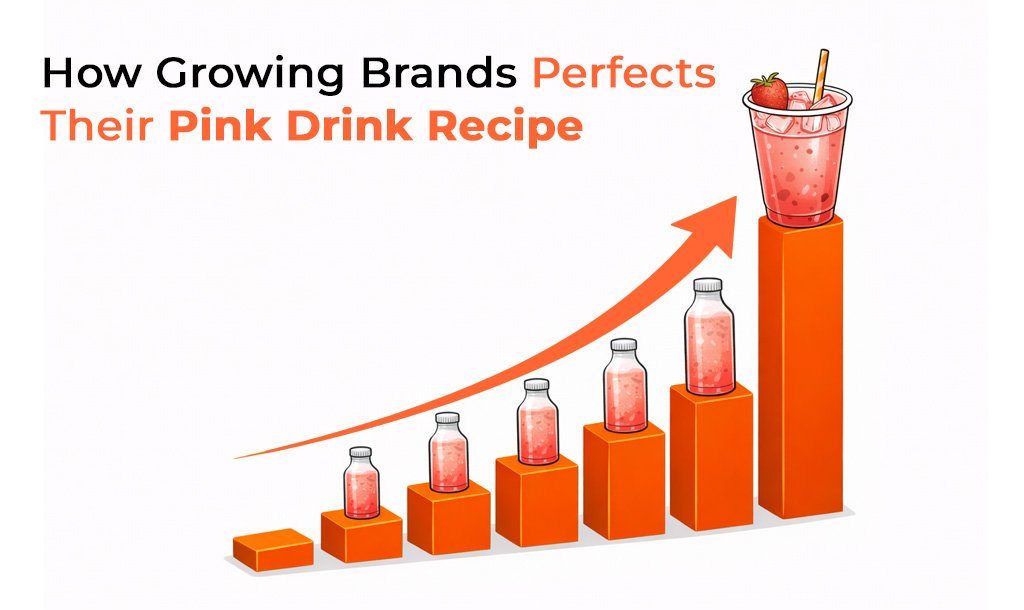
Successful brands tend to follow a similar pattern, despite their beverages appearing different.
They begin with an appearance aim but do not pursue it naively. Before launch, colour is tested under light and heat, where they optimise sweetness on a repeat basis, as opposed to first-sipping responses. They develop shelf life rather than repairing it after the fact.
It does not simply give a prettier beverage. It has fewer returns, longer shelf life, and repeat business, people who return due to the similarity of the taste of the drink each time they purchase it.
No hype. No shortcuts. Right decisions at the right time.
Strategy is more important than appearance in case you are making a pink beverage that you want to have outlive social media.
Want to Create a Stable, Market-Ready Pink Drink?
Connect with Foodsure’s beverage formulation experts to develop pink drinks that are visually appealing, shelf-stable, and scalable for commercial production.