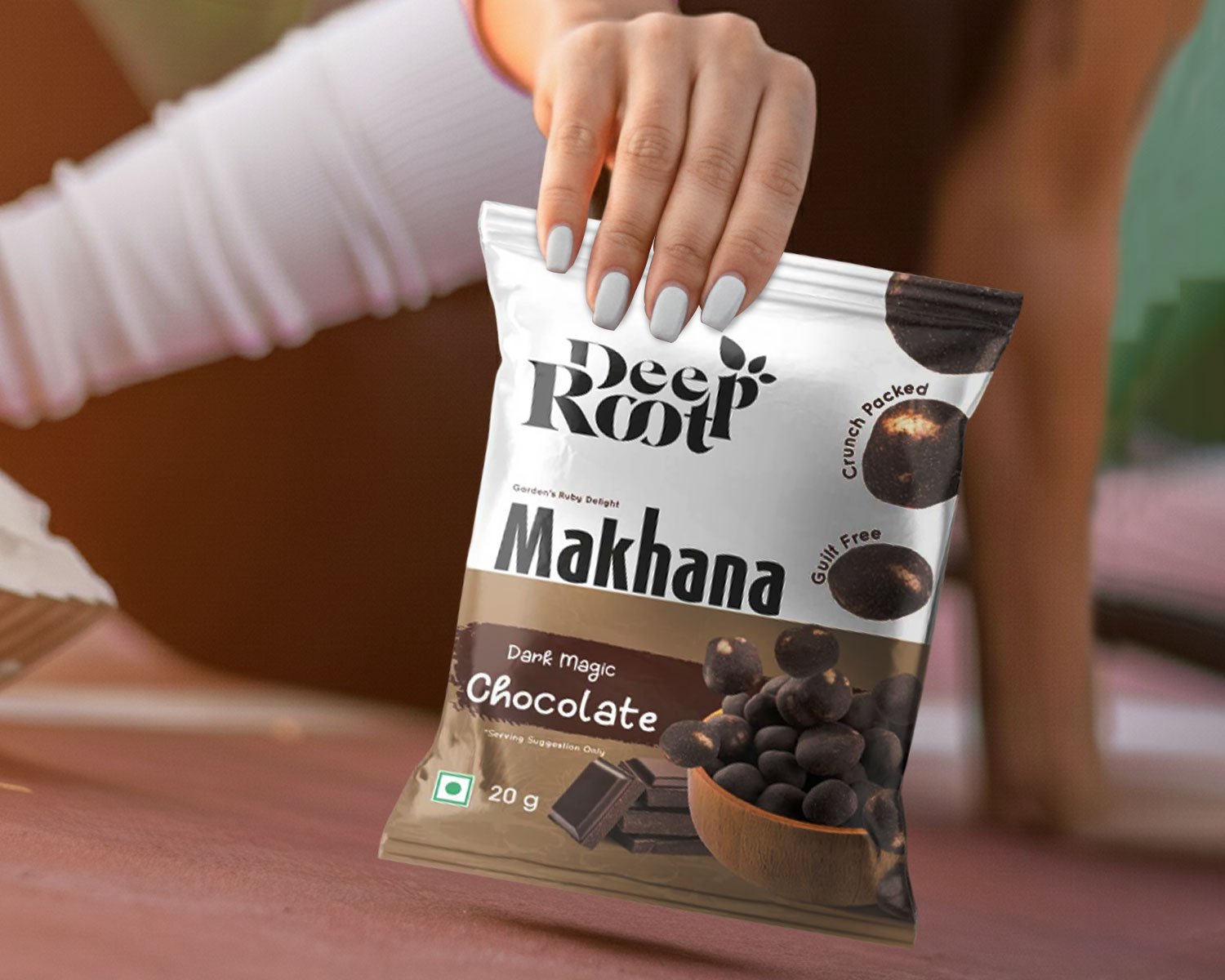
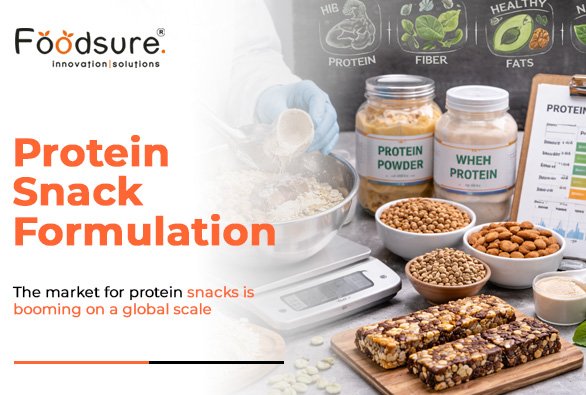
The market for protein snacks is booming on a global scale. A trend that was once mainly gym, goer, centric is now massively impacting the entire food industry. Working professionals and parents looking for better nutrition for their children have also jumped on the bandwagon. Protein has become a daily dietary expectation rather than a niche supplement. Surprisingly, despite such a massive demand, in many instances, protein snack products ‘go’ from the shelves within a few months of their launch. The term ‘marketing’ is hardly ever the main reason behind the problem. Most protein snacks fail due to the lack of scientific discipline in their initial Protein Snack Formulation. Taste issues, texture problems, shelf life instability, and rising production costs are the issues that eventually catch up with brands, thus forcing them into costly reformulations or quiet exits. The difference between a protein snack that fails in trials and one that succeeds on the market is scientific formulation.
Want to optimise your Food Business? Request a free consultation!
Food Product Development Services – Click Here
The Core Reasons Protein Snacks Fail
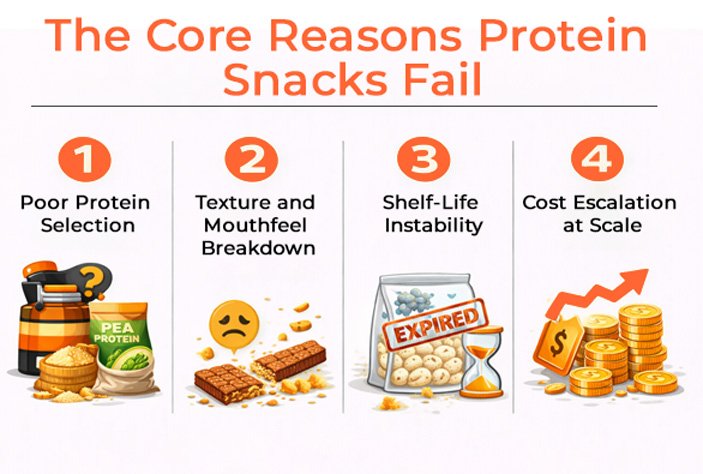
Poor Protein Selection
Protein snack formulation shouldn’t be seen as a single entity. It is a complex and different one that behaves differently depending on their origin, the method of processing, and what they are mixed with. The fact that proteins change their behaviour when heated, moistened, or mechanically stressed is not understood by most of the brands. Whey proteins are capable of denaturing during baking or extrusion. Plant proteins can bring in bitterness, grittiness, or colour changes. If one does not check for functionality at the very beginning, such problems will appear only after scale up.
Texture and Mouthfeel Breakdown
It may be that consumers accept functional foods, however, they will not forgive bad eating experiences. Some of the most common complaints arising from protein snacks that have failed are dryness, excessive hardness, chew resistance, or chalky residues. In most cases, textural failures are the consequence of unbalanced moisture systems, wrong fat distribution, or inappropriate protein particle size. The consumer’s repeat purchase of the product goes down drastically if the product hardens during storage.
Shelf-Life Instability
Many protein snack formulation might appear stable during short pilot runs but are unable to hold up during real, world storage. In most cases, moisture migration, fat oxidation, protein cross, linking, and flavour fade become visible only after 30-60 days. When shelf life has not been confirmed at different temperatures and humidity levels, the brands are still exposed to the risk of product returns, quality complaints, and loss of trust from distributors.
Cost Escalation at Scale
A protein snack formulation that performs well in a lab setting may not necessarily yield a good profit when ingredient prices fluctuate or batch sizes increase. In many cases, engineering with costly proteins or stabilisers results in long term pricing that is not viable. Consequently, this leads to brands being pushed into reactive reformulation, thereby causing inconsistency and loss of trust in the market.
You May Also Like: Art and Science of Food Formulation
How Scientific Formulation Solves These Problems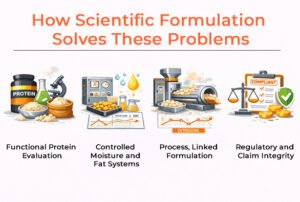
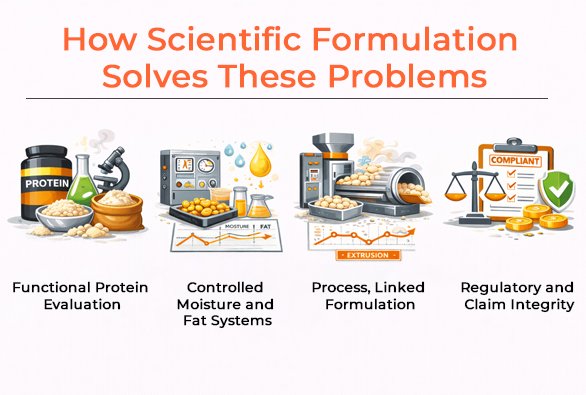
Functional Protein Evaluation
A protein snack formulation begins with a thorough understanding of the protein that is used. The focus is not only on the nutritional value, but also on how the protein behaves through processing. Proteins are sampled for hydration rate, thermal stability, binding capacity, and interaction with fats and carbohydrates. Blending of multiple proteins is a common technique to balance nutrition, texture, and cost while at the same time reducing bitterness or grittiness.
Controlled Moisture and Fat Systems
Water management is at the heart of protein snacks. Scientific formulation sets exact water activity targets, fat distribution ratios, and humectant systems used to keep the product soft without shortening the shelf life.Such systems go through a real validation process via accelerated stability testing rather than relying on mere assumptions.
Process, Linked Formulation
A protein snack formulation scientifically formulated takes into account the actual production method as its core. The formulation decisions are influenced by all these factors: mixing time, shear force, extrusion temperature, baking profile, and cooling rate. The products behave consistently from pilot batches to full, scale production thanks to this cooperation.
Regulatory and Claim Integrity
Protein claims have to be valid and conformant all along shelf life. Scientific formulation guarantees that the protein levels declared, clean, label requirements, and allergen controls are still there after the product has been processed and stored. This helps brands to stay away from regulatory and future relabelling costs.
Why Brands That Invest in Formulation Win Long-Term
A protein snack formulation that wins isn’t usually the quickest to come out on the market. These are the products that go through a thorough testing process, are engineered for mass production, and are made keeping in mind the real usage of the consumers. Scientific formulation leads to fewer reformulation cycles, stabilises cost structures, and increases brand credibility. In a category that is highly competitive and where trust and repeat purchase are more important than novelty, formulation science makes no provision, it is the basis.
 Featured Insight on LinkedIn
Learn why R&D is the real backbone of every successful food brand launch?
This thought-leadership article published on LinkedIn explains how research-driven decisions support innovation, regulatory compliance, and long-term growth in the food industry.
Need Expert Help to Launch Your Food Product Legally & Successfully?
Foodsure supports food brands with FSSAI-compliant labelling, pre-launch checks, and regulatory compliance to ensure a smooth and legal food product launch. We help prevent penalties and delays before your product enters the market.
What We Help You Solve
-
FSSAI label review and correction
-
Nutritional panel accuracy and ingredient validation
-
Claim verification and compliance
-
Packaging artwork and readability checks
-
Audit, inspection, and documentation support
Who We Work With
-
Startups launching new food products
-
FMCG and D2C food brands
-
Private label and co-manufacturers
-
Importers, exporters, and suppliers
FAQ’s (Frequently Asked Question)
What are plant-based high-protein snacks?
They are snacks formulated using plant protein sources such as pea, soy, rice, or legumes to deliver higher protein content without animal ingredients.
Why are plant proteins challenging to use in snacks?
Plant proteins interact differently with heat, moisture, and fats, often affecting flavour, texture, and shelf stability.
Which plant proteins are most commonly used in high-protein snacks?
Pea, soy, rice, chickpea, lentil, and fava bean proteins are widely used due to availability and nutritional value.
How can bitterness in plant-based protein snacks be reduced?
Bitterness is managed through protein blending, flavour-masking systems, and controlled processing conditions.
Why do plant-based protein snacks feel dry or gritty?
High protein levels can interfere with starch and fat systems, leading to poor moisture distribution and rough mouthfeel.
How is texture improved in plant-based high-protein snacks?
Texture is optimised using fine protein particle sizes, functional fibres, and precise control of processing parameters.
Do plant-based high-protein snacks have a shorter shelf life?
They can be moisture-sensitive, but proper formulation and high-barrier packaging significantly extend shelf life.
Is blending different plant proteins beneficial?
Yes — protein blends improve amino-acid balance, functionality, flavour, and overall product performance.
Are plant-based high-protein snacks considered clean-label?
They can be clean-label when formulated with natural stabilisers, flavours, and minimal additives.
What is the biggest mistake brands make in plant protein snack development?
Focusing only on protein percentage instead of balancing formulation, sensory quality, and stability.