The process of opening a food business is exciting, but most of the ideas do not work out as the product has not been prepared to enter the actual market. Taste alone is not enough. Your product has to be steady, secure, cheap to manufacture and has to be simple to multiply. Recipe Development has a significant part here. An excellent recipe system assists in transforming a kitchen concept into a marketable food commodity that is viable at a business scale.
This masterclass guide provides an explanation of how to start a food business in 90 days and how you can do it in a practical and clear way.
You May Also Like: Food Business Ideas
Why Strong Recipe Development Determines the Success or Failure of a Food Business
The majority of food startups fail due to the inability of the recipe to perform at home level. When there is an increase in production, taste fluctuates, the cost is high, or the shelf life is low. Recipe Development assists you in quality, process, yield and ingredient control to make sure that the product is the same each time.
It also saves on wastage, manages the costs of raw materials and ensures food safety. Good recipe planning will ensure that your product is ready to go to retailers, distributors and the internet.
30-day food product launch roadmap
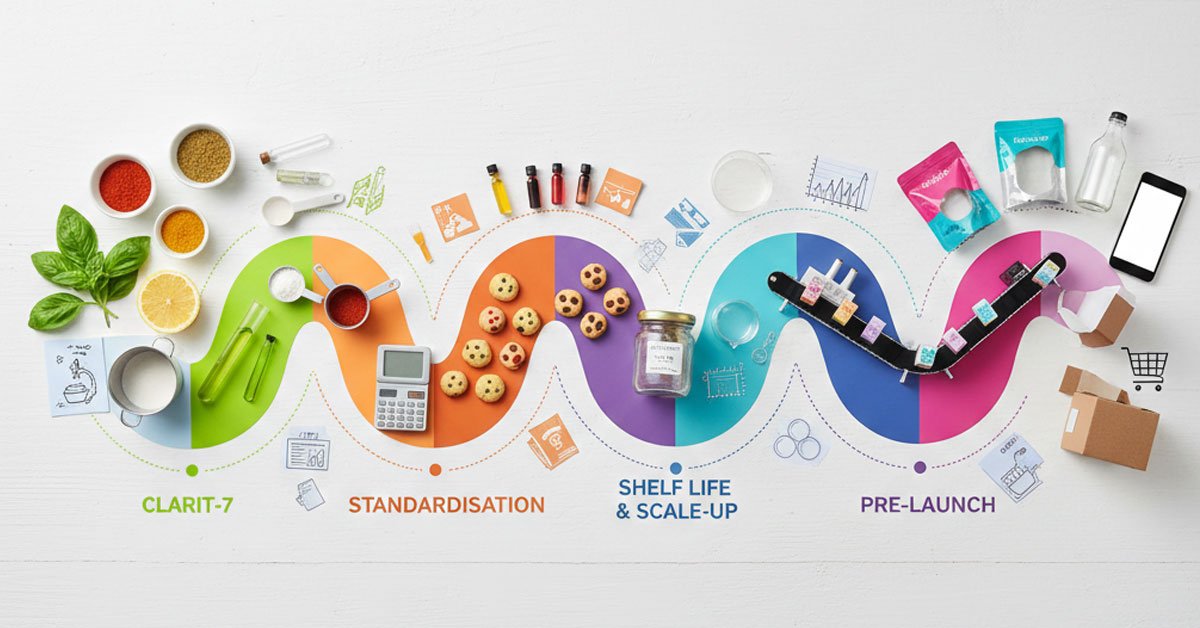
The initial 7 days ought to be dedicated to clarity. You must have an idea of one clear product and know who to sell it to. Compose a basic product brief, such as flavour, texture, price range, pack size, etc. In this step, you are able to conduct a basic kitchen test and an initial laboratory test to know about safety and feasibility.
Between days 8 and 21, emphasis is laid on the standardisation of the recipe. All ingredients should be taken in precise amounts. Here, the Recipe Development is technical and business-oriented. You would need to test several suppliers in terms of quality and cost. Meanwhile, estimate food cost/unit to make sure that at scale, profitability is guaranteed.
The time frame between day 22 and day 45 is concerned with shelf life and scale-up testing. You should know the duration of preservation of your product. Small batch scaling assists in detecting the problems that are not evident in home cooking. Changes are made in ingredients, process and storage regime in order to stabilise the product.
Between day 46 and day 75, the product goes to the pre-launch stage. The choice of packaging is also significant since it can directly influence the shelf life and consumer confidence. Ingredients and other declarations should be written on labels. Smaller business batches assist you in experimenting with actual market reaction without huge financing.
The final 15 days are devoted to the preparation of launch. Feedback from customers is taken, and small adjustments to the recipes are made where necessary. Clear costing and supplier commitments result in finalised sales channels and the production plan that follows.
Major pillars that ensure the recipe development works
An effective food product is formed on a standardised recipe that can be followed by anyone. The cost control means that the margins will be good even when the cost of raw materials changes. Shelf life and safety tests help your brand with quality issues. Scale readiness guarantees that there is no change in taste and texture with the volume of production.
Good labelling and adherence create credibility with the customers and the retailers.
You May Also Like: Food Technology Consultant in India: Food Technologist
Process of picking the correct recipe development service
When choosing a partner in business you want to enter into, seek someone with experience in the launching of actual products and not just making recipes. It is important to have access to food testing laboratories, transparent prices, and regulatory assistance.
A Recipe Development service is also useful in pilot batches, sourcing of ingredients and basic sensory analysis. This saves time and money and avoids trial and error.
Other fast steps that you can initiate this week
You will be able to move with speed by holding on to one product idea and recording it down in a coherent manner. Begin measuring ingredients rather than using cups or spoons. Call a local food testing laboratory to know the cost of shelf life testing.
Prepare a draft of the rough packaging and labelling of a product to have a preview of the finished product.
Some of the pitfalls that food startups must avoid
Most founders pay too much attention to high-quality taste and disregard the cost of production. Some others do not pilot test and proceed to bulk production, which is a loss. Disregard of food regulations and labelling regulations may slow down product launch. Such errors can be eliminated through appropriate Recipe Development planning.
The support that Foodsure-style provides to launch faster
Having a seasoned food innovation team will reduce the learning curve. Professional service assists in transferring homemade recipes into a commercial formulation, carrying out shelf life testing, compliance and readying the product to the market.
This systematic bar is beneficial to food startups, which can launch more rapidly and with a greater level of confidence.
Struggling to Develop a Recipe That Actually Lasts?
FAQ’s
What is the duration of the recipe development of a commercial food product?
The average period of commercial recipe development is 3-8 weeks, depending on the type of product, trial number, shelf life need and scale testing. A little longer may be required with complex products.
Which tests are needed in connection with shelf life and food safety?
Depending on the type of product, common tests are microbiological testing, shelf life stability testing, pH and moisture analysis and occasionally preservative efficacy testing.
What is the cost of professional recipe development in India?
In India, the price of professional recipe development is typically 25,000 to 200,000 (depending on the complexity of the product, the required testing, and support in scaling up).
Is it possible to scale a home-cooked recipe to production by a factory?
Yes, it is possible to scale a homemade recipe to factory production by standardising ingredients, changing processing procedures and performing pilot batch tests to ensure that taste and quality stay the same at large scale.
How do you get permission to sell packaged food products?
In India, to sell packaged food products, the customary requirements are FSSAI registration or license, complying with food labelling, and basic food safety documentation, as the laws require.