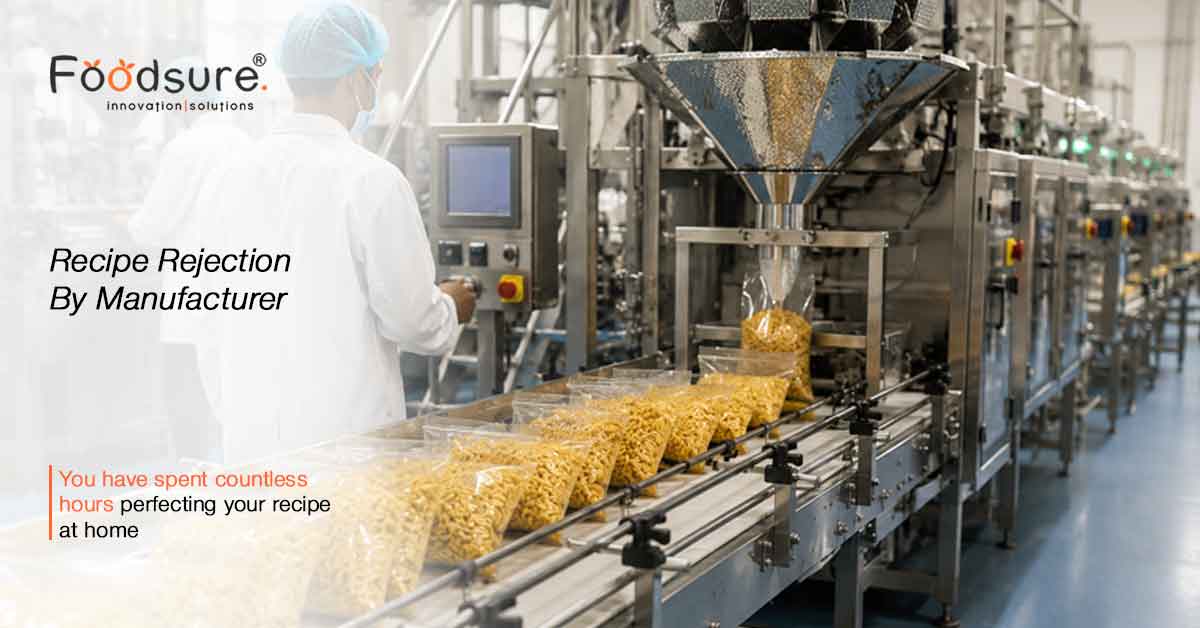
You have spent countless hours perfecting your recipe at home. Your recipe tastes great, has the right texture, and initial feedback has been positive. But the moment you approach a manufacturer with your recipe, you encounter an insurmountable problem. Recipe rejection by manufacturer is probably the most frustrating problem you will encounter in your food startup journey.
The assumption is that if your recipe tastes great, then it must be manufacturable. But the truth is much more complex. Recipe rejection by “manufacturer” could cost you months of your product development cycle and your go-to-market strategy if you are not properly equipped from the start.
What Causes recipe rejection by manufacturer?
Before going for full-scale production, it is important to grasp the underlying causes for a factory denial. Having a bad taste for recipe rejection by the manufacturer is not the only issue. It is a matter of a wide disconnect between the way you cook at home and the realities of food manufacturing.
When a co-packer looks at your recipe, their first priority is the rigorous food manufacturing feasibility. If they quickly recognize critical formulation flaws in food products, they will reject your project. Stability, consistency, and safety are the copacker’s biggest concerns.
A pinch of this and a dash of that is not the way food is made in a food manufacturing facility. Inexact food formulation causes gigantic recipe standardization problems. Founders must take a scientific approach to food formulation.
Comparison: Home Recipe vs. Manufacturer Ready Formulation
The first step toward preventing a rejected recipe from a manufacturer is to grasp the structural gap between a home recipe and a manufacturer ready formulation.
| Feature | Home Kitchen | Factory Floor |
|---|---|---|
| Measurements | Volume cups | Precise grams |
| Equipment | Basic tools | Heavy machinery |
| Shelf Life | Few days | Many months |
| Tolerance | High variations | Strict limits |
Trends Driving Recipe Rejection by Manufacturer
Today, the food processing industry is going through a massive paradigm shift. With safety and efficiency concerns, co-packers are more unforgiving than ever before.
- Co-packers demand detailed documentation
- Factories avoid complex steps
- manufacturing feasibility food dictates approvals
- Speed is a key factor for factories
- Clean label rules are getting tighter
- batch production challenges increase costs
Indian and global food startups are in an excellent position to leverage current trends, provided they are sufficiently prepared.
The Core Components That Lead to Recipe Rejection By Manufacturer
Learning the root cause of problems helps founders design better products from the very beginning. Food product formulation problems are not often accidental; they result from a lack of industrial knowledge at the initial stages of development.
| Component | Common Issue | Fix Required |
|---|---|---|
| Ingredient Sourcing | Unspecified Grade | Food-Grade Sourcing |
| Moisture Content | Inconsistent Levels | Stability Testing |
| Processing Steps | Overcomplicated Method | Process Simplification |
| Equipment Compatibility | Home-Scale Method | Industrial Alignment |
The Real Problem Behind Recipe Rejection
The most painful truth is that most cases of recipe rejection by manufacturers are entirely preventable. Batch production problems often occur not because a product is bad, but because a recipe was never developed with industrial production in mind.
- Wrong ingredient specifications
- Ignoring high heat sensitivity
- formulation errors food products delay launches
- Unrealistic factory cost expectations
- Poor product moisture control
- Ignoring early food production troubleshooting

Development Stages Where Recipe Rejection Takes Place
Food production troubleshooting becomes more effective when founders understand the development stage with the greatest risk of rejection.
| Stage | Risk Area | Action Needed |
|---|---|---|
| Concept Phase | Ingredient Complexity | Simplify Formula |
| Prototype Phase | Batch Scaling | Lab Testing |
| Pilot Phase | Equipment Gaps | Facility Audit |
| Production Phase | Compliance Gaps | Regulatory Review |
Foodsure’s Process for Fixing Recipe Rejection by Manufacturer
Having a structured process for food production troubleshooting helps avoid costly recipe rejection by manufacturers before it even happens. Dealing with recipe standardization issues at the early stages of recipe development can help you save a lot of valuable time, money, and effort.
Converting Volumes to Weights
- Sourcing Commercial Bulk Ingredients
- Shelf Stability Tests
- Equipment Needs
- Overcoming Recipe Scalability Challenges
- Seeking Expert Food Scientists
We at Foodsure have helped numerous food founders fix recipe rejection by manufacturers issues before they even reached the production floor.
Clean Label Thinking to Avoid Recipe Rejection by Manufacturer
The clean label movement is significantly transforming the landscape of the food industry. Clean label is not a want; it is a need. The removal of chemical preservatives is not as easy as it sounds. It is not easy to avoid batch production with clean label ingredients. More than 60% of modern consumers prefer clean label ingredients.
- Avoid synthetic chemical preservatives
- Use natural plant extracts
- Simplify the ingredient list
- Maintain taste profiles
- Source natural clean stabilizers
The founder who is not paying attention to this trend is going to have a huge problem with recipe standardization.
Insights into Manufacturing Realities: Recipe Rejection by Manufacturer due to Batch Production Problems
The technological decisions made in large-scale manufacturing will ultimately dictate what your final cost profile will look like for your entire brand. Early-stage startups will often outsource to third-party co-packers to keep costs down.
These plants expect perfection. If you do not address your recipe scalability challenges, your profit margins will completely disappear due to ingredient waste.
At Foodsure, we prevent your recipes from being rejected by our manufacturer by perfectly aligning your culinary vision with our strict capabilities from day one. Addressing hidden formulation errors in food products can save you a fortune.
Conclusion: Fix the Root Cause, Not Just the Symptom
Your food start-up dream does not have to come to a halt with a manufacturer rejection of your recipe. It is a wake-up call to lay a stronger and more informed foundation for your business. The correct formulation strategy, combined with timely food production troubleshooting, can turn a rejected recipe into a fully production-ready product.
At Foodsure, we assist food start-ups in fixing their recipe scalability issues, filling in the gaps in compliance, and creating a formulation that manufacturers are confident to produce from the first batch.
Ready to Fix Your Recipe and Get Manufacturer Approval?
Let’s get your formulation review started with Foodsure!
Recipe Rejection by Manufacturer
Avoid manufacturing rejection with a stable, scalable, and production-ready beverage formulation.
FAQs
What is the most common reason for recipe rejection by manufacturer?
Most rejections stem from formulation errors, food products and poor ingredient standardisation.
How do I fix recipe scalability issues before approaching a manufacturer? Conduct pilot batch testing and work with a food technologist early on.
What does manufacturing feasibility food assessment actually involve?
It reviews ingredients, equipment fit, shelf life stability, and compliance requirements.
How much can batch production challenges delay a product launch? Unresolved challenges typically delay a launch by three to six months on average.
Can industrial food processing limits be worked around during development? Yes, by reformulating with ingredients compatible with available processing equipment.
What are the main formulation errors food products face at the pilot stage? Incorrect emulsifier ratios, moisture imbalance, and improper pH levels are most common.
How does Foodsure help with food production troubleshooting?
Foodsure audits your recipe and resolves all manufacturing gaps before production begins.