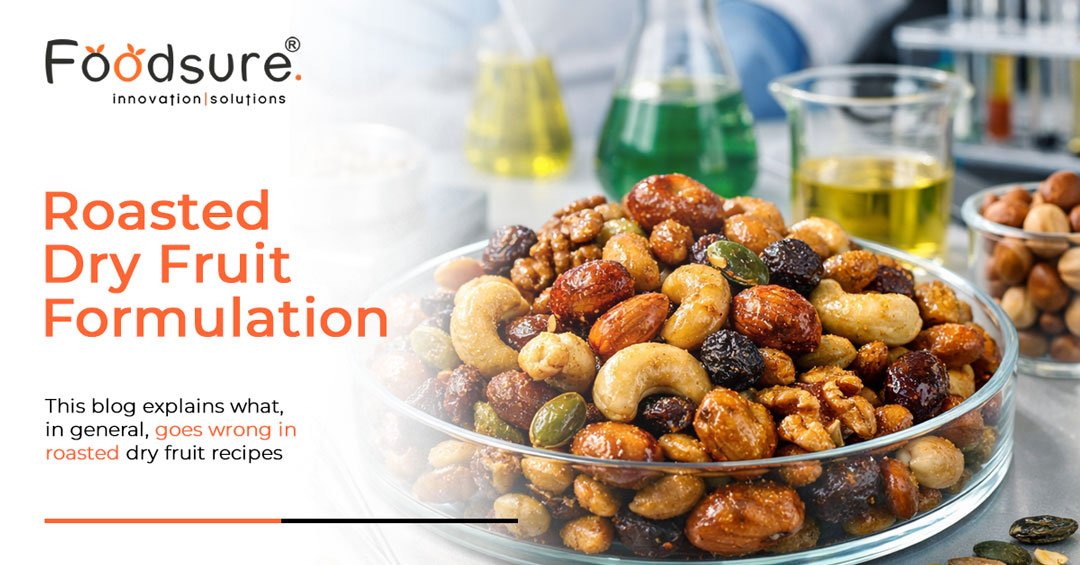
At first sight, roasted dry fruits may seem like simple products. Basically, just almonds, cashews, raisins, and pistachios with a touch of roasting and seasoning, and the product seems ready. However, in fact, roasted dry fruit products are one of the snack categories that quite often fail when small batches are taken to a commercial scale. It is not demand that is the reason; it is a weak roasted dry fruit formulation.
Launch your Dry Fruit Brand?
This blog explains what, in general, goes wrong in roasted dry fruit recipes, how these problems come up during food product development, and how a well-structured recipe formulation leads to no quality, shelf life, and consistency failures.
Why Roasted Dry Fruit Formulation Is Often Underestimated
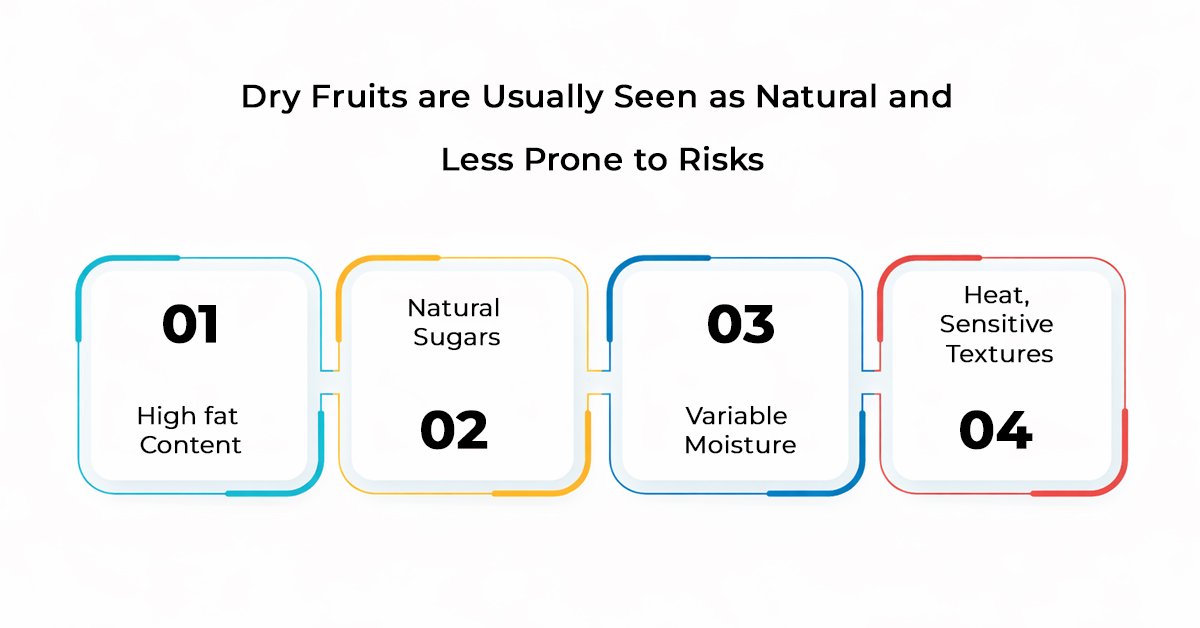
Dry fruits are usually seen as natural and less prone to risks, that is why many brands don’t even consider doing a proper food formulation. On the other hand, dry fruits behave very differently compared to grains or other snacks.
They contain:
- High fat content
- Natural sugars
- Variable moisture
- Heat, sensitive textures
Without a controlled roasted dry fruit formulation, brands will see oil leaking, uneven roasting, bitterness, short shelf life, and consumer complaints within a few months of launch.
You May Also Like: Hire a Food Technologist
Common Problems Seen in Roasted Dry Fruit Recipes
1. Uneven Roasting Across Different Dry Fruits
Almonds, cashews, raisins and pistachios all respond differently to roasting. It is hardly ever the case that a single roasting time or temperature can be suitable for all components.
What gets wrong:
- While almonds stay under, roasted cashews over-brown,
- Raisins get hardened or burnt,
- Pistachios lose their natural sweetness
Generally, this is because a dry fruit recipe has been made without conducting ingredient-specific heat profiling.
2. Oil Seepage and Greasy Mouthfeel
Besides, a lot of roasted dry fruit products look tempting at first, but over time, the grease penetrates the inside of the pack.
Some of the root causes are:
- More than adequate oil absorption during roasting
- Using the wrong type of oil
- Bottled up too soon after roasting
This is a typical storyline of a roasted dry fruit product that went wrong, wherein the food product’s fat migration was not controlled during development.
3. Loss of Crunch During Storage
The first sensory expectation in roasted dry fruit products is crunch. However, there are still many products that completely lose crunch within a few weeks.
The reasons are:
- Moisture getting in after roasting
- Short cooling and resting time
- Wrong packaging barrier
Crunch retention is no mere chance; it comes as a result of recipe formulation and post-roast handling.
4. Bitter or Burnt Aftertaste
Almonds and walnuts may be bitter after over-roasting as the bitter compounds are released.
It happens mostly when:
- The roasting temperatures are too high,
- There is an inconsistency with the timing from one batch to another
- The colour of the surface is used instead of internal doneness
The focus of a professional roasted dry fruit formulation is on internal texture and flavour, not just surface colour.
5. Seasoning Doesn’t Stick or Tastes Patchy
Seasoning inconsistency is one of the most obvious issues related to product quality.
Mistakes commonly made:
- Adding seasoning at the wrong temperature
- The particle size of the seasoning is not suitable
- The recipe has no binding logic
A premium roasted dry fruit can turn it into an unreliable product that delivers uneven flavour only because of these two aspects.
6. Short Shelf Life and Rancidity
Dry fruits are rich in fats and thus are prone to oxidation.
Most shelf life problems occur when:
- Raw materials are of poor quality
- Products are exposed to oxygen
- Antioxidant strategy is not adequate
- Packing selection is weak
Roasted dry fruit shelf life should be sacrificed during the formulation stage, not “tested later.”
Where Most Brands Go Wrong in Food Product Development
The main error is to treat roasted dry fruit only as a DIY kitchen recipe rather than a product for sale on the market. In the development of a food product, every variable matters, including specifications of raw materials, roasting curves, behaviour of the oil, cooling time, and packaging environment.
Skipping a structured recipe formulation will result in:
- High rates of product rejection
- Customer complaints
- Batch inconsistency
- Unsuccessful scale-ups
You May Also Like: Trending Food Business Ideas in 2026
Stages For Commercial Roasted Dry Fruit Formulation
Below is a practical checklist that highlights what should happen during proper roasted dry fruit formulation:
| Stage | What Must Be Defined |
|---|---|
| Raw Material Selection | Size uniformity, moisture, fat quality |
| Ingredient Segregation | Separate roasting logic per dry fruit |
| Roasting Profile | Temperature-time curve per ingredient |
| Oil System | Oil type, percentage, absorption control |
| Seasoning Design | Particle size, timing, and adhesion |
| Cooling & Resting | Moisture stabilization, crunch retention |
| Shelf-Life Strategy | Oxidation control, antioxidants if needed |
| Packaging Selection | Oxygen and moisture barrier |
| Scale-Up SOP | Batch consistency rules |
| Final Recipe Lock | Commercially reproducible formulation |
This checklist is what separates stable brands from short-lived launches.
Why Recipe Formulation Matters More Than Ever
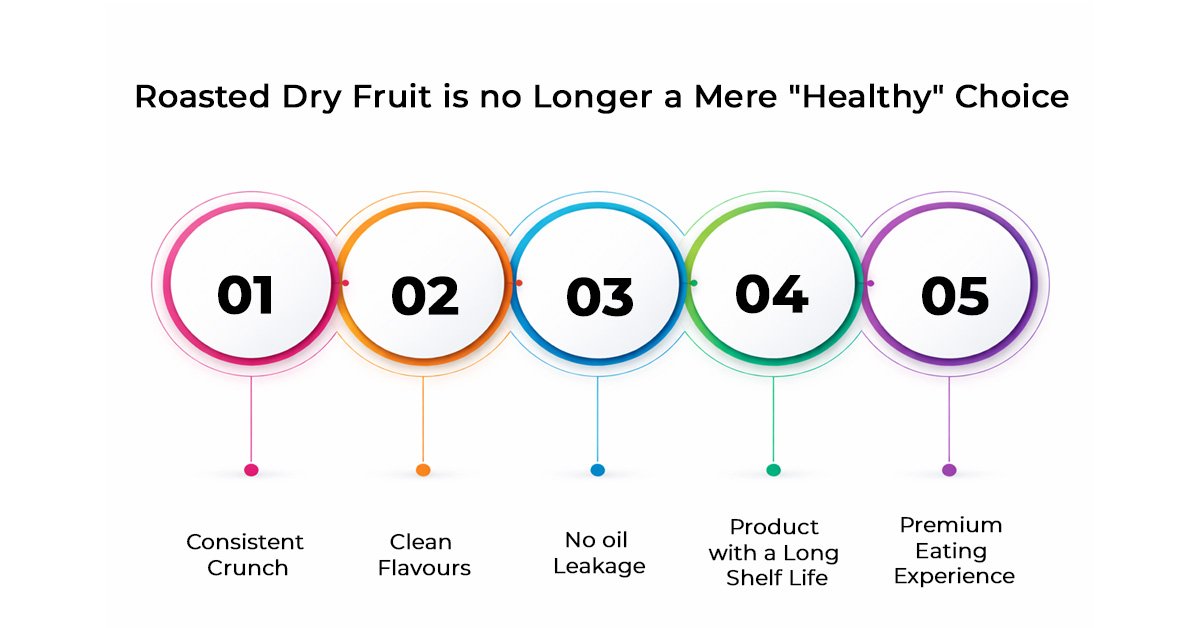
As more players enter the market, roasted dry fruit is no longer a mere “healthy” choice.
Consumers want:
- Consistent crunch
- Clean flavours
- No oil leakage
- Product with a long shelf life
- Premium eating experience
Only a well-planned, roasted dry fruit recipe that is backed up by food formulation science can reliably deliver all those features.
Final Thoughts
Most of the time, when roasted dry fruits don’t sell, it is not a sales problem but a product formulation problem.
If your product has issues with oil leakage, bitterness, loss of crunch, or inconsistency, then the problem is not marketing. It is your recipe formulation. Make the changes in the formula at the very beginning, and you will save your margins, brand reputation, and long-term growth.
At Foodsure, we assist founders in transforming their roasted dry fruit ideas into stable, scalable, market-ready products that can resist real-world conditions.
Get Expert Help With Roasted Dry Fruit Product Development & Compliance
Struggling with oily packs, loss of crunch, or inconsistent flavour in your roasted dry fruits? Foodsure helps dry fruit brands, snack startups, and FMCG companies develop stable, market-ready products with correct packaging, labelling, and recipe formulation. Avoid product failures and launch with confidence.
Why Leading Dry Fruit Brands Choose Foodsure
- Expert roasted dry fruit recipe formulation and scale-up guidance
- FSSAI-compliant packaging and labelling for nuts and mixes
- Control of oil seepage, moisture, and crunch retention
- Nutritional labelling, allergen declaration, and ingredient accuracy
- Shelf-life strategies to prevent rancidity and flavour loss
- End-to-end support from development to market launch
Who We Help
- Dry fruit startups launching roasted or flavoured variants
- Established FMCG brands expanding into dry fruits or nut snacks
- D2C snack brands looking for shelf-stable, scalable products
- Health and premium dry fruit brands wanting consistent quality
- Exporters needing compliant and shelf-stable dry fruit packs
Book Your Free Consultation & Get Market-Ready Dry Fruits
Stop wasting money on failed batches and inconsistent products. Our experts will help you optimise roasted dry fruit recipes, control oil and moisture, ensure labelling compliance, and select the right packaging so your products hit the market perfectly every time.
FAQ’s (Frequently Asked Questions)
Why do roasted dry fruits get oily in the packet?
Oil seepage results from the over-oil absorption, incorrect cooling, or lack of formulation control.
Why does roasted dry fruit lose its crunch after some time?
Moisture absorption, weak cooling protocols, or inappropriate packaging barriers usually cause the loss of crunch.
Can all dry fruits be roasted together in one batch?
No, different dry fruits require different roasting profiles owing to the different levels of fat and moisture.
What makes roasted dry fruits bitter?
Over-roasting or very high temperatures cause the release of bitter compounds, more so in almonds and walnuts.
How long can roasted dry fruits be stored on the shelf?
Products can remain stable for 69 months, depending on packaging with correct roasted dry fruit formulations.
Why does seasoning not coat roasted dry fruits evenly?
Patchy flavour delivery is the result of incorrect seasoning timing, particle size, or a lack of binding concept.
Is oil necessary in roasted dry fruit recipes?
Oil can be used to some extent, but the kind and the amount of oil have to be determined during the recipe development stage.
How does food formulation contribute to the improvement of roasted dry fruit quality?
Food formulation through roasting control, fat behaviour, moisture, and shelf life ensures consistent results.
Is it possible to make roasted dry fruits clean, label and shelf-stable?
It is possible to get clean, label stability if the product is well formulated, the antioxidant strategy is in place, and the right packaging is used.
Can a food consultant assist in resolving roasted dry fruit recipe problems?
Indeed, a consultant can optimise the roasted dry fruit formulation process, which results in better consistency, shelf life, and scalability.