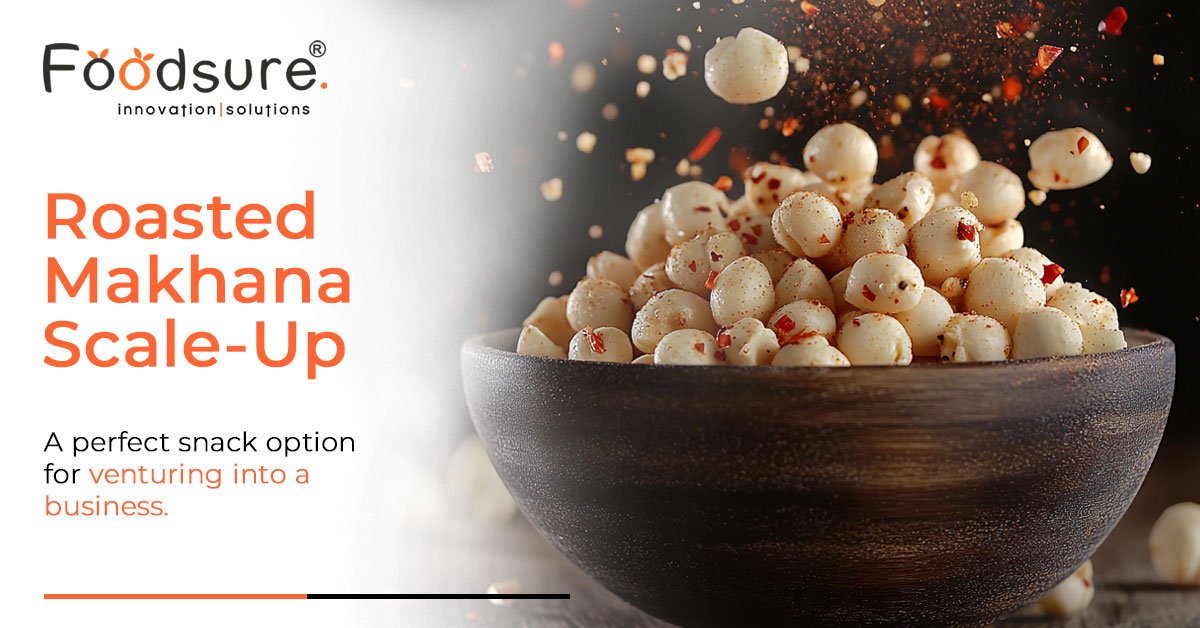
Roasted makhana has quickly become one of the most promising categories in the healthy snack market. It is light, nutritious, plant-based, and already has a strong consumer base. Because of these advantages, many founders believe that launching a roasted makhana brand is a straightforward opportunity.
Initially, everything appears to go well. Small-batch production delivers excellent taste and texture. Early customer feedback is positive, distributors begin showing interest, and orders start coming in. But the real challenge begins when roasted makhana scale-up starts.
At this stage, many brands begin to struggle quietly. Product consistency drops, costs increase, shelf life decreases, and customer complaints start appearing. The issue is not that makhana is a weak category. The real problem is that roasted makhana scale-up is far more complex than most founders anticipate.
The Myth: “If It Works at Small Scale, It Will Work at Big Scale”
One of the biggest misconceptions in the snack industry is that a recipe developed in a kitchen will perform the same way in a factory.
Small-scale trials happen under ideal conditions. But large-scale manufacturing introduces completely new variables, such as:
- Industrial equipment differences
- Raw material variability
- Operator inconsistencies
- Longer supply chains
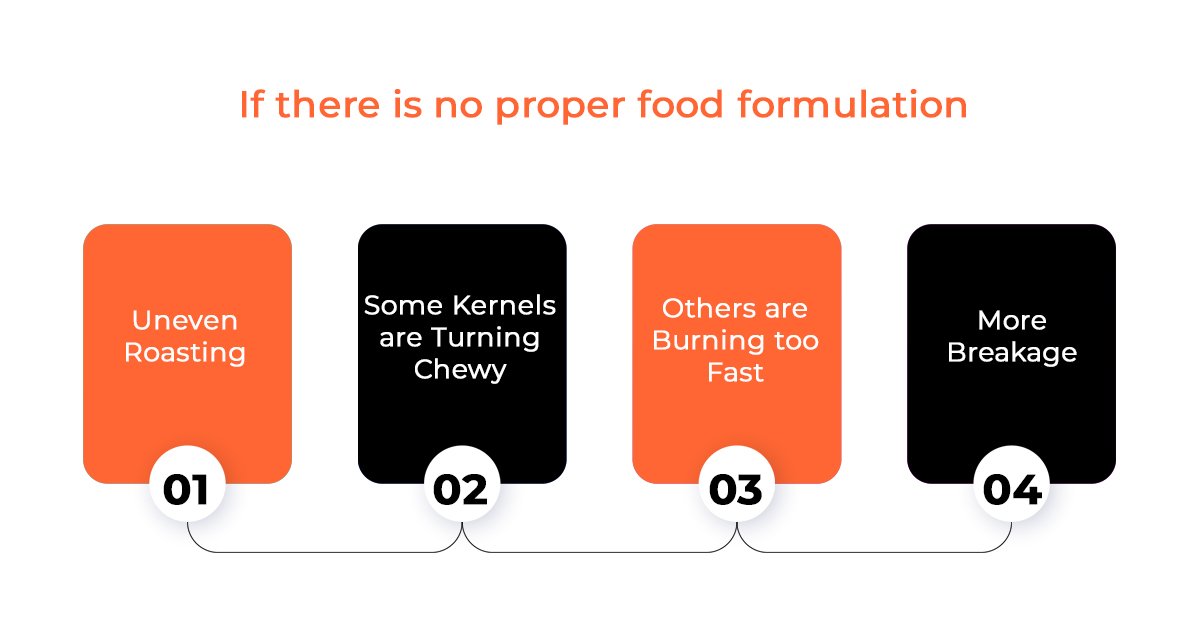
When brands treat roasted makhana scale-up as simply increasing volume rather than redesigning the process, production problems begin. Scaling is not about multiplying a recipe, it requires rebuilding the formulation and process.
Problem 1: Ignoring Raw Makhana Variability
One of the biggest misconceptions in snack manufacturing is assuming that a recipe that works perfectly in a kitchen will behave the same way in a factory. Small-scale production happens under controlled conditions. Ingredients are measured carefully, batches are small, and adjustments can be made instantly.
Large-scale manufacturing introduces new factors such as:
- Industrial roasting equipment
- Variability in raw materials
- Multiple operators handling production
- Longer distribution and storage cycles
Because of these changes, products behave differently when roasted makhana scale-up begins. Scaling is not just multiplying a recipe. It requires redesigning the process to maintain consistency at higher volumes.
Problem 2: Roasting Equipment Changes Everything
Roasting makhana in a small pan behaves very differently from roasting it in industrial machines. Large equipment changes heat distribution, roasting time, and batch thickness. Many companies increase machine size without adjusting the roasting process.
Equipment like the Foodsure makhana machine helps control roasting conditions and maintain consistency during large production runs. Without proper calibration, achieving uniform crunch becomes difficult.
Problem 3: Fat and Seasoning Stop Behaving the Same
Seasoning application becomes more challenging during roasted makhana scale-up. Because makhana has a porous structure, oil and seasoning must be balanced carefully.
Common problems include:
- Seasoning not sticking properly
- Uneven flavour distribution
- Oil absorption differences
Without proper formulation, flavour consistency becomes difficult for any roasted makhana brand.
Problem 4: Crunch Loss Over Time
Crunch is the most important quality attribute of roasted makhana. However, many brands experience texture loss after packaging. Makhana easily absorbs moisture and is sensitive to oxygen exposure. During roasted makhana scale-up, products travel longer distances and stay in storage longer.
Without proper shelf-life design, the product may reach consumers with a soft texture.
Problem 5: Packaging Is Treated as an Afterthought
Packaging plays a major role in protecting roasted makhana. Many brands choose packaging based only on design or cost. However, makhana requires packaging that protects against moisture and oxygen. If this protection is weak, the crunch quickly disappears.
Many roasted makhana brands realise this only after roasted makhana scale-up begins, when changing packaging becomes costly.
Problem 6: Cost Explosion at Higher Volumes
Scaling production should reduce costs, but poor planning can cause the opposite.
During roasted makhana scale-up, brands may face:
- Higher oil consumption
- Increased breakage
- More rejected batches
- Seasoning wastage
Without process optimization, higher production volume may reduce profit margins.
Problem 7: Lack of Process Documentation
Small groups trust their gut feelings, and the big groups need to have established procedures.
With an increase in production, several workers do roasting, seasoning, cooling and packing. In the absence of documented controls, the quality of products is determined by the person who is on duty that day.
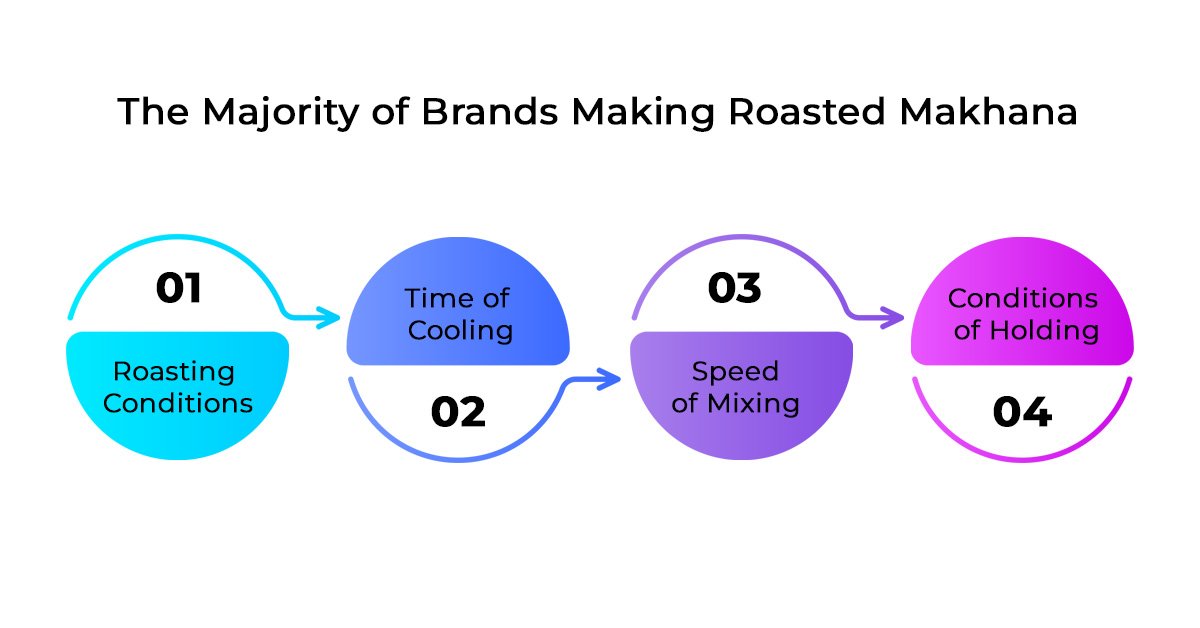
The majority of brands making roasted makhana do not keep records regarding:
- Roasting conditions
- Time of cooling
- Speed of mixing
- Conditions of holding
Once this discipline is not followed, there will be no consistency. Professional food formulation is about documentation as much as it is about the ingredients.
Problem 8: Regulatory and Labelling Oversights
When things get bigger, they also get more closely examined. It claims that at a small scale, one could barely notice, but later on, it can be the reason for compliance issues. Nutritional values naturally change a bit due to processing. Ingredient declarations become not quite accurate.
During the development of a food product, regulatory agreement should be a part of the plan from the very beginning. A lot of roasted makhana scale-up brands treat it as something to fix after the launch, which results in a very expensive correction or market withdrawal.
Problem 9: No Buffer for Distribution Stress
Markets that are real, in fact, are not soft to the product. The products also undergo heat, humidity, pressure from stacking, and transport delays. What comes out of the production line may not be the same as what will survive the supply chain.
Roasted makhana scale-up fails when brands don’t simulate real distribution conditions. A formulation that works only in ideal storage is not market-ready. That’s why seasoned food formulation is the key here; it not only figures out the abuse factor but also gets the best possible perfection.
Why Some Brands Do Scale Successfully
Some companies manage to scale successfully because they treat makhana as a technical product rather than a simple snack.
Successful brands invest early in:
- Product development
- Process control
- Shelf-life testing
- Equipment optimization
By planning for roasted makhana scale-up from the beginning, they avoid many production problems.
Our Perspective
At Foodsure, we treat roasted makhana scale-up as both a formulation and engineering challenge. Consistent results require proper roasting systems, controlled flavour application, and stable packaging.
Tools such as the Foodsure makhana machine help maintain roasting consistency and improve production efficiency for growing snack brands.
Final Thoughts
Roasted makhana is a high-potential category in the healthy snack business, but it rewards discipline, not shortcuts. If your product is following the growth path, the question is not “Can we sell more?” The real question is “Is our formulation ready for roasted makhana scale-up?” Because in this category, success is not determined at launch. It is determined at scale. And that is the point where either most brands grow up or die out.
Frequently Asked Questions
What are the reasons behind the failure of most roasted makhana brands at the time of scaling up?
The small-batch recipe is not scaled up to the larger equipment, raw materials, and supply chain’s advantages.
What is the major factor in scaling up roasted makhana?
The change in the roasting and seasoning behaviour at the large scale causes the difficulty in keeping the crunch and flavour of the whole product..
How does food formulation play a role in makhana scale-up?
Proper food formulation allows one to have control over the variability of the ingredients, the moisture, the oil absorption, and the seasoning adhesion, which are all necessary for scalable production.
Can you give a recipe for home-style roasted makhana that can be made in large quantities for commercial use?
Such an occurrence is occasional because home-like recipes lack process control, shelf-life stability, and cost predictability, which are essential for the mass production of commercial products.
What are the factors behind scaling up roasted makhana losing its crunch?
Loss of crunch is caused by improper moisture control, incorrect fat levels, packaging issues, and cooling and resting stages not long enough.
How important is the roasting equipment to the production scale-up?
Roasting equipment is very important since the variations in the heat and airflow directly impact the drying, texturing, and overall product consistency.
What is the main factor of packaging in the roasting of makhana scaling?
The packaging not only decides the moisture and oxygen protection, but if the barrier properties are not good, even the best of the product can be compromised.
How can roasted makhana brands maintain their costs during scaling up?
Cost is controlled through the best formulation, less waste, process stability, and the use of ingredients and packaging that are efficient in scale.
At what point should brands make an investment in professional food product development?
Before the scaling starts, as otherwise it will result in higher losses, recalls, and costly reformulation.
How can brands increase their probability of success in scaling?
By considering scaling a formulation and process challenge, and creating systems that guarantee consistency and endurance.