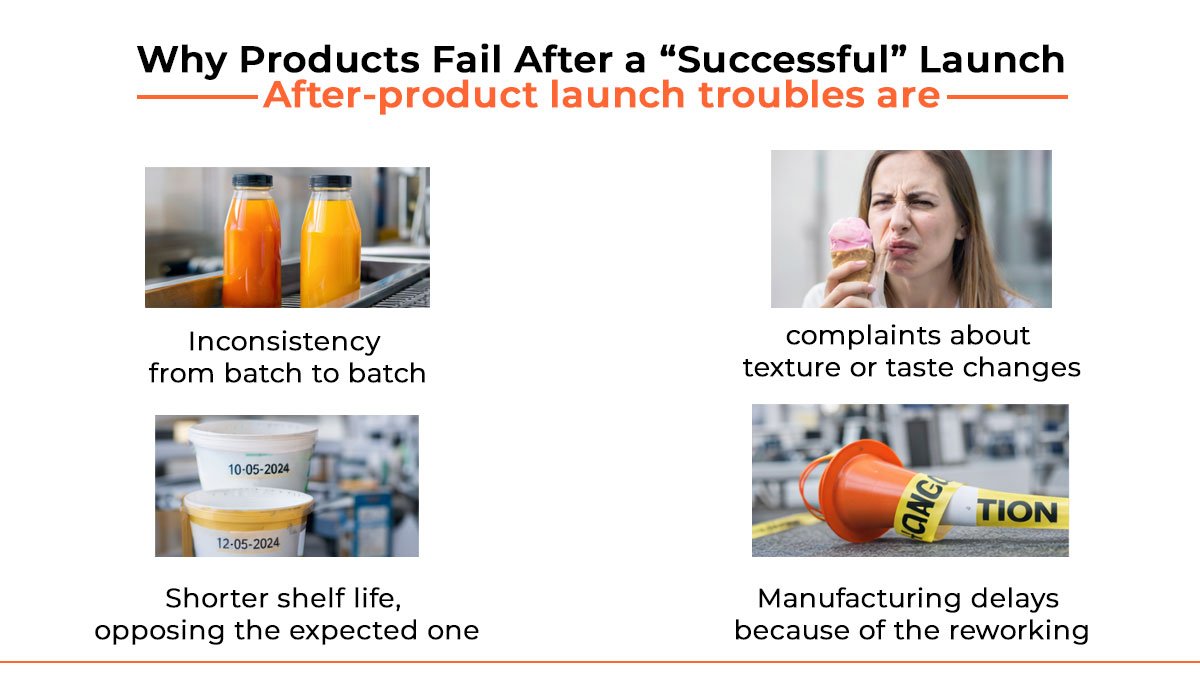
There are changes in the texture. There is a drop in the flavour. The shelf life decreases. The costs increase. The product is no longer consistent.
Want to optimise your Food Business? Request a free consultation!
Food Product Development Services – Click Here
This gap between successful lab trials and failed factory production is where many promising products lose momentum. In reality, the idea behind the product is rarely the problem. The real challenge lies in misunderstanding the difference between a lab-scale recipe and a true manufacturing formulation, especially when scaling up food products without proper planning.
Understanding the complexities of food formulation development & scale-up is essential for brands that want to transition from concept to commercial production successfully.
The Illusion of a “Perfect” Lab Recipe
In a laboratory environment, conditions are carefully controlled. Ingredients are measured with precision, equipment is small and manageable, and adjustments can be made instantly. These controlled conditions make scale food labs ideal for experimentation, innovation, and early-stage product development.
Lab testing plays a crucial role in the food formulation development & scale-up process. It helps define flavour profiles, texture, and the overall identity of a product. However, lab trials are designed for experimentation, not for replicating real manufacturing conditions.
The problem arises when brands treat a lab recipe as the final formulation rather than as a prototype.
A lab recipe answers one question:
Is the product possible?
A factory recipe answers another:
Can the product be produced consistently, safely, and affordably at scale?
Confusing these two stages often leads to major issues during commercial production.
Why Lab Recipes Behave Differently at Factory Scale

1. Equipment Changes Everything
In scale food labs, mixing often happens using small tabletop blenders, kettles, or laboratory mixers. These systems allow precise control and quick adjustments.
In a factory, however, production relies on industrial equipment such as:
- High-capacity mixers
- Continuous cookers
- Extruders
- High-shear processing systems
These machines operate with different mechanical forces, temperatures, and processing times. As a result, ingredients behave differently.
This is why large-scale product formulation is not simply about multiplying ingredient quantities. It requires redesigning the formulation and processing conditions for industrial equipment.
2. Ingredient Behaviour Shifts with Volume
Ingredients that are not compatible with each other often show poor relations in small-batch formulations. But in large-scale production, the same ingredients might behave differently because of longer holding times, higher shear, and even heat transfer.
Common problems are:
- Separation in sauces or beverages
- Grittiness in protein-rich products
- Off-notes emerging after processing.
- Loss of functional claims during heat treatment
If these issues are not taken care of in the Food Research & Development phase of food formulation, the factory will be the testing ground, an expensive and hazardous place to conduct experiments.
3. Time Is a Critical Variable at Scale
Time behaves very differently in a factory compared to a lab. In the Food Testing Laboratory, transitions between production steps are quick. Ingredients move immediately from mixing to heating, cooling, or packaging.
In industrial production, materials may remain in:
- Storage tanks
- Pipelines
- Holding vessels
- Hopper systems
This extended processing time can lead to:
- Oxidation
- Microbial instability
- Texture degradation
A formulation that remains stable for 30 minutes in a lab may degrade after two hours on a production line. This is why time management becomes a crucial variable when scaling up food products.
The Hidden Cost of Ignoring Factory Reality
Many brands approach food consultants only after facing repeated production failures. By that time, significant investments have already been made in:
- Raw materials
- Packaging
- Marketing campaigns
- Manufacturing runs
Ignoring the realities of large-scale product formulation can result in:
- Multiple reformulation cycles
- Delayed product launches
- Increased material waste
- Strained relationships with manufacturers
Most of these problems can be avoided when food formulation development & scale-up are integrated into the product design process from the very beginning.
Why Strategic Scale-Up Food Formulation Planning Matters
Successful food products are not just developed, they are engineered for scale.
When formulation scientists design products specifically for large-scale product formulation, they consider multiple factors early in the process, such as:
- Industrial processing conditions
- Ingredient stability under heat and shear
- Shelf-life performance
- Manufacturing efficiency
This proactive approach reduces risk during scaling up food products and ensures smoother commercialisation.
Final Thoughts
If you want your product to succeed beyond the lab, scale-up planning must begin from day one.
At Foodsure, we help brands design formulations that perform not only in scale food labs, but also in real production environments through expert large-scale product formulation and food formulation development & scale-up strategies.
Want to optimise your food product for commercial manufacturing?
Request a consultation and take the first step toward successful scaling up food products.
Frequently Asked Questions
What is the reason for lab recipes failing during factory production?
The lab recipes are made in a controlled environment, but on the other hand, in a factory production, the heat, shear, time, and even the type of machinery are all factors that influence the evolution of the ingredients.
How do factory recipes differ from lab recipes?
Lab recipe is for trial and error, but the factory recipe is made to be consistent, cheap, safe, and suitable for large-scale production.
What does scale-up food formulation entail?
Scale-up food formulation refers to the task of making a recipe and a process that are no longer tied to the original lab conditions but instead are controlled by the factory conditions in terms of both consistency and economy.
Is it possible to directly scale a lab recipe for commercial production?
Absolutely not, Direct scaling very often leads to failures of texture, flavour, and stability, which could have been avoided with proper pilot trials and process validation.
What causes food texture to alter when scaling up?
The changes in equipment, mixing intensity, heating rate, and holding time can have a paramount effect on proteins, emulsions, and stabilisers.
What are the largest mistakes made during food scale-up?
One of the biggest mistakes is skipping pilot trials; also, ignoring the restrictions of the equipment, underestimating ingredient interactions, and not planning for costs at the scale of production.
How significant are pilot trials in food formulation?
Pilot trials are very important as they help to identify any issues that might arise in large-scale production by mimicking the factory conditions.
Could scaling up harm the shelf life of food?
Definitely, if not properly tested, processing stress, oxygen exposure and moisture changes at scale can greatly shorten the shelf life.
When in product development should scaling planning start?
The scaling planning should commence during R&D and not after the lab recipe has been approved.
Should the process of food formulation scaling be assisted by a consultant?
Certainly. The involvement of scale-up specialists ensures the laboratory production of food recipes being transformed into stable, factory-ready formulations, and they also prevent the occurrence of expensive failures.