The Shirley Temple drink is a drink to remember. It’s all about bright colour, gentle sweetness, and a sense of nostalgia built into every sip. But that reference can be misleading. The classic version was never designed for consistency, shelf life, or large-scale production. Most Shirley Temple drink recipes work fine at home and fall apart the moment you try to scale them. Flavours flatten, colour drifts, carbonation disappears, and sugar spikes beyond what’s commercially feasible. The reason behind the classic build was never designed for production.
This blog is about a Shirley Temple drink recipe considered as a formulation problem rather than a party trick. We will discuss the ingredient functionality, the ratios that can actually be scaled, and the decisions that differentiate a nostalgic idea from a beverage that can be made in a factory.
Why the Classic Shirley Temple Recipe Needs Reformulation for Production
Home recipes need immediate consumption; production does not. When you pack a bottle or a Can of Shirley Temple drink, inconsistency shows up fast. Grenadine fades, Citrus drops out, and Carbonation softens while packaging and storing it. To add shelf life expectation, the recipe needs structure, which also fails multiple times while scaling.
If this sounds familiar, it ties directly into broader beverage formulation challenges and the realities of scaling drink recipes for manufacturing. The fix isn’t more grenadine. It’s a smarter formulation.
Core Ingredients in a Shirley Temple Drink Recipe and Their Functions
Let’s break it down ingredient by ingredient. Every component in a Shirley Temple drink recipe needs to earn its place once you move beyond the glass.
Ginger Ale or Lemon-Lime Base
In a commercial Shirley Temple drink recipe, the carbonated base does more than just add bubbles. It acts as the sweetness carrier and the primary flavour volume. Ginger ale brings spice notes that help mask sugar and grenadine intensity. Lemon-lime soda offers a cleaner profile but requires tighter acid control.
From a carbonated beverage formulation standpoint, base selection affects CO₂ retention, perceived sweetness, and overall mouthfeel. The wrong base collapses under processing stress.
Grenadine Syrup
Grenadine is not just a colour; in a Shirley Temple drink recipe, it drives the sweetness curve, contributes fruit aromatics, and masks bitterness from acids or preservatives. At scale, colour stability becomes the real issue. Natural red systems are prone to oxidation and light fade.
Your grenadine ratio must balance visual impact with shelf life. Too little and the drink looks washed out. Too much and you amplify sugar load while shortening stability windows.
Citrus Components (Lime or Lemon)
Citrus is where control happens. Acid balances sweetness, sharpens flavour, and locks in freshness perception. In a Shirley Temple drink recipe, citrus also helps manage pH, which directly affects microbial stability and colour retention.
This is not garnished with lemon. This is measured acidulation. Small shifts here change everything downstream.
Garnish vs Functional Ingredients
The cherry matters to the consumer, not the formulation. In a commercial Shirley Temple drink recipe, cherries are visual cues, not functional inputs. Flavour, colour, and sweetness should never depend on a garnish that may or may not survive processing.
Design the liquid first. Let the garnish be optional.
Ideal Ingredient Ratios for a Shelf-Stable Shirley Temple Drink
At scale, ratios stop being casual. They become guardrails.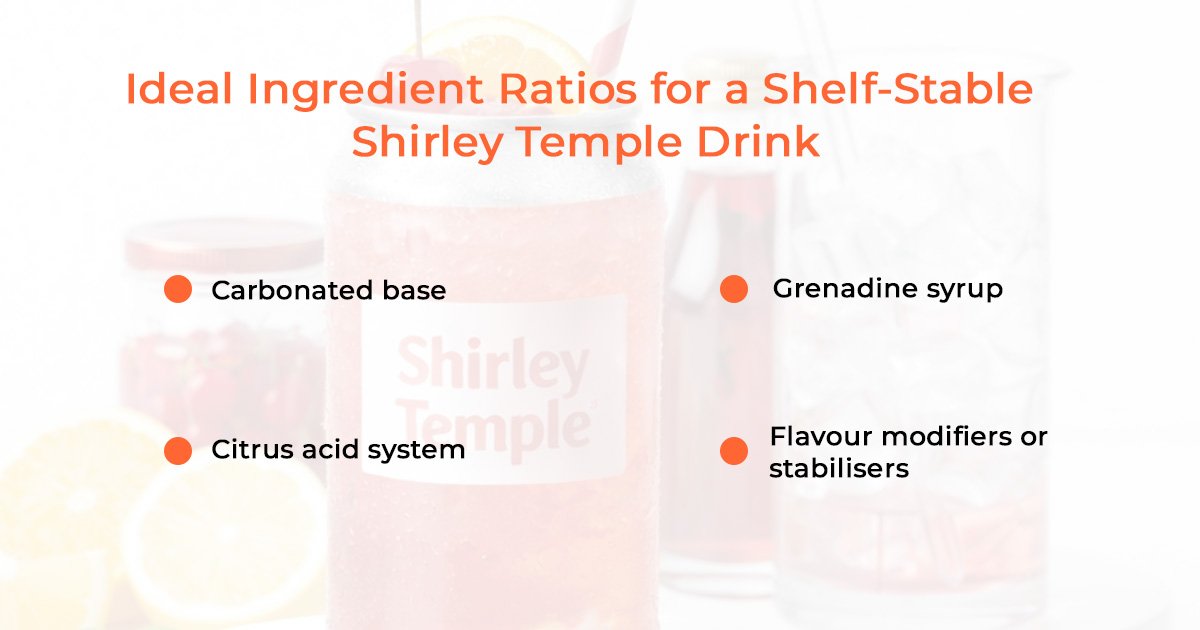
Typical starting ranges for a shelf-stable Shirley Temple formulation look like this:
- Carbonated base: 88 to 92 per cent
- Grenadine syrup: 5 to 7 per cent, depending on Brix target
- Citrus acid system: 0.15 to 0.25 per cent acid equivalent
- Flavour modifiers or stabilisers: balance as needed
Why do these ratios change at scale? Because heat, oxygen, and time all dull flavour. What tastes loud in a glass tastes thin after processing. Sugar perception increases without ice. Carbonation drops during filling. Ratios compensate for those losses.
Common Formulation Mistakes and How to Avoid Them
Over-sweetening is the most common error. It hides instability in the short term and creates rejection in the long term.
Colour degradation follows close behind. If you ignore light and oxygen exposure, red becomes brown fast.
Carbonation loss is often treated as a filling problem when it’s really a formulation problem. Poor base selection and sugar density work against gas retention.
Each issue is fixable, but only if addressed intentionally.
Related Blogs
Explore more insights on beverage innovation, formulation strategies, and future-ready industry practices.
Final Thoughts: Turning a Classic into a Commercially Viable Product
A Shirley Temple drink recipe can scale, but only when you stop treating it like nostalgia and start treating it like a system. Ingredient function, ratio control, and processing awareness matter more than tradition.
If you’re looking to turn a familiar concept into a stable, selling beverage, formulation support saves time and costly mistakes.
Ready to move from concept to production? Reach out for consulting or formulation guidance tailored to your process and goals.
Frequently Asked Questions
What are the ingredients in a Shirley Temple drink?
A classic Shirley Temple contains lemon-lime soda, grenadine, ice, and a maraschino cherry.
How was the Shirley Temple drink created?
It was created in the 1930s by bartenders who made a non-alcoholic drink for child actress Shirley Temple.
How to create a drink recipe?
Start with a base liquid, add a sweetener and flavour, balance acidity, and adjust proportions through tasting.
Is a Shirley Temple made with Sprite or 7UP?
It can be made with either Sprite or 7UP, as both are lemon-lime sodas.
Is 0.5% alcohol actually alcohol free?
No, 0.5% alcohol contains trace alcohol but is generally considered non-alcoholic in many regions.
What is 7 Up Shirley Temple?
It is a Shirley Temple made specifically with 7UP, grenadine, and a cherry.
What does Gen Z drink instead of alcohol?
Gen Z often chooses mocktails, functional drinks, sparkling water, kombucha, and zero-alcohol beverages.
What are the 7 classic cocktails?
Common classics include the Martini, Old Fashioned, Margarita, Manhattan, Negroni, Daiquiri, and Mojito.
What are the ingredients in 7 Up Shirley Temple Zero?
It includes 7UP Zero Sugar, grenadine or cherry flavouring, ice, and a cherry garnish.
What was in the original Shirley Temple?
The original version used ginger ale or lemon-lime soda, grenadine, and a maraschino cherry.
Why is it called Dirty Shirley?
A Dirty Shirley adds vodka to the classic Shirley Temple, making it alcoholic.
What is the ratio of Sprite to grenadine?
A typical ratio is about 8–10 parts Sprite to 1 part grenadine.