If you’ve ever wondered how to develop a food product that consumers truly love, the answer lies in following a structured and strategic approach. A successful launch is never accidental; it’s built on complete research, testing, refinement, and careful execution.
Understanding the food development process helps transform a simple idea into a scalable, market-ready product. Whether you’re a startup founder or an established brand, following the right steps to create a food product reduces risk and improves your chances of success.
This guide walks you through developing a food product step by step, covering everything from concept to commercial launch.
This Blog is informational. For professional services, visit our Food Product Development Services page.
Why a Structured Approach Matters?
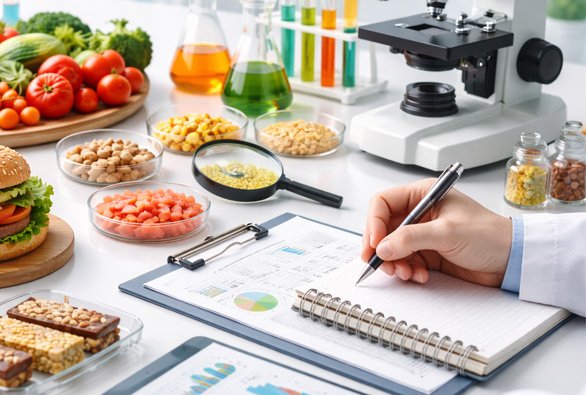
Launching a food product involves much more than creating a great recipe. You must consider:
- Market demand
- Ingredient sourcing
- Shelf life and safety
- Costing and pricing
- Regulatory compliance
- Packaging and branding
A clear food product planning guide ensures that creativity aligns with technical feasibility and commercial viability.
You May Also Like: Food R&D Excellence Turning Ideas Into Products
Food Product Developing Steps
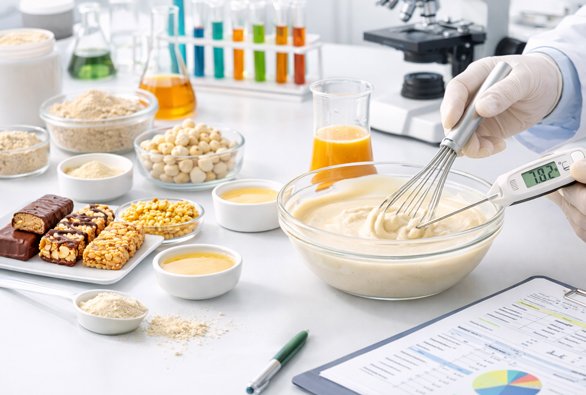
1. Idea Generation & Market Research
Every successful product begins with a validated idea. This stage focuses on identifying real opportunities rather than assumptions.
- Study consumer behaviour, purchasing patterns, and emerging food trends.
- Analyse competitor products, ingredients, claims, pricing, and packaging formats.
- Identify gaps such as unmet dietary needs, convenience demands, or premium positioning opportunities.
- Define your target audience (age group, lifestyle, income level, health preferences).
- Validate the concept through surveys, retailer feedback, or small focus groups.
The goal is to ensure your product idea solves a genuine problem or satisfies a growing market demand.
2. Concept Development & Positioning
Once the opportunity is clear, the next step is defining what your product stands for.
- Clarify your Unique Selling Proposition (USP).
- Decide whether the product will be positioned as healthy, indulgent, functional, affordable, premium, or clean-label.
- Define portion size, format (powder, bar, beverage, snack), and consumption occasion.
- Align branding tone with your target audience.
- Establish preliminary pricing strategy based on positioning.
Strong positioning ensures consistency in formulation, branding, packaging, and marketing communication.
3. Recipe Formulation & Prototype Creation
This is where food science and creativity come together.
- Select ingredients based on functionality, nutrition, taste, availability, and cost.
- Develop the first formulation in a controlled lab environment.
- Create multiple prototype variations for comparison.
- Evaluate texture, mouthfeel, aroma, colour, and overall sensory appeal.
- Optimise nutritional profile according to your claims (high-protein, low-sugar, fortified, etc.).
Several iterations are often required before finalising a stable and appealing formulation.
4. Testing & Validation
A product must perform consistently beyond just taste.
- Conduct sensory evaluations with trained panels or target consumers.
- Perform shelf-life studies under different storage conditions.
- Carry out microbial testing and stability assessments.
- Validate packaging compatibility with the product.
- Ensure compliance with food safety standards and quality benchmarks.
This stage minimises risk before large-scale production and market launch.
5. Costing & Commercial Feasibility
Even the best product must be financially viable.
- Calculate raw material costs based on projected volumes.
- Estimate packaging, logistics, and warehousing expenses.
- Include manufacturing, labour, and overhead costs.
- Analyse expected margins at distributor and retailer levels.
- Reformulate if necessary to balance cost efficiency and product quality.
Clear cost modelling ensures sustainable profitability.
6. Regulatory & Compliance Check
Regulatory compliance protects both your brand and consumers.
- Verify ingredient approvals under relevant food safety authorities.
- Ensure labelling accuracy (nutrition facts, allergen declarations, claims).
- Confirm adherence to food safety standards and certifications.
- Prepare documentation required for audits and approvals.
Compliance should be addressed early to avoid delays or penalties during launch.
7. Pilot Production & Scale-Up
Scaling from lab to factory requires technical precision.
- Conduct pilot-scale production to replicate manufacturing conditions.
- Monitor processing parameters such as temperature, mixing time, and batch size.
- Evaluate product consistency and quality across batches.
- Identify potential equipment or operational challenges.
- Fine-tune process parameters before full-scale production.
This step ensures a smooth transition to commercial manufacturing.
8. Branding, Packaging & Launch
A strong product needs strong market execution.
- Finalise packaging design aligned with brand identity and compliance norms.
- Select appropriate packaging materials to maintain shelf stability.
- Develop brand messaging that clearly communicates benefits.
- Choose distribution channels (retail, e-commerce, modern trade, export).
- Plan marketing activities such as digital campaigns, sampling, influencer collaborations, and trade promotions.
A strategic launch maximises visibility, builds consumer trust, and accelerates market adoption.
You May Also Like: Food Recipe Formulation
Key Considerations When Developing a Food Product
- Maintain consistent quality
- Focus on shelf stability
- Ensure regulatory compliance
- Align pricing with target consumers
- Prepare for scalability
Each of these elements plays a crucial role in developing a food product that survives real-world market pressures.
Conclusion
Understanding the food product development process gives you clarity, reduces costly mistakes, and improves your product’s success rate. By following these structured steps to create a food product, you can confidently move from concept to commercial launch.
If you’re serious about developing a food product step by step, use this guide as your roadmap to navigate research, formulation, compliance, and market entry effectively.
Need Help Developing Your Food Product?
We help startups and FMCG brands turn food ideas into successful, market-ready products. From formulation to manufacturing, we simplify the entire journey so you can launch faster, safer, and more profitably.
Why 500+ Brands Choose Foodsure?
- R&D and product formulation support
- Cost optimisation without quality compromise
- Private label and co-manufacturing solutions
- Regulatory and compliance guidance (FSSAI, labelling)
- Pilot trials, shelf-life testing, and stability studies
- Packaging, scaling, and go-to-market support
Who We Work With
- D2C founders launching their first product
- FMCG companies expanding product lines
- Restaurants & cloud kitchens creating packaged foods
- Health, fitness, and Ayurveda-focused brands
- Export brands needing compliant formulations
Book a Free Consultation
Tap into expert guidance for your food product. Whether it’s R&D, formulation, scaling, or manufacturing, our team will help you build the perfect solution.
FAQs
1. How to develop a food product?
Start by identifying a clear market need. Research trends, competitors, and target customers before creating your first recipe prototype.
2. What are the main steps to create a food product?
The key steps include idea validation, concept development, recipe formulation, testing, costing, regulatory compliance, pilot production, and market launch.
3. How long does it take to develop a food product?
It typically takes anywhere from 3 months to over a year, depending on product complexity, testing requirements, and regulatory approvals.
4. How much does it cost to develop a new food product?
Costs vary widely based on ingredients, testing, packaging, certifications, and production scale. Early planning helps control expenses.
5. Do I need regulatory approval before launching a food product?
Yes. You must comply with food safety regulations, labelling norms, and obtain necessary certifications before selling your product.
6. How do I test the shelf life of my food product?
Shelf-life testing involves stability studies, microbial testing, and monitoring changes in taste, texture, and safety over time.
7. Can I develop a food product without my own factory?
Yes. Many brands use third-party or contract manufacturers to produce their products without investing in their own facilities.
8. How do I price my food product correctly?
Consider ingredient costs, packaging, manufacturing, distribution, and desired profit margins while staying competitive in the market.
9. What makes a food product successful in the market?
Strong taste, consistent quality, clear positioning, attractive packaging, competitive pricing, and effective marketing all contribute to success.
10. What is the biggest mistake people make when launching a food product?
Skipping proper market research and testing. Many products fail because they are launched without validating demand or ensuring scalability.