
Why Does Food Product Development Need A Structured Plan?
The food and beverage industry is at its peak, with consumers wanting clean-label, functional foods for their healthy lives. But to meet the functional benefits, clean labels, and satisfaction in sensory needs proper structured plan is meeting all regulatory terms and price boundaries. A structured development plan makes sure that every decision made must be proven by data, science, and commercial logic.
Without a defined food recipe development plan, the food product teams should match the goals across departments, skip critical validation steps, or build prototypes that aren’t scalable. A food recipe development plan acts as a cross-functional roadmap that connects the market insights, food recipe formulation, processing, packaging, and regulatory compliance under one proper, structured framework. This prevents errors that would emerge only after the product has entered the market.
Role Of Cross-Functional Collaboration In Food Product Development Plan
It involves marketing, quality, operations, regulatory, and sourcing teams working in coordination. Lack of collaboration between the different food product development teams results in decisions that fail at launch.
Strong collaboration between the product development team makes sure that:
- Marketing briefs match actual food recipe formulation possibilities
- Regulatory teams flag risky claims early
- Procurement ensures the long-term availability of ingredients
- QA validates critical process parameters from the start
When everyone works from the same product development plan, the product moves faster and more efficiently through development.
7 Warning Signs To Watch In 2026
A food product can fail due to many reasons, but most issues trace back to gaps in the development plan. The 7 warning signs of why a food product development plan fails before it reaches the shelf are:
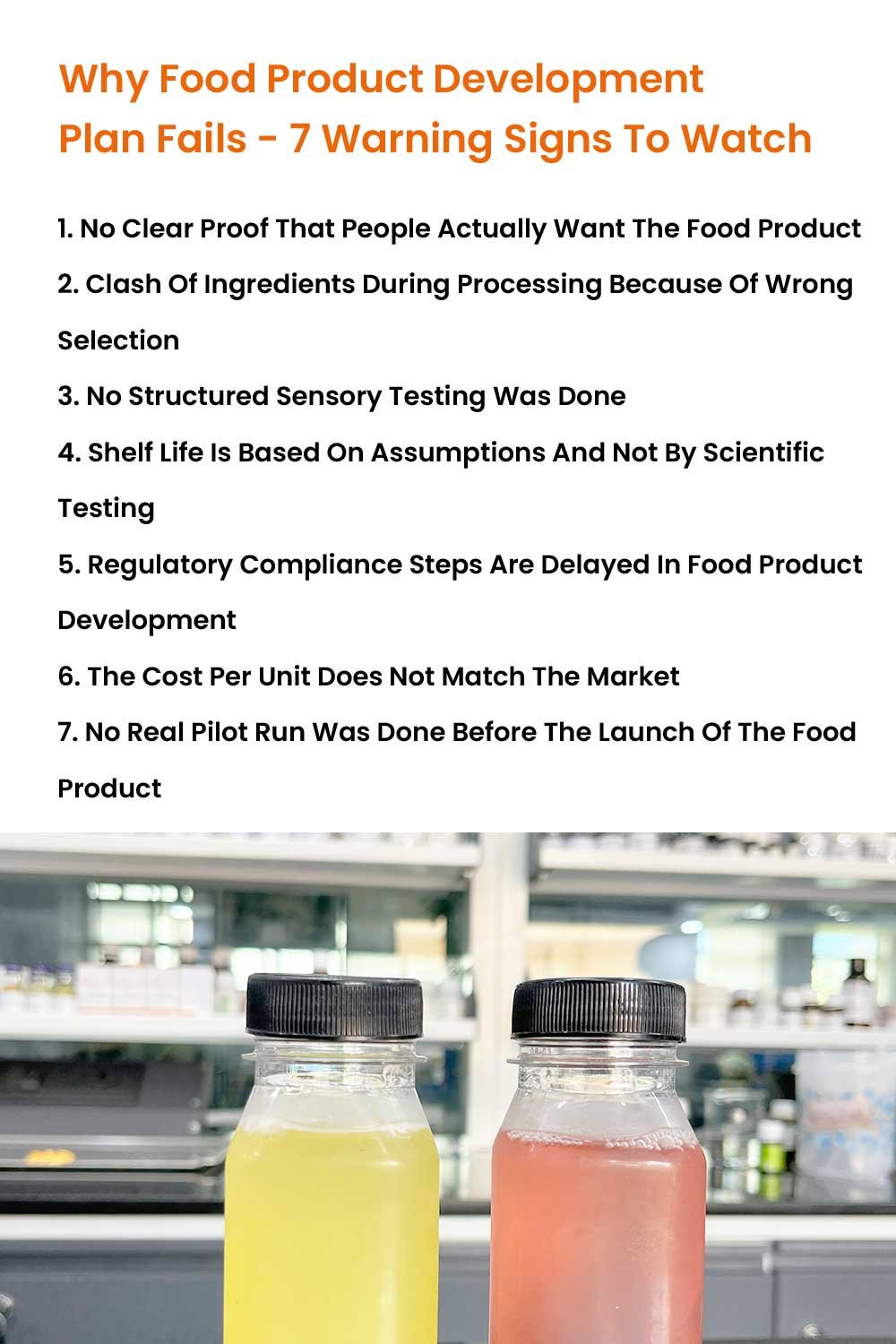
1. No Clear Proof That People Actually Want The Food Product
Many brands skip validating real demand and jump straight into custom food product development. A strong development process must start with proven consumer insights, clear targeting, and a defined problem-solution fit. Without this, even great ideas fail at launch.
2. Clash Of Ingredients During Processing Because Of Wrong Selection
Trendy ingredients don’t guarantee success in food recipe development. Poor compatibility between proteins, fibres, or botanicals can disrupt texture, stability, and taste during commercial food recipe development. Every formulation must be tested under real processing conditions.
3. No Structured Sensory Testing Was Done
Internal feedback isn’t enough in food product development. Without proper sensory evaluation methods like preference testing or blind trials, flaws in taste, aroma, or texture go unnoticed, leading to poor market acceptance.
4. Shelf Life Is Based On Assumptions And Not By Scientific Testing
Assuming stability without scientific validation weakens any product development plan. Proper shelf-life testing—covering pH, water activity, and packaging performance- is critical to ensure safety, quality, and compliance before launch.
5. Regulatory Compliance Steps Are Delayed In Food Product Development
Ignoring food regulations early in the development process can cause costly reformulations. Claims and labelling must align with local standards (FSSAI, FDA, etc.) from the beginning to avoid delays and legal risks.
6. The Cost Per Unit Does Not Match The Market
A technically strong product can still fail if the cost structure is weak. Effective commercial product development requires early cost analysis, ingredient sourcing strategy, and scalable production planning to ensure profitability.
7. No Real Pilot Run Was Done Before The Launch Of The Food Product
Lab success doesn’t guarantee factory success. Skipping pilot-scale trials in food product development often leads to inconsistency in taste and texture during mass production. A proper pilot run ensures smooth scale-up and market readiness.
How To Make Your Food Product Development Plan Powerful?
When To Bring In A Food Product Development Consultant?
Hiring a food product consultant may seem like an added cost, but it often saves time, money, and rework in the long run. An experienced consultant brings scientific expertise, cross-industry knowledge, and unbiased feedback that internal teams may overlook.
A food product development expert helps with:
- Clean-label reformulation
- Functional food and nutraceutical product development
- Ingredient sourcing and regulatory approvals
- Optimising sensory profile and texture
- Designing for scale and commercial feasibility
Working with a food recipe formulation consultant makes sure that your team avoids blind spots, validates assumptions, and delivers a product that is not only innovative but also viable and compliant.
Turn Red Flags Into Market-Ready Food Products – Get Experts’ Help!

Worried your food product might hit a roadblock before it even launches? We help you spot the issues early, refine your food recipe, and get every step right, from taste and texture to shelf-life and claims. With our hands-on support, your food product is ready not just to launch, but to last. Call our food recipe formulation experts team on +91 8130404757.
Let’s turn early warnings into a product that works. Talk to us today!
FAQs
Q1. Why do many food product development plans fail?
Because they often lack proper market demand validation before development begins.
Q2. Does assuming shelf-life without testing create issues?
Yes, untested shelf-life assumptions can lead to spoilage complaints and product recalls.
Q3. Why is regulatory compliance important from day one?
Ignoring compliance early often results in costly reformulations and launch delays.
Q4. How can cost-per-unit errors lead to failure?
If production cost is higher than market price expectations, the product becomes commercially unviable.
Q5. Why is pilot-scale production necessary?
Pilot runs help catch formulation, mixing, processing, and packaging issues before large-scale manufacturing.
Q6. Can relying on internal tasting lead to product rejection?
Yes, internal tasting can be biased; real consumer panels reveal true preferences.
Q7. What is the best way to avoid product development failures?
Follow a structured plan: validate demand, select stable ingredients, test sensory & shelf-life, estimate cost, ensure compliance, and run pilots.