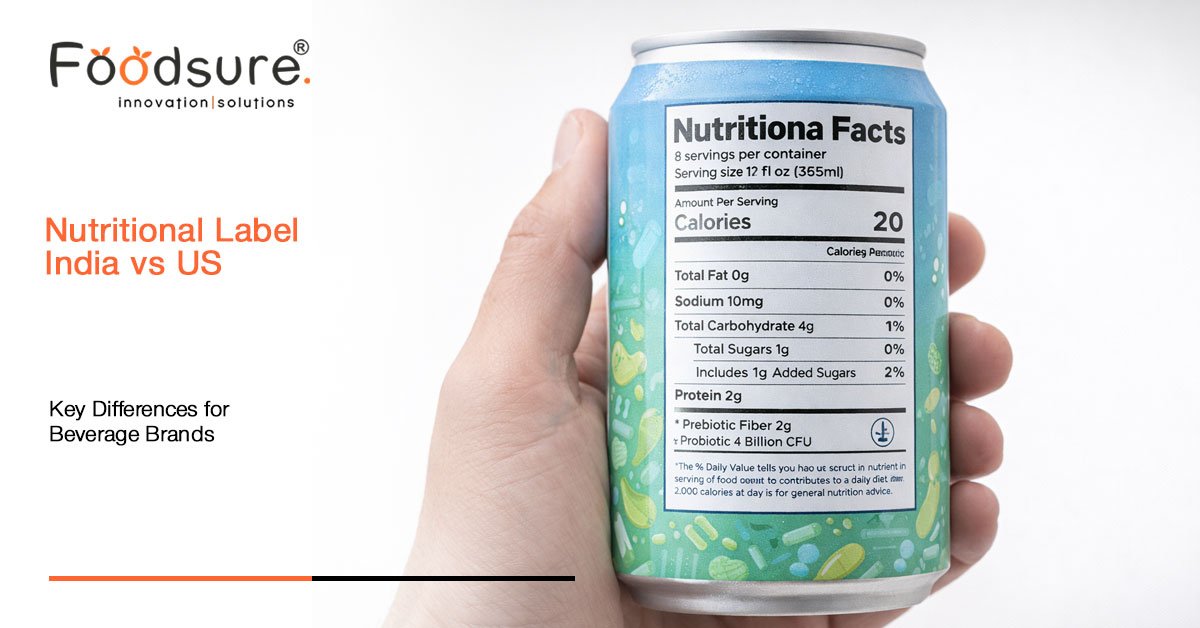
Imagine launching your beverage brand in India and suddenly getting export orders from the US. Exciting, right? But when your product reaches customs, the label gets rejected — not because of product quality, but because the nutrition panel format doesn’t match US regulations. Many founders discover too late that beverage nutrition label India vs US standards are very different. If you are planning international expansion, understanding this difference is not just regulatory — it is the difference between successful export and rejected shipments.
Before diving into the comparison, it helps to understand FSSAI labelling regulations in depth — because a brand that is not compliant in India cannot begin to think about export compliance.
Problem Statement: Beverage Labels That Work in India May Fail in the US
Many beverage brands assume that once their product is FSSAI-compliant, it will automatically meet international standards. But this is rarely the case.
The difference between US and India beverage labelling often causes:
- Export shipment rejection
- Product relabelling costs
- Customs delays
- Retail listing rejection
- Compliance penalties
Even small formatting differences in the nutrition panel can lead to non-compliance. For example:
| Factor | India (FSSAI) | USA (FDA) |
|---|---|---|
| Authority | FSSAI | US FDA |
| Label Format | Per 100g / 100ml | Per serving |
| Daily Value Reference | %RDA India | %Daily Value US |
| Calories Highlight | Not mandatory highlight | Must be prominent |
| Font & Layout | Flexible | Strict standard format |
These differences are critical when planning export beverage labelling compliance.
Why This Happens: Nutritional Label India vs US Regulations Are Built Differently
Both countries follow different nutritional labelling philosophies:
- India (FSSAI approach): Focuses on ingredient transparency and nutritional composition per 100ml or 100g — product composition view
- United States (FDA approach): Focuses on consumer serving size and daily dietary intake guidance — consumer consumption behaviour view
In short: India → Product composition. US → Consumer consumption behaviour.
This difference explains why US FDA nutrition facts vs FSSAI labelling format is significantly different — and why a label designed for one market almost always fails in the other.
Founder Pain Points: Nutritional Label India vs US Compliance
- Confusion about serving size vs per 100ml labelling
- Difficulty converting nutrition panel formats
- Rejected labels during export beverage registration
- Additional cost for label redesign
- Lack of clarity on mandatory vs optional nutrients
- Font size and layout compliance issues
- Export delays due to labelling mismatch
- Incorrect Daily Value calculations
Nutritional Label India vs US Made Easy
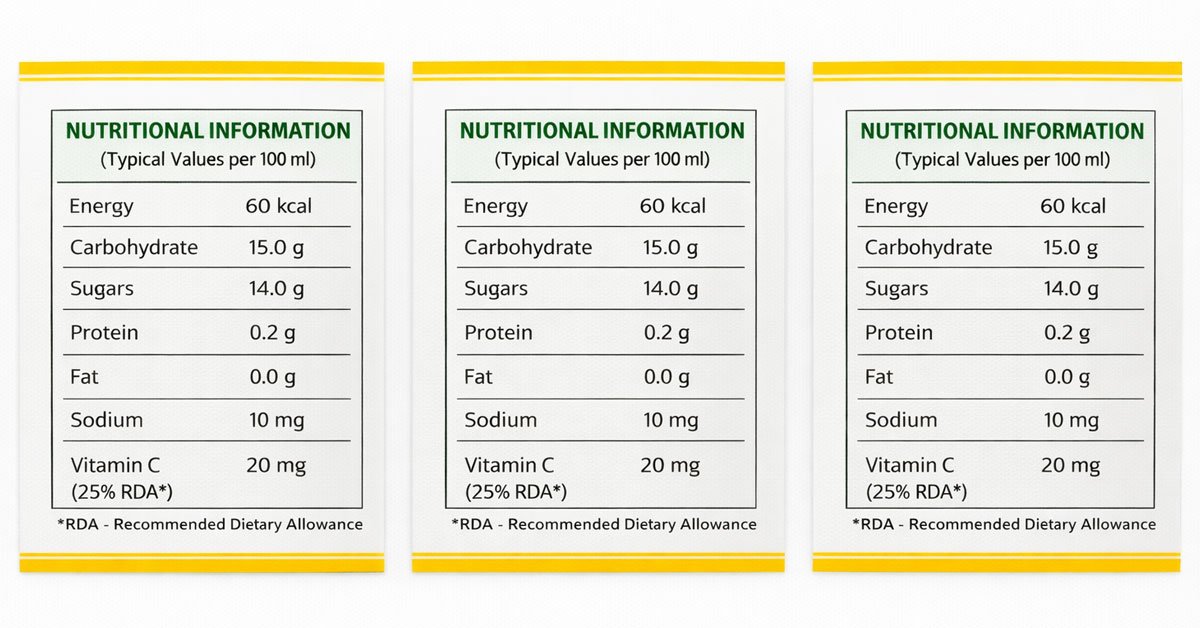
Think of India and US nutrition labels as two different languages describing the same product.
In India — the nutrition panel shows how much nutrition exists in 100ml of the drink:
| Nutrient | Per 100ml |
|---|---|
| Energy | 45 kcal |
| Sugar | 10 g |
| Protein | 0 g |
In the United States — labels focus on how much nutrition you consume per serving, plus % Daily Value:
| Nutrient | Per Serving (250ml) |
|---|---|
| Calories | 112 kcal |
| Sugar | 25 g |
| Protein | 0 g |
The US also adds % Daily Value, helping consumers understand how the drink fits into their daily diet. That is the biggest difference between US and India beverage labelling systems.
Export-Ready Label Compliance
Planning to Export Your Beverage to the US? Get Your Label Validated First
A single labelling error — wrong serving size format, missing mandatory nutrients, or non-compliant layout — can result in US Customs rejection. Foodsure converts your FSSAI label to FDA-compliant format before your shipment leaves India.
Key Differences: US FDA Nutrition Facts vs FSSAI Beverage Labels
| Element | India (FSSAI) | USA (FDA) |
|---|---|---|
| Governing Authority | FSSAI | US FDA |
| Nutrition Format | Per 100g / 100ml | Per Serving |
| Calories Display | Normal text | Large bold text |
| Added Sugar Declaration | Recently mandatory | Mandatory |
| Serving Size | Optional | Mandatory |
| % Daily Value | Based on Indian RDA | Based on US FDA DV |
| Label Layout | Flexible | Fixed template |
| Nutrients Required | Energy, protein, fat, carbs, sugar | Larger nutrient list including Vitamin D, Potassium |
This beverage nutrition label India vs US difference means that export brands almost always need two different label formats. This is exactly why working with a beverage regulatory compliance partner from the packaging design stage — not after — saves significant time and money.
Export Beverage Labelling Differences You Must Know
When exporting beverages from India to the US, companies must ensure the following:
Serving Size Calculation
US labels must specify serving size and servings per container — this is mandatory and must reflect actual consumption norms for the beverage category.
DA Nutrition Panel Format
The Nutrition Facts box format is strictly regulated — font sizes, layout, bold requirements, and order of nutrients are all fixed by FDA guidelines.
Mandatory Nutrient Disclosure
The US requires additional nutrients beyond what FSSAI mandates:
- Added sugars
- Vitamin D
- Calcium
- Iron
- Potassium
Calorie Highlight
Calories must appear in large bold font — a specific requirement with no equivalent in FSSAI format.
Ingredient Order
Ingredients must be listed in descending weight order — same principle as FSSAI, but the specific wording and allergen declaration format differs.
Export-Ready Beverage Labelling Checklist
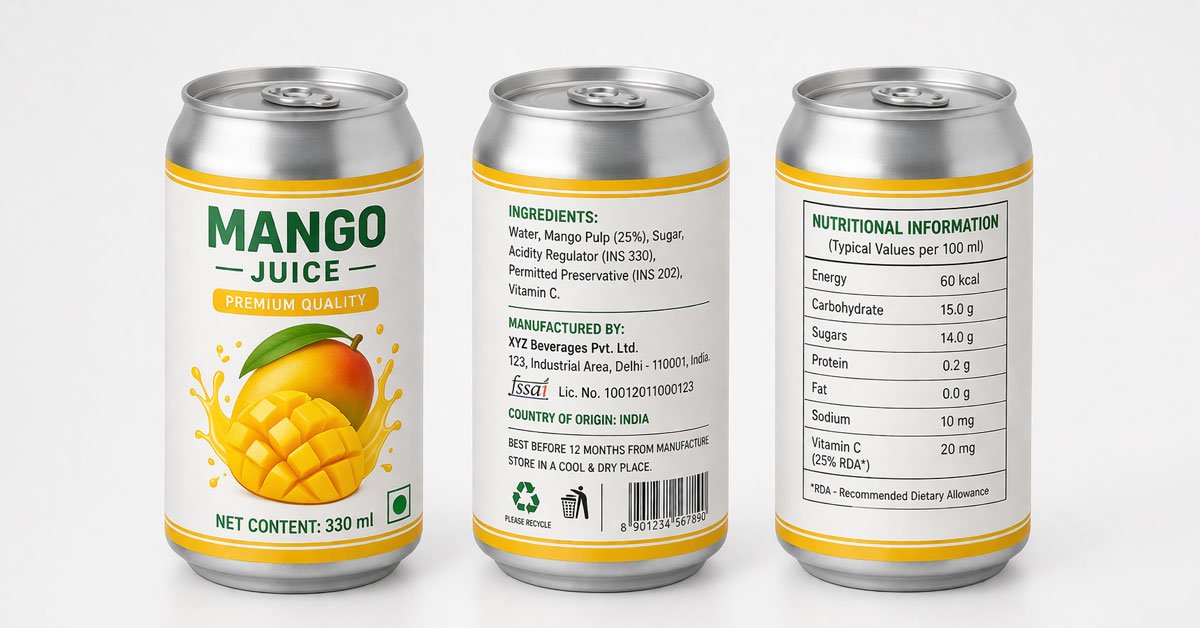
If you want to export beverages internationally, your label must include:
- Product name
- Net quantity
- Ingredient list
- Allergen declaration
- Nutrition panel (FDA format for US)
- Manufacturer details
- Country of origin
- Importer information
- Batch number
- Expiry or best-before date
This checklist ensures drink labelling compliance for both India and international markets. For a full domestic compliance checklist, our guide to FSSAI label compliance for beverage startups covers every mandatory element in detail.
Something Most Beverage Founders Don’t Realise
A major mistake many brands make is designing one universal label. In reality, global beverage brands create separate labels for each market:
- India domestic label
- US export label
- EU export label
- Middle East label
Each market has different beverage regulation requirements. For startups, building an export-ready label from the beginning saves significant cost and time — and is far cheaper than redesigning after a rejection.
What Actually Works
Brands that successfully export beverages follow a structured approach:
- Step 1: Design labels based on target market regulations — not one-size-fits-all
- Step 2: Convert nutrition panel format correctly — per 100ml to per serving
- Step 3: Use regulatory experts to validate labels before print
- Step 4: Ensure FDA or FSSAI compliant layout as applicable
- Step 5: Run a final regulatory audit before printing
This approach avoids costly compliance errors. The beverage startup cost of getting a label wrong — through rejected shipments, relabelling, and customs delays — typically far exceeds the cost of getting expert compliance support upfront.
How Foodsure Helps With Labelling Compliance
Navigating nutritional label India vs US compliance can be complex, especially for beverage startups planning exports. Foodsure helps brands with:
- Nutrition panel conversion from FSSAI to FDA format
- FDA and FSSAI label compliance review
- Export documentation support
- Ingredient verification and allergen declaration
- Market-specific labelling strategy
This helps beverage brands launch globally compliant products faster.
Founder Takeaway on Nutritional Label India vs US
If you are building a beverage brand, remember: a compliant product is not enough — a compliant label is equally important. Understanding the difference between US and India beverage labelling early helps you avoid export rejections, save relabelling costs, speed up market entry, and build global-ready brands. In today’s global beverage market, label strategy is a growth strategy.
Conclusion
The nutritional label India vs US comparison reveals that while both systems aim to inform consumers, their structure and compliance requirements are very different. India’s FSSAI labelling system focuses on product composition, whereas the US FDA nutrition facts system focuses on consumer serving behaviour and dietary impact.
For beverage founders planning international expansion, understanding these export beverage labelling differences is critical. Proper compliance ensures smooth exports, faster regulatory approvals, and stronger brand credibility in global markets.
Go Global With a Compliant Label
Make Your Beverage Label Export-Ready for the US — Before Your Shipment Leaves India
Foodsure converts your FSSAI nutrition panel to FDA-compliant format, reviews allergen declarations, validates mandatory nutrients, and ensures your label clears US Customs and retail listing requirements.
✓Mandatory Nutrient Review
✓Export Documentation Support
Frequently Asked Questions
What is the main difference between US FDA nutrition facts vs FSSAI labelling?
India uses per 100ml nutrition values, while the US uses per serving nutrition facts with % Daily Value references based on US dietary guidelines.
Is the nutrition panel format the same in India and the US?
No — the US FDA has a strict Nutrition Facts box format with fixed layout, font sizes, and mandatory bold elements, while FSSAI allows more flexibility in format.
Can the same beverage label be used for India and US exports?
Usually no. Brands almost always require separate label formats for each market — different format, different mandatory nutrients, and different layout requirements.
What nutrients are mandatory in US beverage labels?
Calories, total fat, sodium, carbohydrates, added sugar, protein, Vitamin D, calcium, iron, and potassium are all mandatory in the US FDA Nutrition Facts format.
Why do beverage exports fail due to labelling?
Incorrect nutrition panel format, missing serving size declaration, wrong font layout, or missing mandatory nutrients are the most common reasons for US Customs rejection of Indian beverage exports.