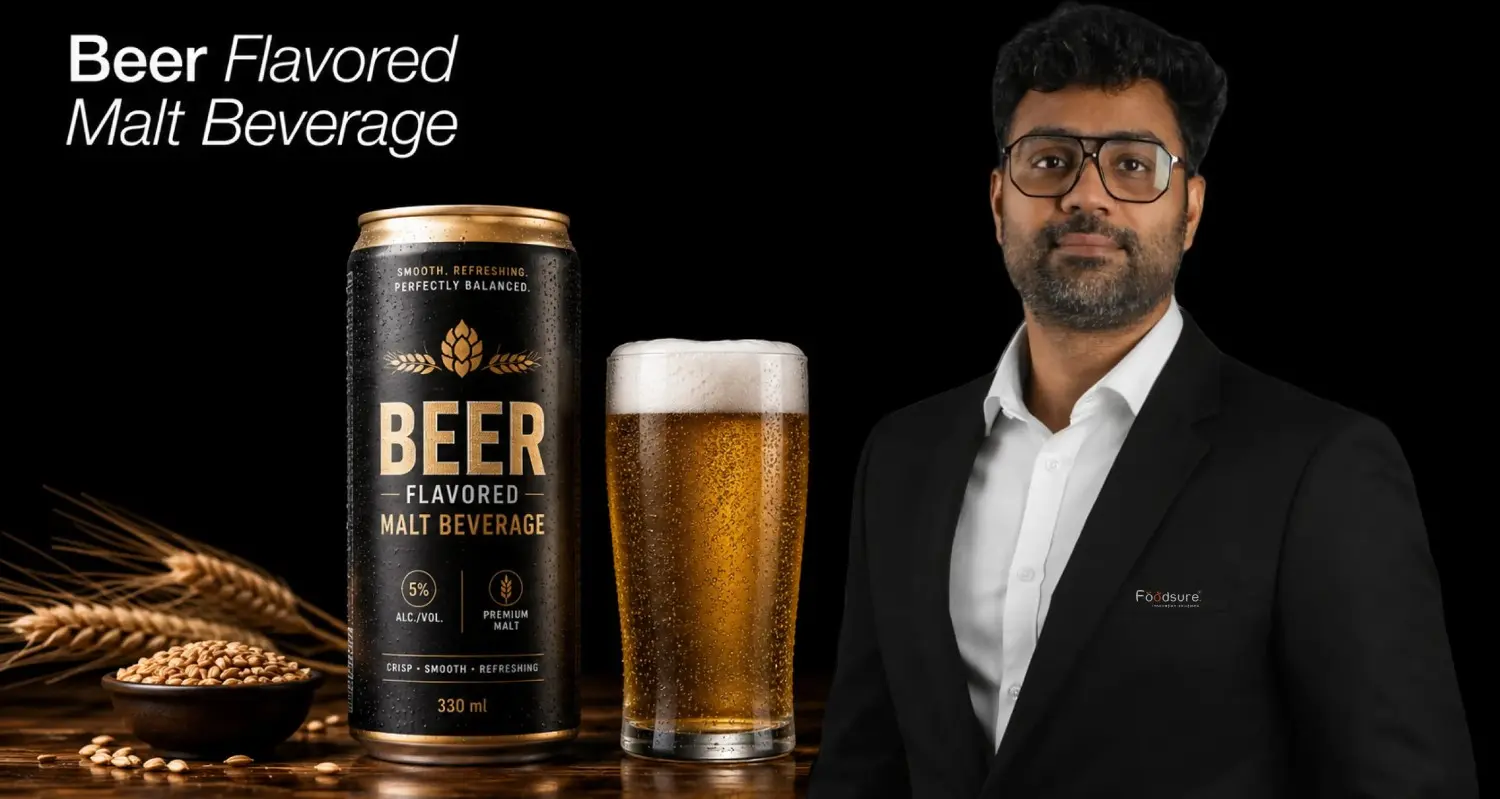
Complete Guide from Recipe Formulation to Commercial Manufacturing
Enter any contemporary F&B retail shelf and you’ll find one sector booming quietly.
Non-alcoholic beer. Beer coolers. Hopped beverages.
They’re products that consumers enjoy the occasion of drinking beer without the alcohol content, and companies are competing for the business.
However, crafting a malt beverage that truly delivers the right beer flavor is not as easy as it sounds.
It is in the formulation of a malt beverage that determines whether it will be consumed once or repeatedly.
At Foodsure, we assist beverage companies, QSRs, and F&B start-ups in formulating malt-based beverages.
Why Malt Beverage Formulation Matters
Consumers are not purchasing malt beverages for the packaging; they are purchasing them because of the enjoyment of “beer, without the buzz.”
Good malt beverage formulations can:
- Match Real Beer Flavor
- Reduce Repeat Purchasing Costs
- Develop a Strong Brand Image
- Serve Multiple Purposes (social, sober, sports)
- Enhance Credibility of Category
Quite often, many of the fastest-growing beverage brands in existence today are based on a single hop & malt profile.
Understanding Indian Consumer Psychology
Indian consumers analyzing the malt beverage consider:
- Characteristic Beer Aroma
- Bitter-Balance
- Mild Carbonation
- Clean Finish
- Minimal or No Sweetness Perception
Unlike in the West, Indian consumers tend to be sampling non-alcoholic beer for the very first time. Straight import does not work. The formulation has to resonate as being authentic but still easily approachable.
Popular Malt Beverage Categories
Non-Alcoholic Beers
- Lager Classic Format
- Wheat Format
- IPA Craft Format
Malt-Based Ready-to-drink Beverages
- Ginger Malt Cooler
- Citrus Malt Soda
- Herbal Malt Fusion
Functional Malt Beverages
- Electrolyte Malt Beverage
- Low Calorie Malt Cooler
- High Protein Malt Beverage
Hops-Focused Beverages
- Hop Water
- Hop Infused Soda
- Session Style Hop Cooler
Fusions of malt, hops, and functional elements are showing the most differentiation.
Step 1: Define the Consumer
Before formulation starts, answer one question: who is this for?
Youth Market
- Bold Hop Character
- Social Occasion Positioning
Health-Conscious Consumers
- Low Sugar
- Clean Label Claims
Premium Consumers
- Craft Positioning
- Imported Flavor Cues
Value Segment
- Cost-Optimized Base
- Simplified Ingredient Deck
The target consumer drives every decision in the malt beverage formulation process, from hop dosage to sweetness level.
Step 2: Build the Flavor Architecture
An effective beer-flavored drink has to be complex in its flavor, rather than just have a simple one-note flavor.
Base Notes give structure and substance. Example Ingredients: malt extract, barley malt base, light caramel malt.
Middle Notes give the taste of beer. Example Ingredients: barley flavor, light yeast flavors, roasted grains.
Top Notes give an immediate impression. Example Ingredients: hop extract, citrus hop oils, herbal hop blends.
Doing this correctly is what makes or breaks a formula’s authenticity.
Malt Beverage Formulation Development Flow Chart
Consumer Research
↓
Benchmarking
↓
Formulation of Recipes
↓
Lab Experiments
↓
Sensory Assessment
↓
Pilot Run
↓
Stability Studies
↓
Packaging
↓
Mass Production
↓
Market Launch
Step 3: Focus on Mouthfeel and Carbonation
Mouthfeel is often what separates a premium malt beverage from a generic one.
Consumers immediately notice:
- Flat Carbonation
- Watery Body
- Harsh Bitterness
- Artificial Aftertaste
Premium malt beverage formulation requires:
- Balanced Carbonation
- Rounded Mouthfeel
- Smooth Bitterness Curve
- Clean Finish
Foodsure typically uses controlled carbonation systems and bittering-unit calibration to fine-tune this balance during trials.
Step 4: Build Shelf Stability
Many startups formulate a great-tasting sample that fails after a few weeks on shelf.
Common issues include:
- Hop Flavor Fade
- Carbonation Loss
- Color Drift
- Sediment Formation
- Short Shelf Life
Shelf stability must be engineered into the malt beverage formulation from day one, validated through accelerated stability testing, not discovered after launch.
Step 5: Select the Right Processing Equipment
Commercial-scale production requires the right processing line.
Processing Section
- High Shear Mixer
- Carbonation Unit
- Filtration System
Brewing/Cooking Section
- Wort Preparation Vessel
- Steam-Jacketed Kettle
Filling Section
- Isobaric Filler
- Automatic Bottling Line
Quality Section
- pH Meter
- Brix Meter
- Bitterness (IBU) Testing
The right equipment setup is what allows a lab-perfected malt beverage formulation to scale into consistent commercial batches.
Step 6: Packaging Development
The beer-style product is evaluated by consumers even before tasting the drink.
This means that packaging needs to convey:
- Craft/Premium Signal
- Visual identity of beer-style drinks
- Non-Alcoholic Clear Signal
The popular options are:
Glass bottles: to signal authenticity and premium positioning of the product.
Cans: to be cost-effective and easy-to-use during retail and events.
PET bottles: to be convenient for QSR and large sizes.
Common Mistakes During Malt Beverage Formulation
Mistake 1
Copying international recipes without adapting to Indian palate expectations.
Mistake 2
Skipping accelerated stability testing before scale-up.
Mistake 3
Over-indexing on hop bitterness without balancing mouthfeel.
Mistake 4
Using flavor systems that cannot survive pasteurization or carbonation.
Mistake 5
Ignoring production realities during early-stage recipe development.
A commercially viable malt beverage formulation must work in the lab and on the production line.
Why the Indian Market Needs Malt Beverage Innovation
India is seeing rapid growth in:
- Non-Alcoholic Beverage Occasions
- Health-Conscious Retail Categories
- QSR and Cloud Kitchen Beverage Menus
- Sober-Curious Consumer Behavior
As competition rises, a distinctive malt beverage formulation is one of the fastest ways for a brand to stand apart on a crowded shelf.
Why Brands Work with Foodsure
Foodsure supports:
- Hop and Malt Flavor Development
- Functional Beverage Fortification
- Accelerated Stability Testing
- Pilot Batch Production
- Contract Manufacturing
- Commercial Launch Support
Our focus is helping brands take a malt beverage formulation from concept to shelf-ready product without compromising taste or scalability.
Conclusion
Malt drinks tasting like beer are not a fringe experiment anymore.
They represent a true growth category for beverage brands in India.
A consumer might forget a regular soft drink. However, he will always remember a properly formulated malt drink that genuinely tastes as it should.
The brands investing now in the development of proper malt formulations are establishing a category advantage for themselves, which will be difficult to copy in the future.
If you are formulating a non-alcoholic lager, hop-based cooler or a functional malt RTD, the formulation and process know-how is crucial.
Looking to Develop a Beer-Flavoured Malt Beverage?
- Malt Beverage Recipe Formulation
- Hop Extract and Flavor Development
- Accelerated Stability Testing
- Pilot Batch Production
- Packaging Development
- Commercial Launch Assistance
Check the feasibility of your malt beverage formulation today.
Contact
Email: [email protected]
FAQs
What gives a malt beverage a beer-like taste without alcohol?
The right combination of malt, barley, and hop extract provides the taste of beer. The beverage is completed by carbonation and proper bitterness.
Are malt beverages completely alcohol-free beverages?
Yes. They can be produced at a 0.0% alcohol level using non-fermented malt extracts or through dealcoholization, retaining beer-like taste.
How much time does it take for a malt beverage formulation to reach its market?
It usually takes a few weeks, including the entire process – from the development to pilot batch production.
Which type of packaging is the best one for malt beverages?
Glass bottles make the product premium, cans are convenient in retail, PET bottles are perfect for QSR.
Does Foodsure provide malt beverages contract manufacturing services?
Yes. Foodsure develops, produces, and documents FSSAI-approved formulations of malt beverages.