Launching a beverage brand looks deceptively simple from the outside. A flavour idea, a label design, a co-packer, and suddenly you’re “nearly ready”. Yet in reality, beverage startup costs frequently collapse long before the first bottle reaches a shelf.
Across early-stage beverage ventures, it’s common to see ₹30–50 lakhs spent before a single marketable sale, not because founders are careless, but because the sequence of decisions is flawed. Money leaks through formulation resets, compliance corrections, packaging changes, and product misalignment, each appearing minor in isolation, but disastrous in total.
This composition breaks down where beverage startup costs in India quietly escalate, why these charges feel necessary at the time, and how market discipline, not cost-cutting, prevents burnout.
Why Beverage Startup Cost in India Is Rarely a Single Number
One of the major assumptions founders make is treating the beverage startup cost in India as a fixed capital requirement. In reality, it behaves more like a leak-prone system, expanding every time a decision is made without downstream visibility.
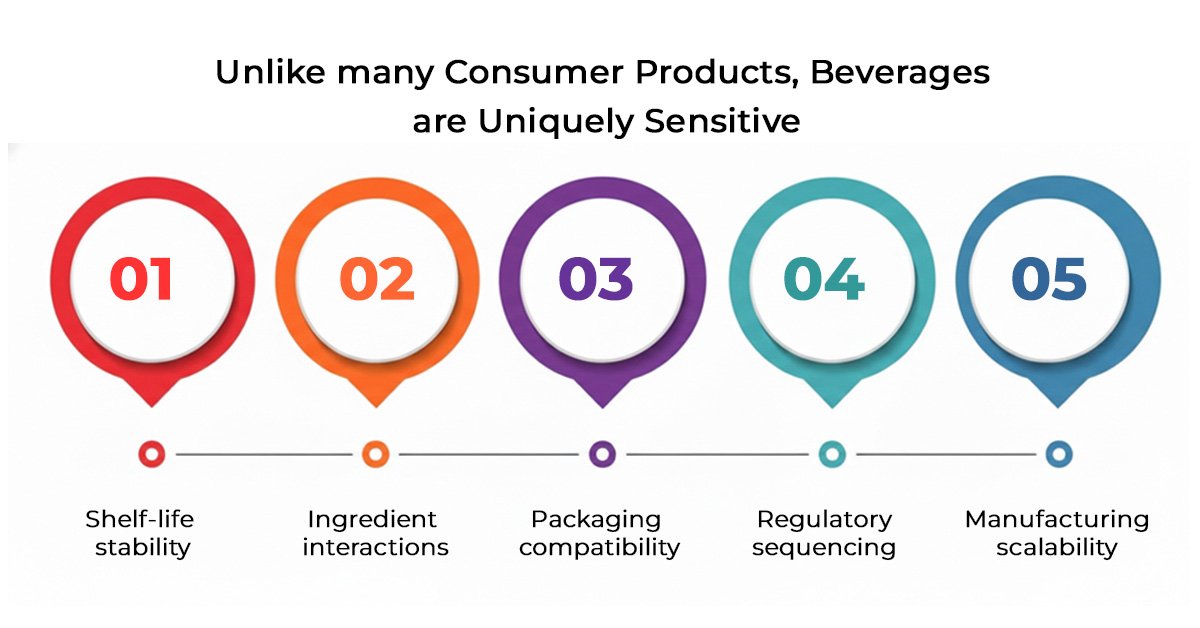
Unlike many consumer products, beverages are uniquely sensitive to:
- Shelf-life stability
- Ingredient interactions
- Packaging compatibility
- Regulatory sequencing
- Manufacturing scalability
Each oversight multiplies beverage manufacturing cost rather than adding to it linearly.
Mistake #1: Product Development Without Commercial Boundaries
Beverage Product Development Cost Is Where Most Burn Begins
Early enthusiasm frequently leads founders to over-invest in perfection before feasibility. Multiple lab trials, flavour variants, and ingredient substitutions feel like progress, but without market constraints, beverage product development costs quickly go up.
Common cost traps include:
- Reformulating after shelf-life failures
- Switching constituents due to late compliance discoveries
- Revamping sweetness or acidity after airman feedback
- Repeating trials to match an “imported taste standard”
Each reset increases beverage R&D cost, while pushing manufacturing viability further down.
Mistake #2: Underestimating Beverage Compliance Cost
Compliance Is Not a Checkbox: It Is a System
Numerous startups assume compliance happens after the product is ready. This misunderstanding alone accounts for a significant chunk of beverage startup costs overruns.
Hidden compliance drains include:
- Ingredient approvals were missed during formulation
- Label design after regulatory review
- Nutritive recalculation due to minor recipe changes
- Packaging textbook re-printing
Every improvisation adds time and compounds beverage compliance cost, often forcing earlier charges to be written off entirely.
Mistake #3: Packaging Decisions Made in Isolation
Beverage Packaging Expenses Are Locked-In Costs
Packaging is often chosen for visual appeal rather than production logic. Unfortunately, packaging errors are among the most expensive to reverse.
Where beverage packaging charges escalate:
- Bottle shapes incompatible with filling lines
- Caps or seals failing pressure or shelf tests
- Label materials reacting to humidity or condensation
- Minimal order amounts that block iteration
Once packaging is procured, it anchors beverage manufacturing cost, even if the product itself changes.
Mistake #4: Production Setup Before Demand Validation
Beverage Production Setup Is Not a Milestone: It’s a Commitment
Securing a co-packer or product slot feels like progress, but premature setup frequently accelerates losses. Founders lock into:
- Batch sizes larger than market demand
- Equipment unsuitable for future SKUs
- Cost structures are impossible to sustain at low volumes
These opinions inflate beverage production setup costs long before revenue validates them.
Mistake #5: Scaling Before System Stability
Scaling Magnifies Every Hidden Cost
When traction appears beforehand, startups rush to scale without functional maturity. Unfortunately, insecurity compounds faster at volume.
Scaling failures generally increase:
- Wastage from inconsistent batches
- Logistics losses from fragile packaging
- Returns due to shelf-life mismatch
- Brand damage is taking a relaunch
At this stage, the beverage startup cost in India transforms from investment into unrecoverable burn.
How ₹30–50 Lakhs Disappear: A Realistic Cost Stack
Without country-specific figures, the pattern remains consistent:
- Repeated formulation trials
- Compliance revisions
- Packaging reorders
- Airman product losses
- Adviser corrections
- Idle force
None of these is neglected in the moment. Collectively, they explain why beverage startup costs in India routinely exceed founder projections.
The Real Issue: Sequence, Not Spending
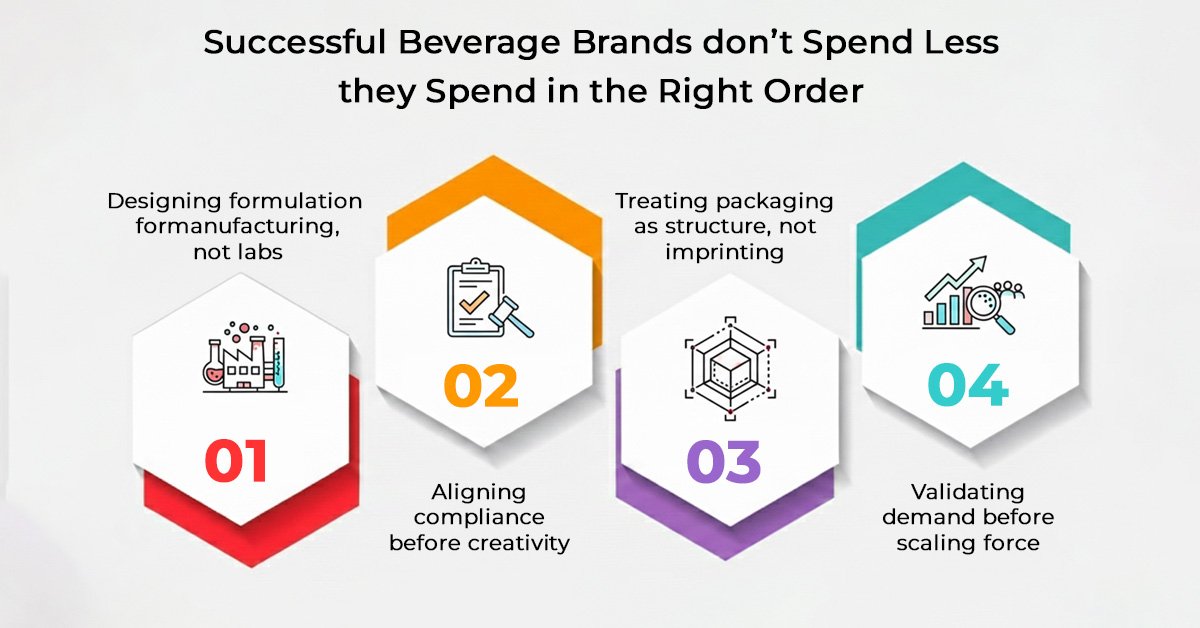
Successful beverage brands don’t spend less; they spend in the right order. Commercial discipline means:
- Designing formulation for manufacturing, not labs
- Aligning compliance before creativity
- Treating packaging as structure, not imprinting
- Validating demand before scaling force
When the sequence is correct, beverage manufacturing cost becomes predictable rather than punitive.
Related Reads for Beverage Founders
- Beverage Startup Failure Reasons
- Beverage Scale-Up Failure
- Beverage Formulation Cost
- Beverage Manufacturing SOP
- Beverage Product Development
- Steps to Start a Beverage Company
Conclusion
Burning ₹ 30–50 lakhs before the first trade isn’t a failure of ambition; it’s a failure of sequencing. Beverage startup cost in India rises when decisions are made emotionally rather than systemically.
Founders who survive early stages understand that beverages aren’t just products; they are interdependent systems of formulation, regulation, packaging, and production. Ignoring that reality is expensive.
At Foodsure, the focus isn’t on shortcuts, but on structuring beverage ideas to survive marketable reality before capital is committed. If you’re serious about protecting your early investment and building a beverage brand that scales sustainably, the right conversations need to happen before money starts leaking.
The smartest next step is not spending more, it’s spending with foresight.
Planning Your Beverage Startup Budget?
Most beverage founders lose ₹30–50 lakhs due to late formulation fixes, compliance rework, and scale-up mistakes.
FoodSure helps you plan formulation, packaging, compliance, and manufacturing costs right—before money starts leaking.
Trusted by 100+ beverage founders across formulation, compliance, and manufacturing
FAQs
What is the biggest contributor to the beverage startup cost India overruns?
Repeated formulation and compliance corrections are the largest hidden contributors.
Why is beverage product development cost so unpredictable?
Because ingredient interactions, shelf life, and scalability are often tested too late.
Can beverage compliance cost be reduced?
It can’t be eliminated, but early integration prevents expensive rework.
Why are beverage packaging expenses hard to reverse?
Packaging involves tooling, minimum quantities, and production compatibility.
Is small-batch production safer for new brands?
Only if the process mirrors future commercial conditions.
How does beverage manufacturing cost change at scale?
Costs stabilise only when formulation and packaging are already optimised.
Should startups secure co-packers early?
Only after formulation and compliance are production-ready.
Why do many startups fail after pilot success?
Pilot success often masks system instability at scale.
Can consulting reduce beverage R&D cost?
Yes—when it aligns technical decisions with commercial realities.
When should founders plan for scale?
After repeatable quality, compliance stability, and demand validation are proven.