You have the product, you have a concept, maybe you have even tried some recipes in your kitchen, or you have heard from your friends that your product is better than any product available in the market. So what is the capital required for this business?
This is certainly a question worth asking, but difficult to give an answer to it all by yourself. If you type ‘food startup cost in India‘ on Google, you will find results ranging from INR 50,000 to INR 50 lakh, which cannot help you at all. This blog will clear your doubts on this matter.
This report analyses the true costs involved in setting up a food business in India for the year 2026, taking into account all aspects from compliance and packaging to production and promotion.
The Real Problem: Most Founders Are Calculating the Wrong Things
Typically, a founder’s budget plan usually goes as raw material costs, one-time packaging, limited-scale production run. That’s all. But then the harsh reality hits.
A proper food startup cost in India includes a lot more than the first batch, as it includes-
- FSSAI approval and compliance costs
- Testing in the lab and shelf life studies
- Packaging design, printing, and high MOQ commitments
- Repetition of the reformulation process if the first attempt fails
- Marketing and distribution investments to make it work
Founders don’t fail because the idea is weak. They fail because cash flow breaks before the business stabilises.
Why the Cost to Start a Food Business in India Feels So Unpredictable
Truth be told, there is no single figure for the cost of starting a food business in India. This varies widely depending on what exactly you plan on making.
Homemade granola, a plant-based protein beverage, and a frozen snack are three very different products from a regulatory, shelf-life, manufacturing, and packaging perspective. Searches for the cost of starting a food business in India yield very varied results because it’s structural, meaning it’s dependent on your choices rather than a particular product category.
India’s food processing industry, valued at over INR 33 lakh crore in 2025, is projected to nearly double to INR 65.83 lakh crore by 2034, highlighting strong long-term opportunities for food brands. That’s why cost comparisons between two food businesses usually don’t hold water without knowing what exactly went into each.

What Founders Usually Don’t Anticipate
After interacting with different food companies in various stages, a few cost patterns emerge consistently:
- Recipe formulation is costly- Most products undergo at least two to three iterations of taste and texture improvements to satisfy quality standards. More iterations mean additional costs.
- MOQs in packaging are underestimated- The MOQs set by printers or packaging providers can be as high as 1,000 or 5,000 units. A founder expecting an order of 200 units may find himself stuck with unsold inventory.
- Compliance is mandatory- FSSAI license, quality tests, and labels are a must. Any deviation from these steps will result in complications during distribution.
- Delays result in more costs– A launch delayed by two months equates to spending another two months storing the products and building momentum lost due to the initial progress.
Invisible costs usually account for an extra 30% to 60% of the original cost estimates. They do not signify poor budgeting, but rather a budget that fails to account for all variables.
Food Startup Budget Breakdown India: What the Numbers Actually Look Like (2026)
Here’s how food product launch cost in India actually breaks down across the major cost areas, for two common launch models:
The above figures show the budget allocation for food startups in India in the year 2026. For a lean D2C, the cost of launch ranges from ₹3-5 Lakhs. Most mid-scale brands are considering around the ₹6-12 lakh mark for a modern trade or fast trade. The amount needed for creating an export-ready brand depends on the requirements of the export market, ranging from ₹12–25 lakhs or even above.
What Actually Works: How Smart Founders Control Food Brand Budget India
Those founders who start off well and remain financially sound share a handful of traits:
- They have fewer SKUs to begin – One or two products to demonstrate the concept, not a big lineup. It saves complexity and cost and helps to avoid a too-early focus split.
- They work with contract manufacturing- They do not construct a plant, but rather use a co-manufacturer instead. This eliminates the hefty initial capital investment and maintains food startup cost in India at the early stages.
- They don’t aim for perfection before launch– The difference between a product ready, and a product endlessly refined. One of the most common reasons for the undetected rise in the costs of food product development in India is over-formulation.
- Marketing is a priority early on – When a product brand waits until “everything’s perfect” to start investing in marketing, it usually has a hard time building momentum. People don’t like it when it’s distributed without awareness of the individual.
- They test before growing– The food brand launch budget in India is kept in check by launching in one channel or market, proving sell-through, and then expanding, as opposed to wishing to be in all markets simultaneously.
The total investment needed to launch a food brand in India is not reduced by cutting corners. It’s optimised by deciding what deserves investment first and what can wait.
How a Structured Launch Model Changes the Numbers
One of the reasons food startup cost in India run over budget is fragmentation. Founders are managing formulation discussions with one party, compliance documentation with another, manufacturer relationships separately, and packaging vendors on their own – with no single view of how these pieces interact.
When formulation, compliance, and manufacturing are aligned under one framework, the cost of errors drops significantly. Fewer reformulation cycles. Cleaner regulatory timelines. Packaging decisions that factor in manufacturing constraints from the start. This is where working with a food startup consultant in India – one that integrates these functions – changes the total investment needed to launch a food brand in India, not just the headline spend.
Foodsure supports food and beverage founders in building this kind of structured launch system, reducing early-stage uncertainty across formulation, compliance, and go-to-market planning.

Founder Takeaway
The real question is not “how much does it cost to start a food startup in India in 2026?” The real question is how clearly do you understand your cost structure before you start spending?
Founders who answer that question first – who map out the food startup budget breakdown in India before committing capital make fewer expensive mistakes. They don’t necessarily spend less. They spend better.
A food brand is not built on a good recipe. It’s built on a good system. And the first version of that system is a realistic budget.
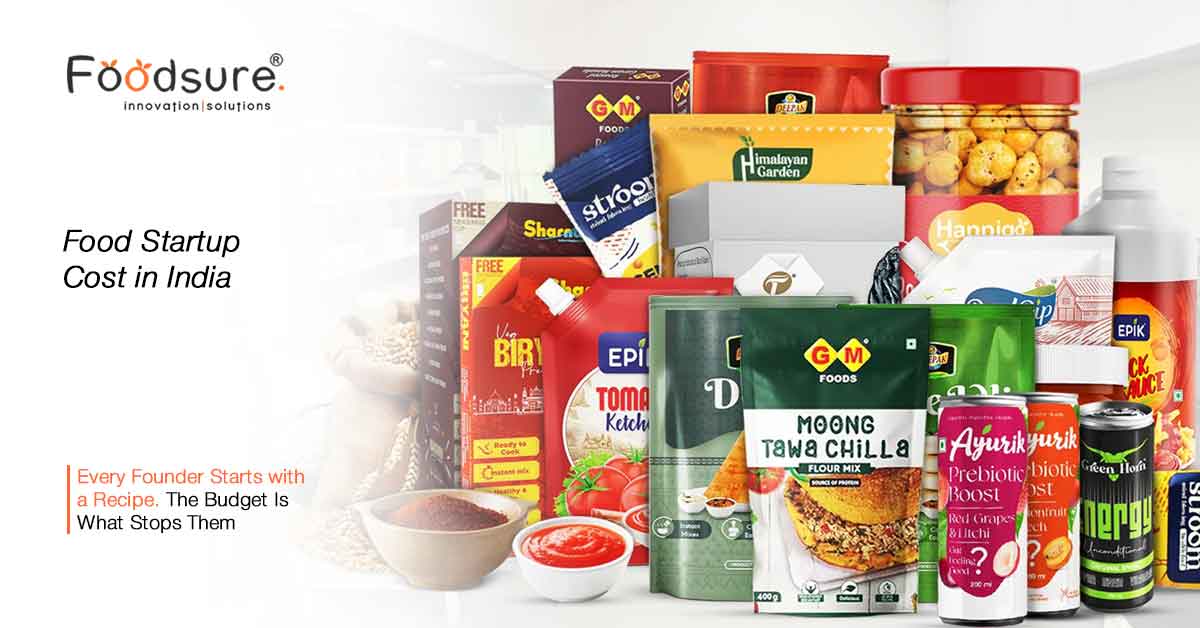
Food Startup Cost in India: Every Founder Starts with a Recipe
Starting a food business in India involves product development, FSSAI licensing, packaging, manufacturing, branding, and market launch expenses. Build a scalable and market-ready food startup with proper planning, cost optimisation, regulatory compliance, and efficient production systems designed for D2C brands, retail expansion, and long-term business growth.
FAQs
- How much money is required for setting up a food business in India?
Food startup cost in india varies depending on the type of food products and food business models. For example, a lean D2C food brand could launch at ₹3-5 lakhs, whereas a retail food brand or export food brand may require ₹8-25 lakhs.
- How much minimum investment you need for a food business?
A very lean business model of food business startups could require ₹2.5-3 lakhs of investment if it follows a single SKU, contract manufacturing, and launches only via a direct-to-consumer channel.
- What are the hidden costs of starting a food business?
Hidden costs in setting up a food business could include additional reformulation cycles, waste incurred from minimum order quantity of packaging, lab testing charges, compliance-related costs, and delay costs associated with delays in launches.
- How much money would you need to set up a food business in 2026?
There would be little variation in the budget for launching a food brand in 2026 compared to the budget today in India. However, the cost of inputs such as packaging, lab tests, and logistics will increase.
- How much money do you need to invest to start a food brand in India?
The investment needed to launch a new food brand in India depends on many factors but usually lies between ₹3 lakhs and ₹25+ lakhs.
- Is contract manufacturing a good method for cutting costs in India’s food industry?
Definitely. Contract manufacturing is among the top methods that can help to lower costs at a food startup stage in India. This method helps you avoid expenses related to facility building and operate according to a variable cost model based on your order volume.
- What is the cost of food product development in India?
The main cost components of food product development are ingredient selection and trials, laboratory analysis of safety and shelf-life, formula documentation, and reformulation in case of necessary changes in the recipe. The approximate price range for this service is ₹20,000 – ₹1.5 lakhs