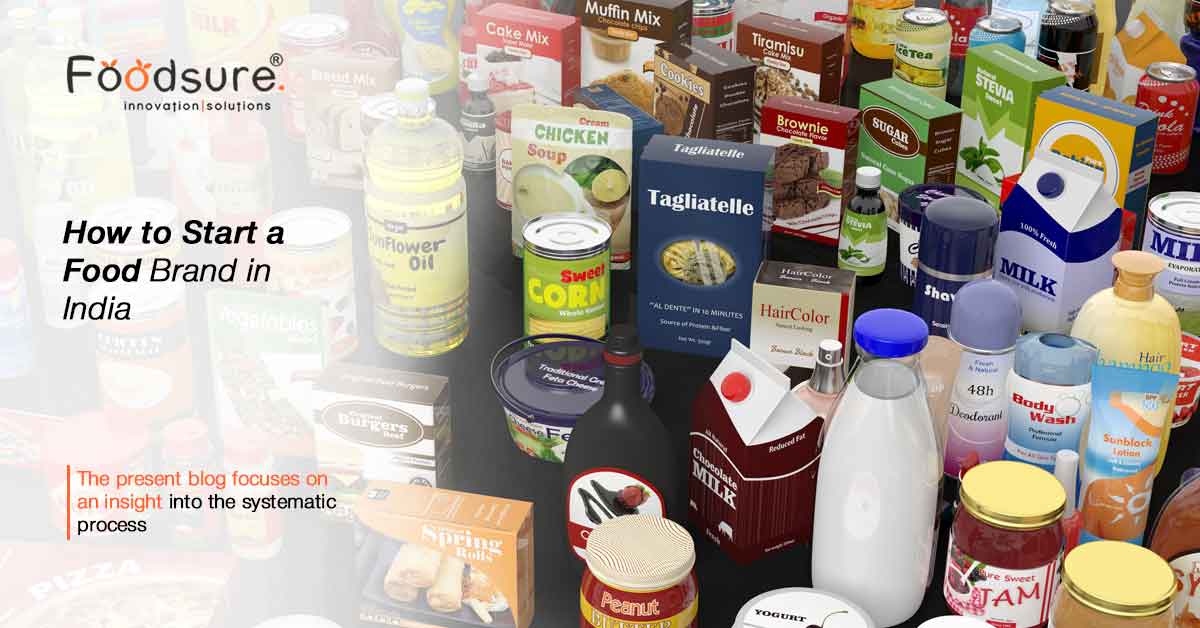
Despite the growth of the food industry in India, there is no denying that the failure rate of food brands emerging in the market is quite alarming. This is because many entrepreneurs pay more attention to product ideas and marketing efforts without paying attention to other aspects of brand creation. Understanding How to Start a Food Brand in India is important, as the success or failure of a brand ultimately depends on its manufacturing capability, compliance structure, and profit margins.
How to Start a Food Brand in India Step by Step 2026
India’s food processing industry, valued at over INR 33 lakh crore in 2025, is projected to nearly double to INR 65.83 lakh crore by 2034, highlighting strong long-term opportunities for food brands. The Steps of launching the food brand in India in a step-by-step way in 2026 are as follows:
Step 1 – Market Validation- During the pre-production phase, production founders test the demand either by sampling, surveying, or conducting a trial production.
Step 2 – Product Development- Final product formulation, taste calibration, shelf-life management, and cost optimisation processes are conducted.
Step 3 – Compliance Management- The food products get FSSAI certification, labelling standards compliance, and proper documentation prior to manufacturing.
Step 4 – Manufacturing Management- Selection of private label manufacturing, contract manufacturing, or third-party manufacturing.
Step 5 – Market Launch: In the market launch, proper branding, pricing, distribution, and marketing implementation strategies are conducted. India’s food startup landscape is very competitive, where market demand for convenience dominates the industry. Nevertheless, operational challenges are very high because of:
- strict compliance standards
- retail margin demands
- minimum order quantities for manufacturing
- shelf-life limitations of the product
Cost of Starting a Food Brand in India (2026 Breakdown)
| Cost Component | What It Includes |
|---|---|
| Product Development | R&D, formulation &testing |
| Compliance | FSSAI, labeling & documentation |
| Manufacturing | MOQ-based production batches |
| Packaging | Design, printing and materials |
| Distribution | Logistics, warehousing and retail margins |
| Marketing | Launch campaigns and customer acquisition |
The startup cost for a food business in India depends on its classification. Yet most entrepreneurs underestimate real operational expenses. The true cost of launching a food brand in India does not lie only in the manufacturing process but also in building the entire ecosystem, including branding, compliance, distribution, and food reformulation cost optimization for long-term profitability and efficiency.
Food Brand Launch Process in India Explained
The food brand launch process in India is not linear. It involves repetition and requires feedback.
Step-by-step structure:
- Idea validation and market testing.
- Product formulation and refinement.
- Compliance and regulatory approval.
- Manufacturing selection and pilot production
- Finalisation of the Packaging
- Distribution setup and the launch execution
Each stage affects another – that is why, when you skip any stage, you fail.

Launch Food Brand in India: Key Operational Challenges
Food entrepreneurs fail not because of bad product concepts, but rather because of problems related to execution in areas like planning, cost, and operations, which are underestimations of the complexities of starting a business. Additional costs may be up to 30-60% higher than budgeted due to multiple reformulations, MOQs (1,000 – 5,000 units), FSSAI compliance, and other costs associated with marketing and distribution, creating unstable cash flows in the initial stages of development.
How to Launch Food Brand in India Successfully
Founders who succeed in launching a food brand in India adhere to these principles:
- Validate the demand before scaling of production
- Optimise formulation for shelf life & cost balance
- Build pricing backwards from retail margins
- Start with limited SKUs instead of large portfolios
- Choose manufacturing partners based on scalability, not just cost
Manufacturing Models in Food Startup India
Selecting the proper manufacturing strategy is necessary when it comes to establishing food startups in India, especially for brands focusing on health-focused products like fiber rich foods. The reason is that different models affect different aspects such as scalability, costs, product quality, and operational control.
| Model | Description | Best For |
|---|---|---|
| Private Label | Ready the formulations under your brand | instant/Fast launches |
| Contract Manufacturing | Custom formulation with control | Differentiate the brand |
| Third-party Manufacturing | Already pre-made products rebranding | Low-cost entry |
Start Food Company in India: Common Founder Mistakes
Founders attempting to launch food companies in India make the same common errors-
- Over-investing in branding before any validation
- Ignoring the shelf-life testing
- Miscalculating the real margins after distribution
- Choosing the wrong manufacturers without scalability checks
- Underestimating the FSSAI compliance timelines
These mistakes directly impact the survival rate in the early stages of the brands.
What Actually Works in Food Brand Development India
In India, food brands that succeed do not begin with branding; they begin with structuring their business model. They verify the need for the product, stabilize the product, coordinate the production process, and then develop the price and brand positioning. Brands should –
- Check product stability before branding
- Check compliance before scaling
- Manufacturing alignment before marketing
- Verify margin planning before pricing
The brands that follow this sequence have a better chance of success.
Foodsure Role in Food Startup Support India
Founders in today’s world don’t work solo, as the food startup support service ecosystem comprises formulation professionals, compliance specialists, and manufacturing managers who assist in minimising the errors in execution.
Just like the food brand development in India, the service process entails transforming theoretical concepts into products that make sense in terms of taste, shelf-life, pricing, and legislation, the formulation, compliance, and manufacturing processes become more predictable and reliable when executed in structured food startup support india frameworks.

Founder Takeaway
How to start a food brand in India involves getting it right, not getting it done quickly. It should be approached as an exercise in sound business practices, not as a stroke of creative genius, and rushing the process without adequate preparation usually means failure. A successful approach to how to start a food brand in india is built around systems, profit margins, and execution, not creativity, publicity, and branding. Every aspect of the product or service must be thought through and developed carefully in advance before scaling.
Many entrepreneurs avoid this important stage and proceed straight to branding or manufacturing, producing what looks like a good idea on paper but ultimately fails under the strain of reality. Disciplined entrepreneurs know that every step along the way acts as a test of viability. Ultimately, success in how to start a food brand in India means starting out with a sound structure and ending up commercially visible later.
Contact us at [email protected]
FAQs
How to start a food brand in India?
It will include the process of validation, formulation, compliance, manufacturing, branding and structured launch execution.
What is the starting cost of a food brand?
The initial capital needed to launch a food business in India will vary for different types of food products, as well as for different compliance and manufacturing costs, packaging, and marketing expenses.
Which licenses are required to start a food brand?
You’ll need FSSAI License, GST License and other category-specific Licenses.
Food brand launching process in India?
It will comprise validation, product formulation, compliance, manufacturing setup, and execution of the launch process.
Is it possible for food startups in India to make money?
Yes, but margins, shelf-life and scalability of manufacturing processes will have to be taken into account.
How to launch food brand in India successfully?
It demands focus on validation, compliance, controlled scaling and structured execution.
What are the prerequisites for starting a food company in India?
Product market fit, compliance, manufacturing set-up, and effective distribution model.