The trend toward healthier baked goods is booming because consumers want low-cal, nutrient-rich, low-sugar, high-fiber, and clean-label items. When choosing healthier cookies, however, they also want the cookie to still have the crispy texture and delicious, fulfilling flavor. This is the product developer’s struggle. It’s easy enough to create a cookie that has fewer calories. But creating a product that people actually enjoy requires a well-structured Low calorie Cookiesformulation approach.
Nearly all Foodsure low calorie cookie formulation programmes are centred around achieving the right combination of fiber inclusion, fat replacement and taste optimization. Those brands that get these three essential elements right in their low calorie cookie formulation strategy are best positioned to achieve repeat sales rather than one-time trial customers.
Reasons Customers Buy low calorie Cookies
Customers seldom buy low-cal cookies because of the calories.
They buy because they desire:
- Better Weight Management
- Healthier Snacking
- Portion Control
- Guilt-Free Indulgence
- Better Lifestyle Choices
This is the issue at hand.
A cookie with a diet taste results in lower repeat sales.
People desire healthy products, but also still require good taste.
What Makes Cookies High in Calories
Typical cookies gain the most calories from the following:
Sugar
Provides:
- Sweetness
- Structure
- Browning
Fat
Provides:
- Richness
- Mouthfeel
- Crispness
Refined Flour
Provides:
- Structure
- Texture
To create a lower-calorie product, formulation efforts often concentrate on sugar reduction and optimising the fat. The global low calorie cookies market was estimated at approximately $8.2 billion in 2025, and it is projected to witness significant growth and reach approximately $14.7 billion in 2034, with a CAGR of about 6.8% during the forecast period of 2026-2034. Growing consumer inclination for healthy snack options is expected to fuel this growth.
Flow Chart of low calorie Cookie Development
Ingredient selection
↓
↓
Development of fiber systems
↓
Selection of a fat replacer
↓
Laboratory experiment
↓
Dough preparation
↓
Baking process
↓
Sensory evaluation
↓
Shelf life assessment
↓
Commercial production
A structured low calorie cookie formulation process ensures consistency from lab scale to industrial manufacturing.
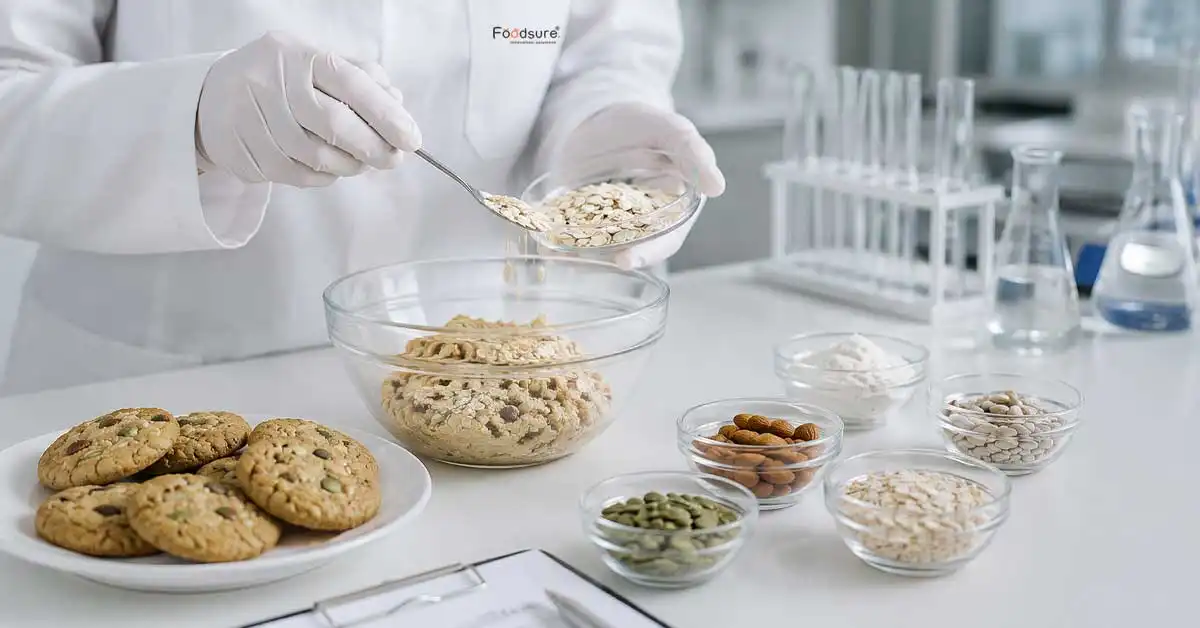
The function of fiber in low calorie cookies
Fibre is perhaps the most potent of all methods for reducing the calorie content of food.
Advantages are:
- Lower Calorie Density
- Improved Satiety
- Better Nutritional Positioning
- Digestive Health Claims
Typical fiber systems:
Chicory Root Fibre
Popular for:
- Clean Label Positioning
- Mild Sweetness
Oat Fibre
Provides:
- Texture Support
- Fibre Enrichment
Soluble Corn Fibre
Provides:
- Calorie Reduction
- Good Processing Characteristics
Resistant Dextrin
Supports:
- Fibre Claims
- Improved Mouthfeel
Conversely, too much fibre can result in the following:
- Hard Texture
- Dry Mouthfeel
- Dense Cookies
Balance is critical.
Fat Replacement Strategies
Fat contributes significantly to cookie quality.
Consumers immediately notice when fat is removed completely.
Benefits of fat include:
- Crispness
- Richness
- Flavor Release
- Mouthfeel
The objective is reduction, not elimination.
Common Fat Replacement Options
Fibre-Based Systems
Can partially replace fat while maintaining structure.
Fruit-Based Systems
Examples include:
- Apple-Based Ingredients
- Fruit Concentrates
Starch-Based Systems
Help maintain texture while reducing calories.
Functional Hydrocolloids
Support moisture retention and mouthfeel.
The final selection depends on product objectives and label positioning.
Taste Balance: The Most Important Factor
Many low calorie cookies fail because formulators focus only on nutritional targets.
Consumers focus on taste.
A successful cookie must deliver the following:
- Sweetness Balance
- Good Aroma
- Crisp Texture
- Pleasant Mouthfeel
Without these attributes, calorie reduction becomes irrelevant.
Sweetness Management
Sugar reduction affects sweetness, browning, and structure. Stevia, monk fruit, and blended sweetener systems are commonly used in low calorie cookie formulation to maintain taste while reducing calories.
It also affects:
- Browning
- Texture
- Structure
Common approaches include:
Stevia Systems
Benefits:
- Calorie Reduction
Challenges:
- Potential aftertaste
Monk Fruit Systems
Benefits:
- Natural Positioning
Challenges:
- Cost Considerations
Blended Sweetener Systems
Often provide the best sensory performance.
Foodsure generally evaluates multiple systems during product development.
Optimization of Texture
Consumers want low calorie cookies to be the following:
- Crisp
- Light
- Easy to Bite
Typical problems encountered with textures:
Hard Cookies
Frequently the result of:
- Excess Fibre
- Poor Fat Replacement
Dry Mouthfeel
Usually caused by:
- Formula Imbalance
- Over-Baking
Dense Structure
Usually caused by:
- Incorrect Ingredient Ratios
Commercial trials assist in defining optimal values of such parameters.
Foodsure’s recommended equipment
Mixing Section
- Planetary Mixer
- Dough Mixer
Forming Section
- Rotary Moulder
- Wire Cut Machine
Baking Section
- Tunnel Oven
- Rotary Rack Oven
Packaging Section
- Flow Wrap Machine
- Nitrogen Flushing System
Quality Control
- Moisture Analyzer
- Texture Testing Equipment
- Shelf-Life Testing
Correct handling increases uniformity and extensibility.
The usual product development issues:
Problem: Hard cookie.
Possible reasons:
- Excess Fibre
- Excess Baking
Dry Mouthfeel
Possible reasons:
- Poor Fat Replacement Strategy
- Low Moisture Retention
Weakness of Sweetness
The problem: Weak sweetness
- Inadequate Sweetener System
Problem: Poor Consumer Acceptance
Possible Causes:
- Excessive Focus on Nutrition
- Insufficient Focus on Taste
The products with the greatest success place importance on both nutrition and sensory enjoyment.
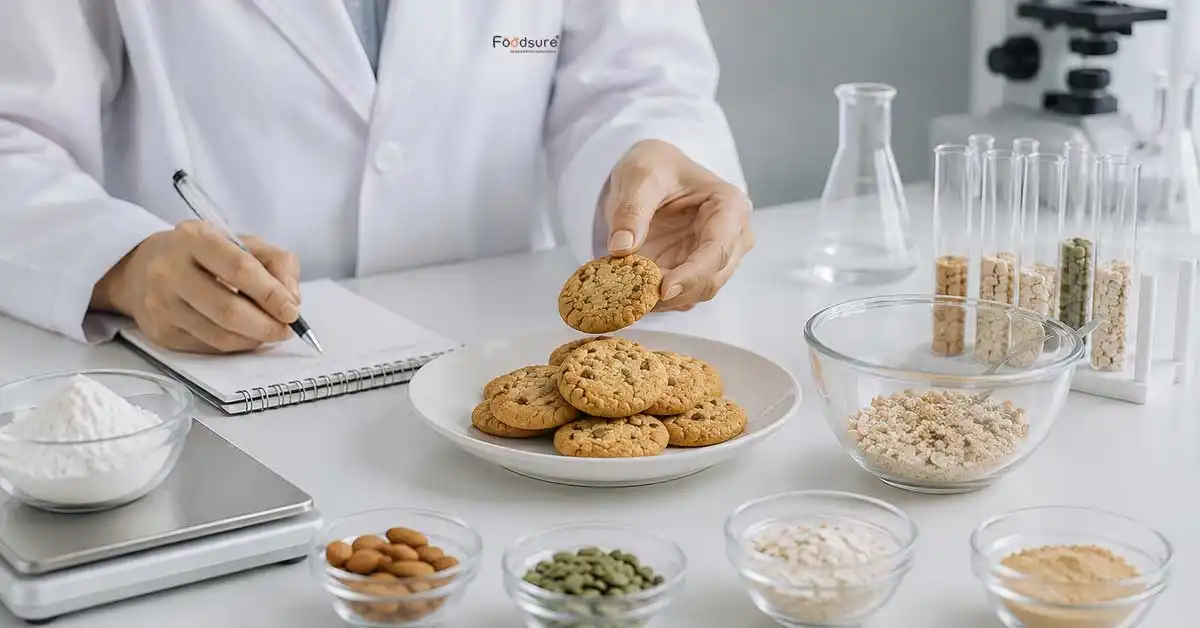
Consumer Psychology: Taste still prevails
Consumers may buy a low calorie cookie once due to the claim made.
They may buy it again and again due to:
- Taste
- Texture
- Satisfaction
A product that only manages 30 calories less but tastes awful is a guaranteed failure.
A product that balances flavor and health leads to repeat purchases.
Emerging Markets
These categories are expanding:
- High-Fibre Cookies
- low calorie Digestive Cookies
- Millet-Based low calorie Cookies
- Protein & Fibre Cookies
- Functional Wellness Cookies
- Kids Better-for-You Cookies
These classifications are still appealing to the consumer.
Looking to Develop a low calorie Cookie
Foodsure Provides:
- low calorie Cookie Recipe Formulation
- Fibre System Development
- Fat Replacement Optimization
- Shelf-Life Validation
- Contract Manufacturing Support
- Commercial Launch Assistance
Conclusion
Today, low calorie cookie formulation are no longer a niche market, as consumer demand for products that satisfy the need for controlled calorie intake, without compromising on taste, texture or the overall consumer eating experience, continues to rise. Numerous factors need to be balanced and fine-tuned in order to produce an optimal low calorie cookie: the addition of fiber, replacement of fat, control over sweetness, optimisation of texture and the consumer response toward the cookie. By optimising the cookie in these different areas, a nutritious and enjoyable eating experience is created, and brands can differentiate their products in the highly competitive healthy bakery market and create loyal consumers, buying the product time and again, not just a one-off.
Email: [email protected]
FAQs
What is the best fibre for low calorie cookies?
The answer depends on nutritional goals, texture requirements, and label positioning.
Can calories be reduced without affecting taste?
Yes, but careful formulation and sensory optimization are required.
Why do low calorie cookies become hard?
Excess fibre, poor fat replacement, and incorrect baking conditions are common causes.
What is the biggest challenge in low calorie cookie development?
Maintaining taste and texture while reducing calories.
Can clean-label low calorie cookies be developed?
Yes. Ingredient selection plays a major role in clean-label positioning.
Can Foodsure develop custom low calorie cookie formulations?
Yes. Foodsure supports formulation development, texture optimization, shelf-life validation, and commercial scale-up.