Consumers no longer purchase goods, but they purchase trust. Whenever an individual picks a nutraceutical product, they automatically read the label to know the ingredients/claims and safety indicators before making a choice. This not only makes nutraceutical food labelling guidelines a regulatory prerequisite, but also a potent means to conduct purchase behaviour.
Meanwhile, the emergence of health-conscious lifestyles in India dictated that the brands made bold statements with regard to their claims, which, without the appropriate nutrition labels and proper health claims labelling, would work against them in terms of legal and commercial consequences.
The Rise of Nutraceuticals in India
The nutraceutical market of India is in full blast due to the trend of preventive health care and rising disposable income.
- Market size is projected to be around $10 billion by 2025
- The market size of herbal products is estimated at Rs 50,000 crore by the industry, with a rapid annual growth of 15%
- Quick expansion because of immunity awareness after the pandemic.
This has caused more powerful application of the packaging rules and the labelling regulations by FSSAI in order to safeguard the consumers.
Nutraceutical Food Labelling Guidelines in India
India controls nutraceuticals through several systems:
- FSS Act, 2006
- Health Supplements and Nutraceuticals FSS Regulations
- FSS (labelling and display) Regulations
- FSS (Advertising and Claims) Regulations
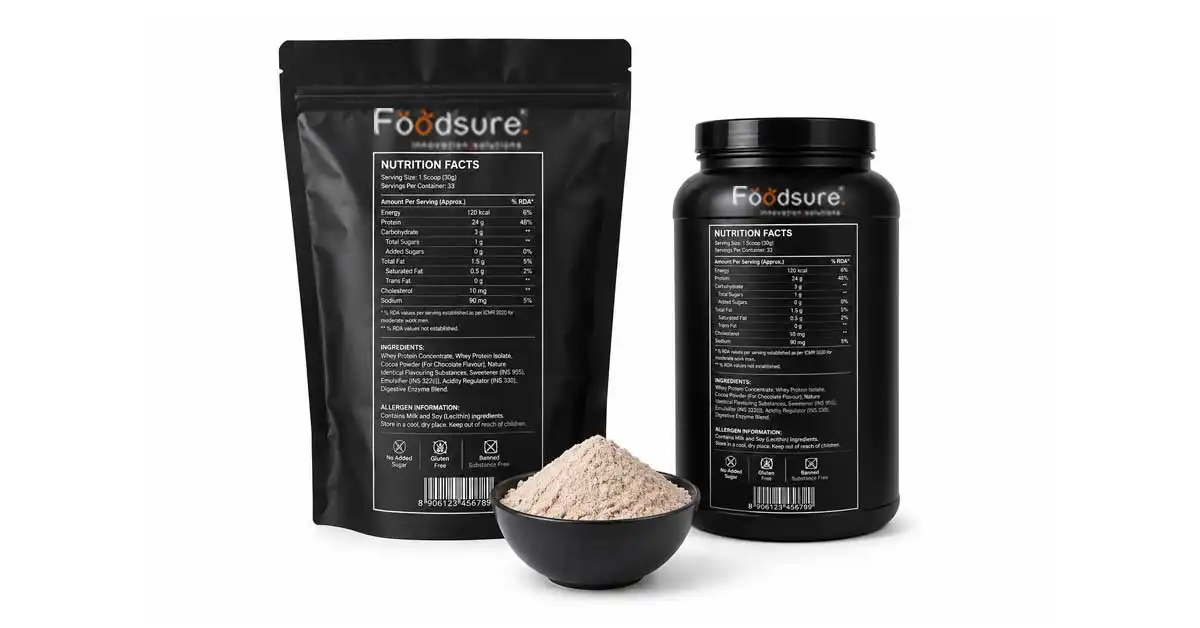
Mandatory Labelling Requirements
| Component | Requirement |
| Product Category | Must mention “Nutraceutical” or “Health Supplement” |
| Ingredient Declaration | List all active ingredients with quantity |
| RDA Disclosure | Nutrients must be expressed as % of RDA |
| Advisory Warning | “NOT FOR MEDICINAL USE” mandatory |
| Usage Instructions | Dosage, duration, and precautions |
| Storage Info | Keep out of reach of children |
| Allergen Info | Mandatory declaration (if applicable) |
Labelling should be clear, showing what the product is, who it is aimed at, and how it should be applied.
Nutraceutical Labelling Requirements in India
With the nutraceutical industry in India showing rapid expansion, product labelling has become an important aspect of regulatory adherence. Nutraceuticals are governed by the Food Safety and Standards Authority of India (FSSAI), which has issued detailed guidelines for product labelling that, among other things, protect public health, provide correct information, and remove any ambiguity. The label of a nutraceutical product, being the first and foremost piece of information a consumer receives, holds a very strong position in the marketing chain. So, the label must carry a full and true disclosure of the product.
Labelling of every nutraceutical product should include the product name, detailed composition, nutritional facts panel, serving size or portion, directions for consumption, and requirements on storage. Some Also compulsory features that help highlight the supplement character of the product and distinguish it from medicines include “NOT FOR MEDICINAL USE” declarations being made conspicuous on the packaging. Besides these, allergen warnings, vegetarian or non-vegetarian symbols, batch numbers, manufacturing and expiry dates, and the FSSAI license details are also quite crucial. Besides ensuring regulatory compliance, correct and comprehensive labelling also instils confidence among consumers by enabling them to make well-thought-out purchasing decisions.
Rules for Health Claims on Nutraceutical Products
Health claims constitute a key issue in the promotion of nutraceuticals as changing a consumer’s mind is often the main aim of the messages. Per the regulations of FSSAI, the brands may announce structure-function claims like “enhances immune system”, “increases energy levels”, or “improves digestive system”, if supported by scientific studies. The intention with health claims is presenting product benefits without deceiving the customer.
But any claims connecting a product to the treatment or prevention of a particular disease are forbidden unless the product has obtained such approval. For instance, declaring one’s product “good for bone health” is allowable, whereas saying it “cures arthritis” or “prevents osteoporosis” might result in a fine in the court of law. Unreasonably high claims like “miracle cure” or “guaranteed results” are not acceptable either.
Another issue that tightly intersects with putting forward health claims is the matter of ingredients. Only those elements that appear on the approved list can be used, plus the level of quantities that is consistent with established dosage limits when composing nutraceutical products with vitamins, minerals, amino acids, probiotics, and plant extracts. This serves the dual purposes of safeguarding the health of the consumer and eliminating the potential risk of abuse through excessive intake. For manufacturers, adhering to the regulations related to health claims and ingredients is a must if they wish to steer clear of any legal troubles, enhance the stature of their product(s), and build consumer confidence over a reasonably extended period in a market that is largely characterised by wellness products.
Nutrition Label Compliance: What Brands Must Get Right
It is essential to get the compliance of nutrition labelling correct to prevent penalties and gain credibility.
Key Rules
- The nutrient contents should not be higher than the ICMR Recommended Dietary Allowance (RDA).
- Such statements as high protein or calcium-rich need minimal content.
- The size of serving has to be attainable and precise.
- The labels should also feature: Energy (kcal), macronutrients and micronutrients.
Common Compliance Mistakes
| Mistake | Risk |
| Exaggerated nutrient claims | Legal penalties |
| Incorrect serving size | Misleading consumers |
| Missing allergen info | Product recall |
| Inconsistent label vs ad claims | Brand credibility loss |
Health Claim Approval in India
The most sensitive element of nutraceutical labelling is health claims.
What is Allowed?
FSSAI allows scientifically proven claims, such as:
- Nutritional claims (e.g., high in Vitamin C)
- Functional claims (e.g., “Supports immunity)
- Limited cases: disease risk reduction claims
What is NOT Allowed?
- Queries of curing or treating diseases
- Misleading terms like “100% cure”
- Unsubstantiated claims
Evidence Required
| Claim Type | Evidence Needed |
| Nutritional | Lab testing |
| Functional | Clinical studies |
| Risk reduction | Strong scientific validation |
All the assertions have to be supported by peer research or clinical information.
Packaging Regulations for Nutraceuticals
Packaging is not branding, and it is a legal document in nutraceuticals.
Key Packaging Regulations
- Should conform to FSS Packaging and Labelling standards.
- The size of font used should be at least the minimum.
- The label needs to be clear and conspicuous.
- The disclaimers and claims should be visible.
Mandatory Disclaimers
- “NOT FOR MEDICINAL USE”
- “Not to be used faster than advisable daily”
- “The product is not a replacement for a balanced diet”
Quick Compliance Checklist
| Area | Checklist |
| Labelling | Category, ingredients, RDA |
| Claims | Scientifically validated |
| Packaging | Legible, compliant fonts |
| Warnings | Mandatory disclaimers included |
| Advertising | Matches label claims |
Why Compliance Matters for Brands
The disregard of nutraceutical food labelling:
- Product recalls
- License suspension
- Legal penalties
- Loss of consumer trust
With a category such as nutraceuticals, where trust is highly valued, brand success is directly related to compliance.
Foodsure’s Role in Nutraceutical Compliance
At Foodsure, we assist a brand to navigate through the complicated world of:
- Formulation of nutraceutical products
- Validation and label development
- Substantiation of health claims
- End-to-end Regulatory compliance
Concept to commercialisation, Foodsure will see that your product is market-ready and regulation-proof.
Call Foodsure for Professional Food & Beverage Product Development
Introduction of a nutraceutical product? No time to waste on waits and rejection.
Work with Foodsure to:
- Construct conforming formulations.
- Validate health claims
- Ready-made labels for design regulation.
- Fast-track FSSAI approvals

📋 Regulatory Compliance
Labelling and Health Claims Rules for Nutraceutical Foods in India
Ensure your nutraceutical products meet FSSAI labelling and health claim requirements with expert regulatory guidance. From mandatory declarations, ingredient disclosures, and warning statements to compliant nutrition and health claims, Foodsure helps brands develop market-ready products while avoiding misleading or non-compliant claims. Proper substantiation and regulatory compliance are critical for successful product launches in India. :contentReference[oaicite:0]{index=0}
FAQs
What are the guidelines on nutraceutical food labelling?
They are the FSSAI-stipulated regulations that require disclosure of ingredients, RDA values, warning and validation of claims of the nutraceutical products.
Do nutraceuticals purport to treat illnesses?
No, FSSAI forbids absolutely any claims of curing or treating diseases.
What do you need to get health claims approved?
It has to be based on scientific evidence, such as clinical trials, lab data, and peer-reviewed research.
Are labels required to have the words “Not for medicinal use?
Yes, it is a mandatory statement for all the nutraceutical products.
What does it mean by nutrition label compliance?
It is the true declaration of the nutritional value, the serving size and the composition of the ingredient according to the norms of FSSAI.
Are nutraceuticals’ packaging regulations strict?
Yes, the packaging has to be compliant with the legal standards of font size, disclosures, and visibility.
What will be the consequences of non-compliance with the label of nutraceuticals?
It may result in fines, recall of products, or suspension of the business license.