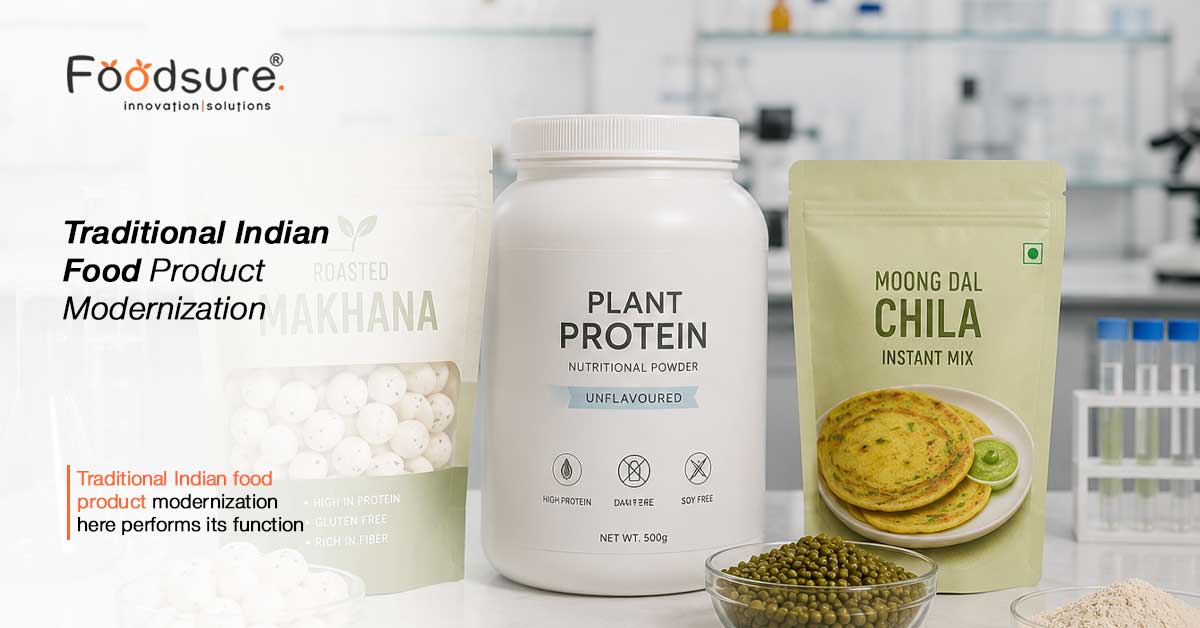
Every Indian household contains food that represents the culinary heritage of its ancestors, whether it is the grandmother’s pickle recipe passed down without documented measurements, the family spice blend identified only through aroma, or the festival sweet prepared without any production chart. Indian food culture achieves its most attractive form through emotional connections and regional flavour, yet businesses face challenges that customers do not see. The growing demand for Traditional Indian Food Product Modernization creates important business prospects that founders can use to develop traditional food for retail markets and export distribution.
Founders who create food businesses based on Indian traditional food recipes will face greater difficulties when trying to expand heritage foods than they initially thought. Modern consumers desire traditional dishes that offer them contemporary accessibility. Customers demand uniform flavor throughout all products, correct product information, extended product lifespan, and packaging that maintains integrity during international shipping. International buyers require destination-country labeling rules, shelf-life verification materials, export documentation, and retail packaging that meets UK, UAE, USA, and Germany market requirements. Traditional Indian food product modernization here performs its function.
India Has the Recipes: The World Has the Demand. Something Is Still Missing.
The Indian market displays a complete opportunity that has achieved perfect market alignment through its traditional food products Development, maintaining dedicated customer bases. People of Indian descent who live throughout the world, including an estimated 32 million having Indian roots, practise Indian Traditional Food Product Modernization customs from their home countries. The current international dining trends prioritize plant-based foods and authentic heritage dishes create a perfect match with traditional Indian cuisine.
International supermarkets do not stock complete collections of Indian heritage products. Indian direct-to-consumer businesses show a pattern of product failure because many items that experienced initial success could not maintain their quality during large-scale production. The export-ready certifications that small food companies need to operate their businesses successfully remain out of reach for more than 100 small food enterprises that produce actual quality items. Indian cuisine modernisation efforts have failed to achieve the required progress because food producers need to develop better methods for developing their traditional food dishes. Food startups continue to treat this business challenge as a flavour issue, although it functions as a fundamental operational difficulty.
Reasons Behind Indian Recipe Commercial Food Products Failing in Modern Retail and Export Markets
The authentic response states that Indian cuisine was never intended to be produced through industrial manufacturing methods. The system exists to establish reliable connections between household sectors and neighbourhood networks and festive occasions.
The operational framework of modern retail stores and export systems relies on assorted methods, including documentation, measurement, repeatable processes and evidence of rules compliance. The two domains exist in separate realms, preventing their ability to understand one another.
The gap between two things becomes especially challenging because of this factor.
- Traditional Food recipes were developed without fixed ingredient ratios. The same pickle might taste slightly different every season depending on the mangoes used, the salt quality or the amount of sunlight during the drying process.
- Indian food processing particularly in the small and medium segment remains unregulated. The Ministry of Food Processing Industries MoFPI reports that 74 of India’s food processing industry operates outside the organized sector, creating challenges for maintaining stable production levels.
- FSSAI regulatory frameworks have undergone considerable changes since 2011 but company founders still show an inconsistent understanding of these changes. Many food businesses operate for years without understanding the difference between a basic registration and a state or central licence and the implications of that difference for export eligibility.
- Export compliance requires Indian regulations to be followed alongside the obligations imposed by the destination country. A product approved for sale in India under FSSAI may still be stopped at the border of the UK or the USA if labelling allergen declarations or additive approvals do not meet local standards.

What Founders Actually Experience: The Ground-Level Reality
All founders who attempt to launch Traditional Indian Food Product Modernization products from their home kitchens or small production units into organised retail and export markets share the same set of frustrations. The failures that we observe do not occur by chance. The existing system deficiencies create these problems which become apparent through these particular failures.
- FSSAI Category Confusion
The food safety system used by India contains multiple categories, creating a confusing system for people who do not understand its operations. A Traditional food products of India.
like a millet based ladoo could fall under bakery products, traditional foods like:- sweets health supplements or cereal based preparations , all requiring different licensing standards, ingredient rules and product identification requirements. The initial mistake leads to a process that requires product relabeling, product reformulation and license reapplication after several months.
- Taste Variation at Scale
The 500 unit batch of a product that receives universal acclaim produces taste variations that become noticeable when the product is made in 5,000 and 50,000 unit batches. Cooking temperature changes, raw material moisture content variations, and the basic distinction between hand stirring and machine stirring methods create differences in flavour, texture and colour. Founders who scale their business without establishing standardised recipes for their products will face this problem after they have established partnerships with retailers.
- ShelfLife Surprises
Shelf-life claims require stability testing proof, which includes testing for microbiological, physical and chemical properties. Many founders assign shelf life based on intuition or informal testing. Retailers and export buyers request test reports which lead to product returns because items spoil before their printed date. The situation results in three major consequences, which include lost stock, reputational harm and retailer penalties.
- Packaging That Does Not Travel
Export grade packaging requires its own separate distinct discipline. The product must maintain its complete barrier properties with its sealing strength, its moisture , oxygen transmission rates, and its carton compression strength all need to be tested during 25 days of sea freight and temperature changing air freight shipment. The majority of conventional food startups use packaging that manufacturers created for local retail markets, which functions properly in Mumbai stores but does not work during shipping on container vessels to Rotterdam. So, traditional Indian food product modernization includes using packaging that ensures safe travel.
- Co-Manufacturing Gaps
The search for a co-manufacturer who possesses both GMP certification and traditional Food formulation expertise and capability to produce small initial production runs presents an authentic challenge. The majority of quality manufacturers require minimum order quantities that exceed the needs of early-stage startups, while smaller manufacturing facilities fail to obtain the necessary certifications for retail and export markets.
- Claims That Cannot Be Substantiated
A product marketed as ‘immunity boosting’ or ‘sugar-free’ or ‘100% natural’ requires regulatory backing for each claim. The FSSAI Food Safety and Standards Advertising and Claims Regulations establish that unauthorized health or nutrition claims will result in product recalls and impose financial penalties. The marketing field demonstrates a significant difference between its instinctual marketing methods and its existing regulatory standards.
India’s Ready-to-Eat Export Segment
The Indian food export market demonstrates its greatest commercial success through traditional Indian food product modernisation that emerged from its traditional food cooking system. The Indian diaspora now consumes retort-packaged Indian meals, which started as a small market segment. The Indian export market now experiences one of its fastest-growing segments through packaged Indian meals, which use this particular cooking method. Indian grocery stores and mainstream supermarkets in the UK, USA, Canada, UAE, and Australia now stock packaged products which include rajma, dal makhani, biryani and various South Indian rice dishes. The recipes remained unchanged, but the existing system developed manufacturing and compliance procedures to support their operations.
The main technical components function as follows:
- The retort processing technology enables food producers to create shelf-stable products that require no refrigeration through their sterilization process of traditional food cooked into pouches or cans.
- Industrial recipe standardisation defines all necessary production requirements through its documentation of ingredient ratios, cooking temperatures, and holding times, which producers can use for mass production.
- Export compliance systems built from the outset, including FSSAI central licensing, APEDA registration, and destination country label compliance.
- The export buyers obtain necessary documentation through accelerated stability testing, which enables them to validate shelf life.
The important lesson from this category is that the recipes themselves were not the innovation. The development of a commercial system that utilizes traditional Indian cooking methods through product modernization enabled the recipes to achieve industrial-scale production.
Heritage Food Brands Entering Premium Global Retail
The current market shows a second trend, which has developed through the establishment of premium Indian heritage food brands that use authentic traditional food recipes to create products designed for contemporary urban and global markets. The market expansion has affected various product categories, which include handcrafted spice blends, traditionally prepared pickles, coldpressed oils, Ayurvedic food products, and artisanal dairy products. The successful brands in this industry demonstrate their product quality through their method of developing from artisanal production into commercial manufacturing.
The common elements across these brands:
- Clean-label product formulation: The product contains no extra additives, while it uses ingredients from clear sources, and its label claims achieve both appealing qualities and legal standards.
- Export-grade packaging engineering: The packaging system contains barrier films and tamper-evident sealing mechanisms and structural cartons that international freight uses instead of domestic retail.
- Story first branding rooted in real heritage: The packaging design, language and origin storytelling elements show actual regional origins instead of fake historical reconstruction.
- Formulation stability for global shipping: The product undergoes necessary reformulation or reprocessing to maintain stability during temperature changes, humidity shifts, and long-distance travel.
Heritage food brand India Modern Packaging describes its actual meaning through practical application, which shows that premium appearance does not define its essence. The company needs to deliver products that fulfill their marketing promises throughout various production operations. The startups that achieved success through this process created their compliance systems before they received their first major retail order, which allowed them to meet standards ahead of time instead of rushing to fulfill requirements after receiving their first major order.
What Actually Works: The System Behind Successful Products
The pattern of successful traditional food brands works the same way in both Indian retail operations and Indian export markets. The process operates through specific methods that produce results that appear to use magic.
| Area | What Does NOT Work | What DOES Work |
| Product Strategy | Preference for Taste, Compliance to Follow | Compliance, with an eye on aesthetics |
| Ingredient Selection | They have the zealous cultural behaviors they go for now. | Their use drove the FSSAI author Id, export author Id elements.”& their exportibilities. |
| Manufacturing | For home kitchens or informal production facilities | Co-manufacturer with SOPs as proof of GMP certification. |
| Packaging | Attractive design, but basic barrier | Export grade barrier with transit-tested structural integrity |
| Shelf Life | Estimated or informally tested | Lab validated through accelerated stability testing |
| Labelling Claims | Marketing led and intuitive language | Legally permissible claims aligned with FSSAI regulations |
| Export Readiness | Reactive to buyer requests. | Proactively built into product development from day one. |
Founders who want to modernise Indian traditional food products should understand that compliance represents a design requirement that defines their entire development work. The design process starts with product development because compliance functions as a requirement for the entire process. Testing laboratory shelf life requirements before finalising the recipe enables scientists to create a formula that maintains optimal product stability.
The label design process needs to start after packaging design work begins because export labelling requirements must be identified first. The FSSAI category must be correctly identified before manufacturing begins because it determines the licensing process and labeling requirements. Product development differs from product system development because the latter establishes which restaurants can grow their business and which ones will remain small indefinitely.
Where Structured Support Makes a Real Difference
Founders developing carbonated and functional beverages need to learn about all the technical requirements for shelf life validation and product compliance that will arise during their commercial production scale-up process. The development process experiences delays together with rising expenses because of challenges, which include testing of accelerated stability and degradation of ingredients, issues with packaging compatibility and requirements for documentation needed by retailers.
Foodsure assists beverage founders from India with their process management through its comprehensive support system, which includes shelf life validation and NABL-accredited laboratory coordination, accelerated stability testing, packaging compatibility assessment, and retailer FSSAI compliance documentation preparation. The company provides support for both formulation development and manufacturing readiness, which enables brands to develop their retail-ready products from their initial concept stage with better operational understanding and confidence.

Founder Takeaway
Traditional Indian food products are entering a strong growth phase across retail, D2C, and export markets as consumers increasingly seek authentic and regional foods. For founders, this creates a major opportunity to build scalable heritage food brands. Traditional Indian food product modernization requires more than a strong recipe to achieve success. Long-term growth requires structured product development, shelf-life validation, compliant packaging, manufacturing consistency, and export-ready systems. Founders who approach traditional food commercially and strategically are far more likely to build scalable and trusted brands.
Conclusion
The D2C and export pathways of traditional food startups in India can achieve permanent success. The technical and regulatory challenges are navigable. The market demand is real. The startup success rate depends on whether founders establish their legal compliance and product development systems at the beginning or try to build them after encountering difficulties. The best investment for you when taking traditional Indian food products from concept to commercial launch involves first building knowledge about your specific product category’s regulatory and technical requirements. Your production can begin only after you complete this first step. Your packaging budget should remain unspent until you reach this first step. You must delay making promises to buyers until your operational capabilities reach readiness.
How to Develop a Traditional Indian Food Product for Modern Retail and Export
Develop authentic traditional Indian food products with modern formulation techniques for retail shelves and export markets. Ensure better shelf life, packaging stability, regulatory compliance, consistent taste, and large-scale production readiness while preserving the original regional flavour and consumer appeal for global success.
FAQs
What is the most significant problem related to modernizing traditional Indian food products?
The company preserves its original taste by creating products which fulfill contemporary retail standards, product shel-flife requirements, legal regulations and international trade standards.
Is it necessary to get approval from the FSSAI before you commercialize a product being recognized as ‘Indian traditional food’?
Yes, the detailed categorization of FSSAI, licensing, labeling, and compliance system has to be finalized before commercial launch.
Can we market traditional Indian foods overseas without altering the recipe?
In many cases- yes, but formulations together with packaging and preservation systems require optimisation to achieve stability and meet international compliance standards.
What does the importance of shelf-life testing lie in, in the context of export-ready products of Indian traditional foods?
The use of shelf life testing validates product safety, quality, and stability for retailers, distributors, and exporters.
How do Indian D2C companies like the fast-growing startup Kickstart scale up with the help of Indian D2C food brands?
The primary factors that drive business expansion for the organization include its strong formulation systems, its compliant packaging, its dependable manufacturing operations and its initial regulatory planning efforts.